2014issue C0626
Zero-debit call-ratio repair for a broken long stock
A 100-share long opened at 70 commits 7000 of cash. This archive note compares leaving that book as hope, averaging the entry with another 100 shares at 50, and adding a zero-debit call-ratio overlay, so covered-call writing, an option spread, and collar-style thinking can each be seen restating breakeven and leftover risk.
- A 100-share long opened at 70 commits 7000 of cash, and an even-money option overlay can be added while leaving that cash-and-risk total unchanged.
- Buying another 100 shares at 50 after the drop averages the stock entry to 60 and adds 5000 of extra capital and downside.
- The illustrated repair buys a 50-strike call for 12 points and sells two 70-strike calls for 6 points each, so the option legs net to a zero debit, with the extra short call treated as covered by the original stock.
- The overlay is framed as useful only when the holder still expects a rebound at least toward the original purchase area; otherwise the stock is to be closed.
The cash already committed
A 100-share long opened at 70 commits 7000 of cash. An even-money option overlay can be added while leaving that cash-and-risk total unchanged.
Editorial focus: the existing book is restated, not replaced with a new cash commitment.
TWTR daily share price, November 2013–April 2014
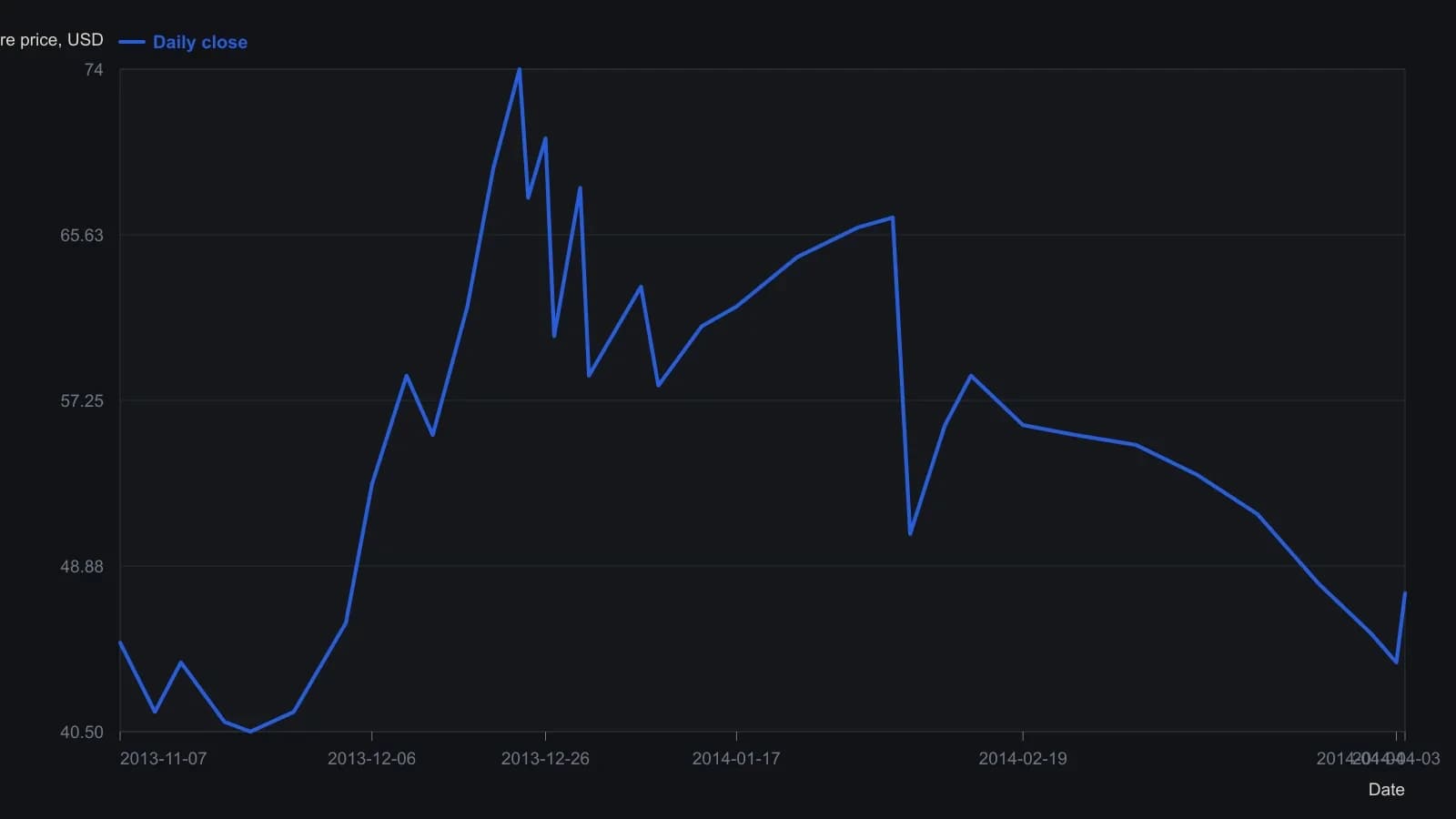
Closes are estimated from the daily bar raster and are only good to about half a dollar. The February hole is the chart’s own gap, not a line drawn through missing prints.
Hope and averaging down
Editorial contrast starts with two cash-stock choices. One is to hold the original 100 shares and wait. Another is to buy another 100 shares at 50 after the drop.
Buying the second lot averages the stock entry to 60 and adds 5000 of extra capital and downside. Averaging down therefore lowers the stock-only entry by spending more cash. It does not leave the original 7000 cash-and-risk total unchanged.
The illustrated call-ratio repair
One illustrated repair buys a 50-strike call for 12 points and sells two 70-strike calls for 6 points each. The option legs net to a zero debit.
That construction is a call-ratio spread used as an even-money overlay. One lower-strike call is financed by more than one higher-strike call, and the long and short premiums offset, so the original stock cash outlay stays at 7000.
The extra short 70-strike call is treated as covered by the original 100-share long rather than as an uncovered short-call book. Covered-call writing is that collateralization: the short upside sits against a share lot already owned.
Placing the long call near the prevailing stock price and the short calls near the original purchase price is the mechanism given for breakeven repair. The combined stock-and-options book is relocated so it can return to flat at a lower print without new cash.
Three restatements of the same position
Editorial reading, not an archive ranking: covered-call writing, the option spread, and protective-collar thinking describe the same overlay from three sides.
Covered-call writing explains why the second short 70-strike call is not booked as uncovered. The option spread explains why the long 50-strike call and the two short 70-strike calls can be paired to a zero debit independently of the stock lot.
Protective-collar thinking explains why the stock-plus-options book can be read as a regime package: an upside sale near the original 70 purchase and a downside-or-repair wing near 50, rather than a naked directional bet.
When the overlay is not the next step
The overlay is framed as useful only when the holder still expects a rebound at least toward the original purchase area. Otherwise the stock is to be closed.
In the 2014 case, a zero-cost pairing of those strikes was available only in a January 2016 expiry. Higher volatility is described as allowing the same even-money ratio spread to be placed closer to expiration.
All readings on this track · 19 readings
- 2002Rebuilding a long-stock book with calls, puts and collars
- 2004Constructing protective collars and reading cheap premia
- 2004Protective collar, straddle exits, and index settlement
- 2005Collar and backspread construction as a pairing problem
- 2006Protective collar, net delta, and implied volatility
- 2007Interest as a sizing filter on collared stock
- 2008Collar versus bull call spread: capital and inventory
- 2008A long-stock case that sizes cash risk, then stays open with a protective put, covered calls, and a collar
- 2008Assignment as a planned handoff from put spread to collar
- 2008Protective collar rolls and straddle entry in extreme volatility
- 2010A margin call is a late exam in position size
- 2011Protective collars and covered calls after a volatility shock
- 2011Mid-life butterfly and collar adjustments across range and correction
- 2012Stacking a 1-by-2 overlay and a collar on underwater stock
- 2013Odd-lot mini-options for covered calls, puts, and collars
- 2014Zero-debit call-ratio repair for a broken long stock
- 2014An open collar funds the puts without capping every share
- 2018A protective collar as an event-risk budget
- 2020Constructing position-level collars around unsold holdings