2008issue C081-6
A long-stock case that sizes cash risk, then stays open with a protective put, covered calls, and a collar
A historical equity case sizes one long-stock sleeve so a 10% to 13% reaction stays near 1% to 2% of total capital, then buys a protective put so the cash loss is known while upside stays open. Later covered call writing, and if needed a protective collar, are used so the same holding can remain open through ordinary pullbacks.
- Size the long-stock sleeve first so a plan that must live through 10% to 13% reactions can still keep that name’s cash loss near 1% to 2% of total capital, then buy a protective put instead of relying only on a wide stop.
- Shares plus a protective put create a limited-loss, still-open-upside payoff while the put is in force, described as equivalent to a long call after the put premium is subtracted.
- After a paper profit, covered call writing can collect extra premium with defined risk; buy the short calls back or close the package if price rises through the short-call strike, so capital is not left capped and blocked.
- A 12% trailing stop can keep a strong uptrend open through ordinary reactions, but a wide stop alone does not tell the trader the cash loss in advance the way a purchased put does.
Size the sleeve before the options
A long-stock plan that must survive 10% to 13% shorter-term reactions in order to capture a 30% or larger advance can still keep a single-trade cash loss near 1% to 2% of total capital by sizing the position first and then buying a protective put instead of relying only on a wide stop.
With a 30000 account split across at least 10 names, a 3000 sleeve and a 10% stock risk of 300 is presented as keeping that name’s cash loss at 1% of total capital before options are added.
What the protective put changes
Owning shares and buying a put creates a limited-loss, still-open-upside payoff while the put is in force, and that payoff is described as equivalent to a long call after the put premium is subtracted.
In the illustrated 200-share purchase at 14.45 with a 14-strike put costing 0.80, the worst-case loss while the put is valid is framed as 1.25 per share, or about 9%, versus a 12% stock-only stop at 12.70.
Covered call writing after a paper profit
After a paper profit appears, part of that gain can be used to sell covered calls so extra premium is collected with a defined risk. If price then rises through the short-call strike, the short calls are to be bought back or the whole package closed so capital is not left capped and blocked.
If price instead falls while a protective put remains in place, previously sold calls can be bought back cheaper. One worked case shows those short calls declining to 0.30 and a net 80 credit on that overlay.
A later overlay on the same holding
A later overlay that sells stock, sells calls, and subtracts the original stock, put, and call outlays is shown as an 840 result, or 29%, after an intervening drawdown of more than 30%.
Holding the same stock-plus-put-and-call package through option expiration is contrasted with a stock-only close: 117% with the calls versus 53% without, in that single expiration-date comparison.
A wide stop does not pre-state the cash loss
A 12% trailing stop on a strong uptrend can keep a long stock open through ordinary reactions until a later trendline break, but a wide stop alone does not tell the trader the cash loss in advance the way a purchased put does.
Goodyear (GT) from the May 2006 entry through January 2007 expiration
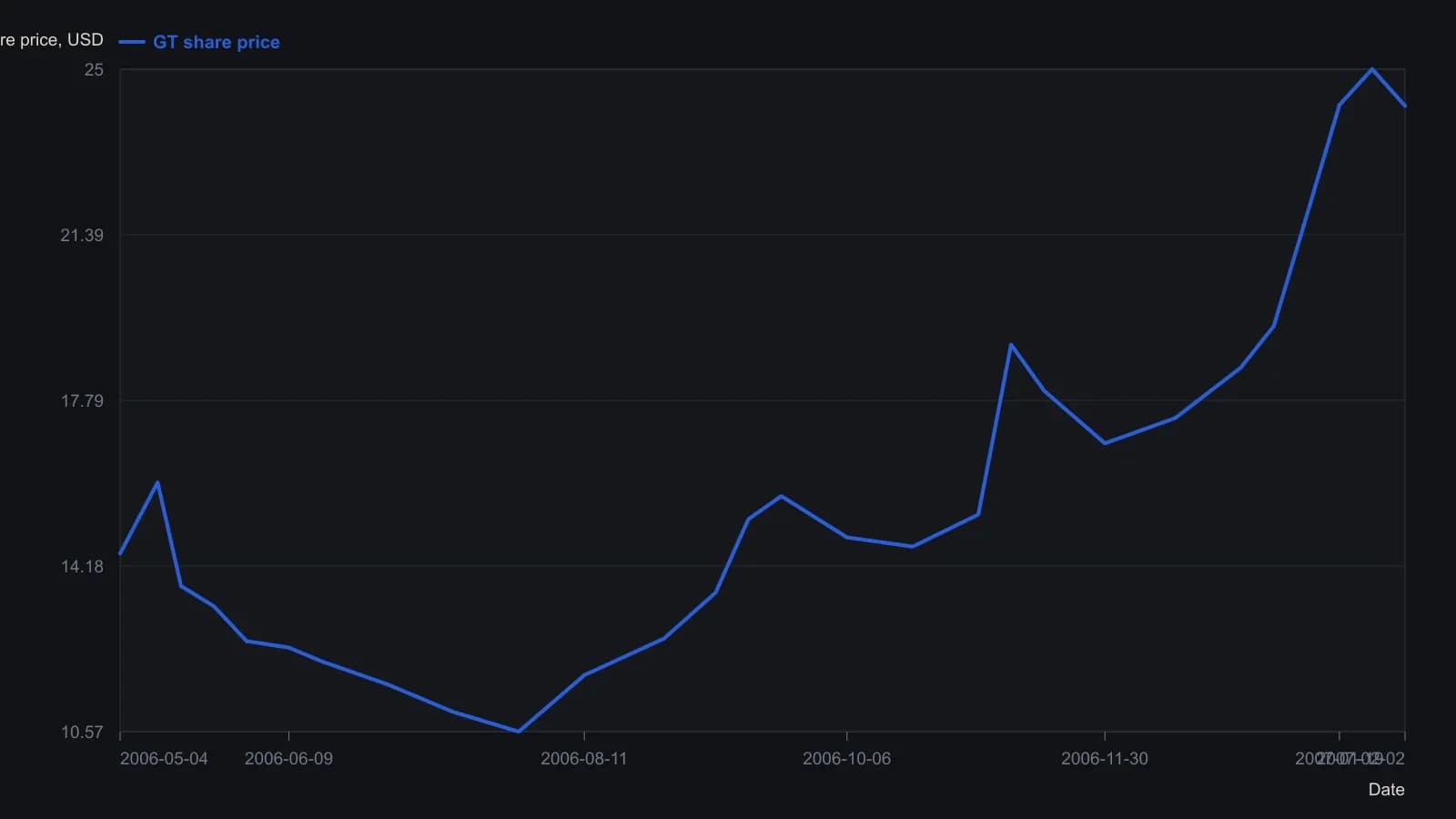
The extracted figure has no printed y-axis numerals. Dollar levels are scaled from the author’s stated GT prints (14.45, 12.54, 10.57, 16.85, 24.22) across the May 2006–February 2007 window; points between those prints are approximate to about half a dollar.
All readings on this track · 19 readings
- 2002Rebuilding a long-stock book with calls, puts and collars
- 2004Constructing protective collars and reading cheap premia
- 2004Protective collar, straddle exits, and index settlement
- 2005Collar and backspread construction as a pairing problem
- 2006Protective collar, net delta, and implied volatility
- 2007Interest as a sizing filter on collared stock
- 2008Collar versus bull call spread: capital and inventory
- 2008A long-stock case that sizes cash risk, then stays open with a protective put, covered calls, and a collar
- 2008Assignment as a planned handoff from put spread to collar
- 2008Protective collar rolls and straddle entry in extreme volatility
- 2010A margin call is a late exam in position size
- 2011Protective collars and covered calls after a volatility shock
- 2011Mid-life butterfly and collar adjustments across range and correction
- 2012Stacking a 1-by-2 overlay and a collar on underwater stock
- 2013Odd-lot mini-options for covered calls, puts, and collars
- 2014Zero-debit call-ratio repair for a broken long stock
- 2014An open collar funds the puts without capping every share
- 2018A protective collar as an event-risk budget
- 2020Constructing position-level collars around unsold holdings