2007issue C081-2
Interest as a sizing filter on collared stock
Under older high percentage-of-price stock margin, the cash required to buy shares typically overshadowed the interest paid or forgone on the same position. A protective put or collar can shrink posted capital to remaining defined risk while interest is still assessed on the full share purchase.
- Under older high percentage-of-price stock margin, the cash required to buy shares typically overshadowed the interest paid or forgone on the same position.
- A protective put can shrink posted capital to remaining defined risk without cancelling interest on the entire share purchase.
- A collar can offset part of the put premium, but omitting interest from the cost can make compressed risk-based margin look like a no-risk, no-cost structure.
- Editorial reading: keep interest on the unreduced share notional in the sizing gate, and take the carry input from the lender's schedule rather than from a simple illustration.
When cash overshadowed carry
Under older high percentage-of-price stock margin, the cash required to buy shares typically overshadowed the interest paid or forgone on the same position. Forgone interest is the return given up when cash leaves an interest-bearing balance to fund or secure a stock purchase.
A 100-share purchase at 450 is a 45,000 cash or credit notional. A simple 6 percent annual rate makes the 30-day interest factor 0.5 percent, or 225 on that full amount. That 225 of 30-day carry equals 2.25 per share, so the stock would need to rise by more than 2.25 over the month to beat leaving the same 45,000 in an interest-bearing account.
Posted capital can fall while interest does not
In a 50 percent stock-margin example with a 1,000 protective-put premium, half of 45,000 is borrowed; 30-day simple interest on 22,500 is 112.50, for an illustrated total of 23,612.50.
A protective put is a long put held against long stock to bound downside. It can shrink posted capital to remaining defined risk without cancelling interest on the shares. When a 30-day at-the-money protective put is treated as covering downside, posted risk capital can fall to the remaining 1,000 of defined risk, while interest is still assessed on the entire 45,000 share purchase.
Adding 225 of full-notional 30-day interest to that 1,000 premium produces an illustrated 1,225 requirement, 22,387.50 below the older 50 percent stock-margin total, with stated maximum loss unchanged.
Cash posted and 30-day interest on 100 GOOG shares
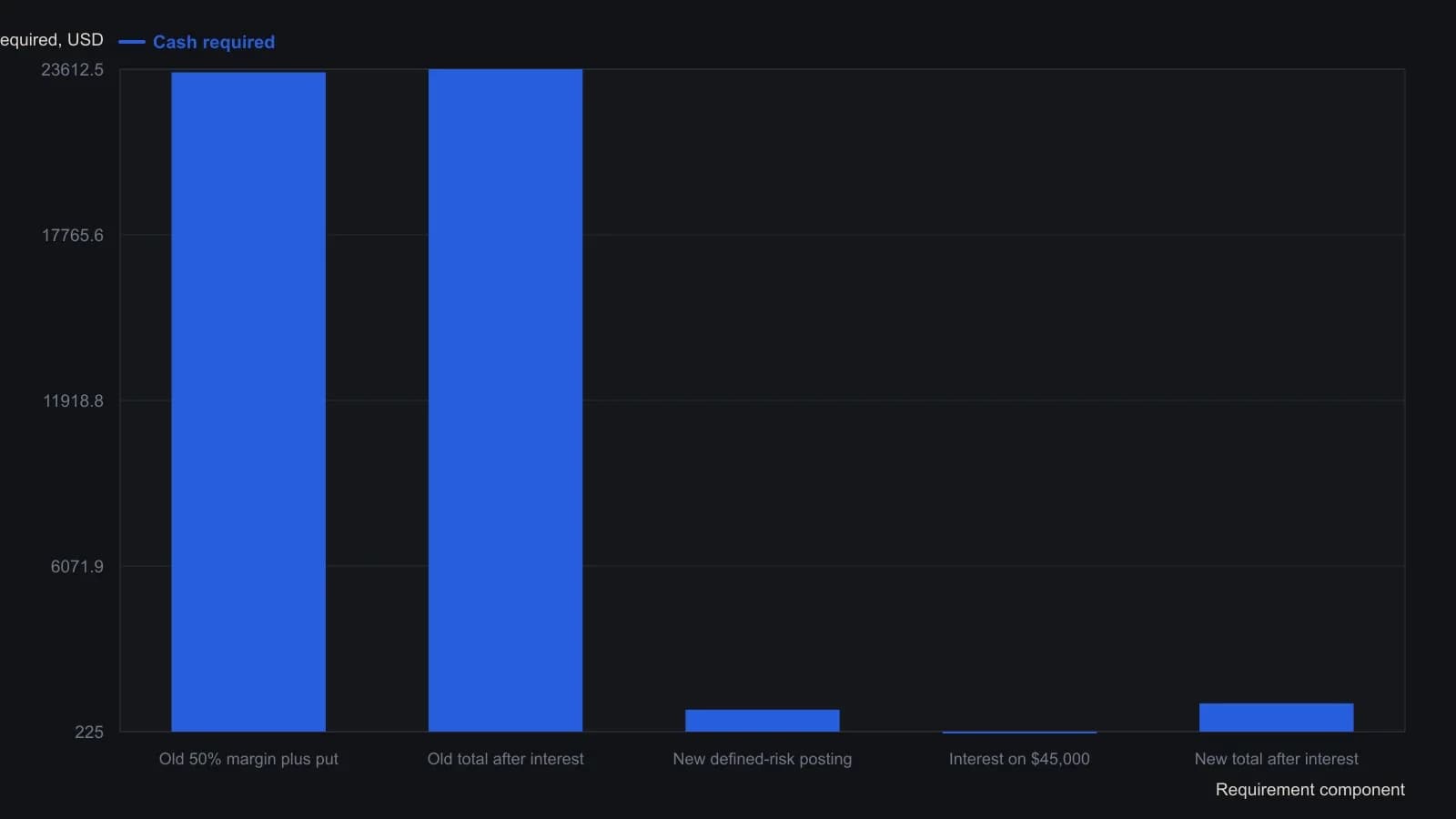
Interest is simple 6 percent annual, or 0.5 percent for a 30-day hold, not broker compounding. The $1,000 figure is the stated 450-strike put premium in the married-put example; the later collar is not given a separate premium.
When a collar looks costless
Selling an upside call against long stock and a protective put forms a collar that can offset part of the put premium. A protective collar is long stock plus a long put and a short upside call, used so the call premium offsets part of the put while upside is capped. The structure still owes carry on the full share purchase.
If interest is omitted from the collar's cost, compressed risk-based margin can make the position look like a no-risk, no-cost structure even though financing on the full share notional remains due. Risk-based margin is a capital rule driven by remaining position risk rather than a fixed fraction of share value, which can make interest a larger share of the all-in outlay.
Size from posted capital plus carry
Margin management is a pre-trade and in-trade filter that sizes a position from posted capital plus expected carry, not from the hedge diagram alone. Actual debit interest may use a different rate and may compound daily or monthly rather than the simple 6 percent, 30-day illustration, so the carry input to a sizing filter should follow the lender's schedule.
All readings on this track · 19 readings
- 2002Rebuilding a long-stock book with calls, puts and collars
- 2004Constructing protective collars and reading cheap premia
- 2004Protective collar, straddle exits, and index settlement
- 2005Collar and backspread construction as a pairing problem
- 2006Protective collar, net delta, and implied volatility
- 2007Interest as a sizing filter on collared stock
- 2008Collar versus bull call spread: capital and inventory
- 2008A long-stock case that sizes cash risk, then stays open with a protective put, covered calls, and a collar
- 2008Assignment as a planned handoff from put spread to collar
- 2008Protective collar rolls and straddle entry in extreme volatility
- 2010A margin call is a late exam in position size
- 2011Protective collars and covered calls after a volatility shock
- 2011Mid-life butterfly and collar adjustments across range and correction
- 2012Stacking a 1-by-2 overlay and a collar on underwater stock
- 2013Odd-lot mini-options for covered calls, puts, and collars
- 2014Zero-debit call-ratio repair for a broken long stock
- 2014An open collar funds the puts without capping every share
- 2018A protective collar as an event-risk budget
- 2020Constructing position-level collars around unsold holdings