2006issue C021
Protective collar, net delta, and implied volatility
A long-stock collar buys one put and sells one call for each 100 shares, so both downside and leftover upside are capped. After those two legs are set, net position delta and implied volatility show whether the remaining tilt still fits a weeks-to-months hold.
- A collar on long stock buys one put and sells one call for each 100 shares, and the call premium can offset some or all of the put cost.
- The protective put grants the right to sell the shares at the put strike through expiration, which bounds downside while the stock-plus-options package stays on.
- Position delta is the sum of stock, long-put, and short-call deltas. Because option deltas change as the underlying moves, a chosen bullish tilt may need later trades in puts, calls, or shares.
- High implied volatility lifts both option premiums. That extra call premium is described as generally helpful when the collar is built with a bullish tilt, subject to strike choice.
What the package holds
A collar on long stock is built by buying one put and selling one call for each 100 shares held. The package combines a protective put with covered-call writing so that call premium offsets some or all of the put cost.
The protective put is a long put held against long stock. It creates the right to sell those shares at the put strike through expiration. Covered-call writing is the sale of one call against each 100 shares already owned, generating premium that can offset the cost of the protective put. Together, the long-stock package caps both downside and remaining upside.
A three-decision risk budget
Editorial reading: treat the collar as three decisions in order. First lock the protective-put floor. Then decide how much remaining upside the covered call may sell. Finally read net position delta and implied volatility to see whether the leftover tilt still matches a weeks-to-months hold after the underlying moves.
Lock the put floor first
The long put grants the right to sell the shares at the put strike through expiration, which is what bounds downside in the collar. That right is the floor. It is not a broker stop, and the collar remains a stock-plus-options position rather than an automatic exit at a stated price.
Then decide how much upside the call may sell
Once the put floor is set, the short call decides how much further gain is left. If the stock trades above the short-call strike, the shares can be assigned, leaving the remaining put and no stock.
Editorial reading: the call strike is therefore a decision about leftover upside, not only a way to collect premium against the put.
Read leftover tilt after the strikes are set
Position delta is the sum of stock, long-put, and short-call deltas. It estimates how much the collar value changes for a one-point move in the underlying.
In the worked example, 100 shares at delta +1.00, a long put at -0.35, and a short call at -0.50 sum to a net position delta of +0.15, or about 15 cents of value change per one-point stock move.
Because option deltas change as the underlying moves, restoring a chosen bullish tilt can require later trades in puts, calls, or shares. Contract delta and volatility are read from an options pricing model, not from the stock quote alone.
Implied volatility is an options-model input that lifts both put and call premiums when it is high, changing how the two option legs finance each other. When implied volatility is high, both the short call and the long put carry richer premiums, and that extra call premium is described as generally helpful when the collar is built with a bullish tilt, subject to strike choice.
Editorial reading: after the underlying moves, reread net delta and implied volatility together. The question is whether the leftover bullish tilt still belongs on a weeks-to-months horizon. The stock quote alone does not answer that.
ZYX collar delta by position leg
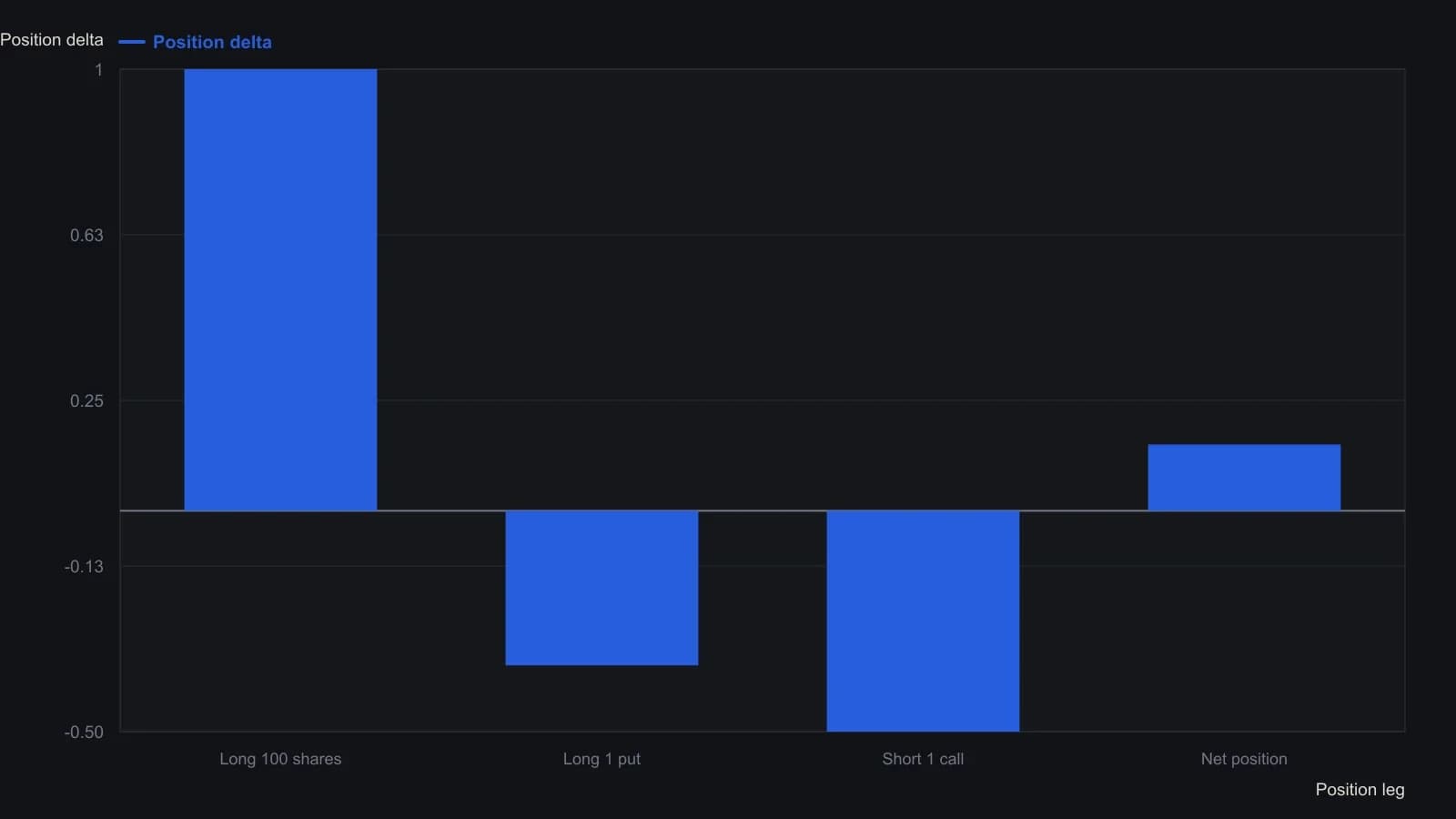
Worked example uses a short call at 0.50 delta and a long put at −0.35 delta against 100 shares of hypothetical ZYX.
All readings on this track · 19 readings
- 2002Rebuilding a long-stock book with calls, puts and collars
- 2004Constructing protective collars and reading cheap premia
- 2004Protective collar, straddle exits, and index settlement
- 2005Collar and backspread construction as a pairing problem
- 2006Protective collar, net delta, and implied volatility
- 2007Interest as a sizing filter on collared stock
- 2008Collar versus bull call spread: capital and inventory
- 2008A long-stock case that sizes cash risk, then stays open with a protective put, covered calls, and a collar
- 2008Assignment as a planned handoff from put spread to collar
- 2008Protective collar rolls and straddle entry in extreme volatility
- 2010A margin call is a late exam in position size
- 2011Protective collars and covered calls after a volatility shock
- 2011Mid-life butterfly and collar adjustments across range and correction
- 2012Stacking a 1-by-2 overlay and a collar on underwater stock
- 2013Odd-lot mini-options for covered calls, puts, and collars
- 2014Zero-debit call-ratio repair for a broken long stock
- 2014An open collar funds the puts without capping every share
- 2018A protective collar as an event-risk budget
- 2020Constructing position-level collars around unsold holdings