2020issue C0746-47
Constructing position-level collars around unsold holdings
A long holding the owner does not want to sell can be hedged with a purchased put or with a collar that pairs that put with a sold call. The call premium offsets some or all of the put cost, and the overlay can be removed after a defined risk window.
- A long holding the owner does not want to sell can be hedged position by position with a protective put, or with a protective collar that pairs that put with a sold call.
- Collar construction keeps the shares, sells a call, and buys a put so the call premium offsets some or all of the put cost.
- Strike selection and overlay ratio trade cash outlay against leftover upside: a call that pays for most of the put can compress the payoff, while selling fewer calls than puts leaves more shares uncapped at a higher net hedge cost.
- The overlay can be held to expiration, closed early, reduced to a married put if the short call cheapens after a decline, or removed after a defined risk window.
A hedge that leaves the shares in place
A long holding that the owner does not want to sell can be hedged position by position with a purchased put, or with a collar that pairs that put with a sold call.
Used alone, a protective put is paid in cash and limits loss if the underlying falls far enough. A protective collar keeps those same shares, adds the put, and finances it with covered-call writing so near-term downside is bounded while leftover upside is capped for as long as the overlay remains on.
How the three-leg overlay is assembled
Collar construction combines the existing shares, one sold call, and one purchased put so that the call premium offsets some or all of the put cost. The cash still required after those call proceeds are applied is the net debit.
Covered-call writing is the sold-call leg written against the held shares. Its premium reduces the cost of the hedge and simultaneously sets the upside cap while the collar is in force.
The illustrated package
In the illustrated package, shares at 170.84 were collared with a 190 call sold at 1.44 and a 170 put bought at 5.58, for a net debit of 414 per 100-share unit, with both options having 56 days to expiration. Through expiration, that same package limited loss to 498 and limited remaining gain to 1502.
Expiration payoff of the TLT 170/190 collar
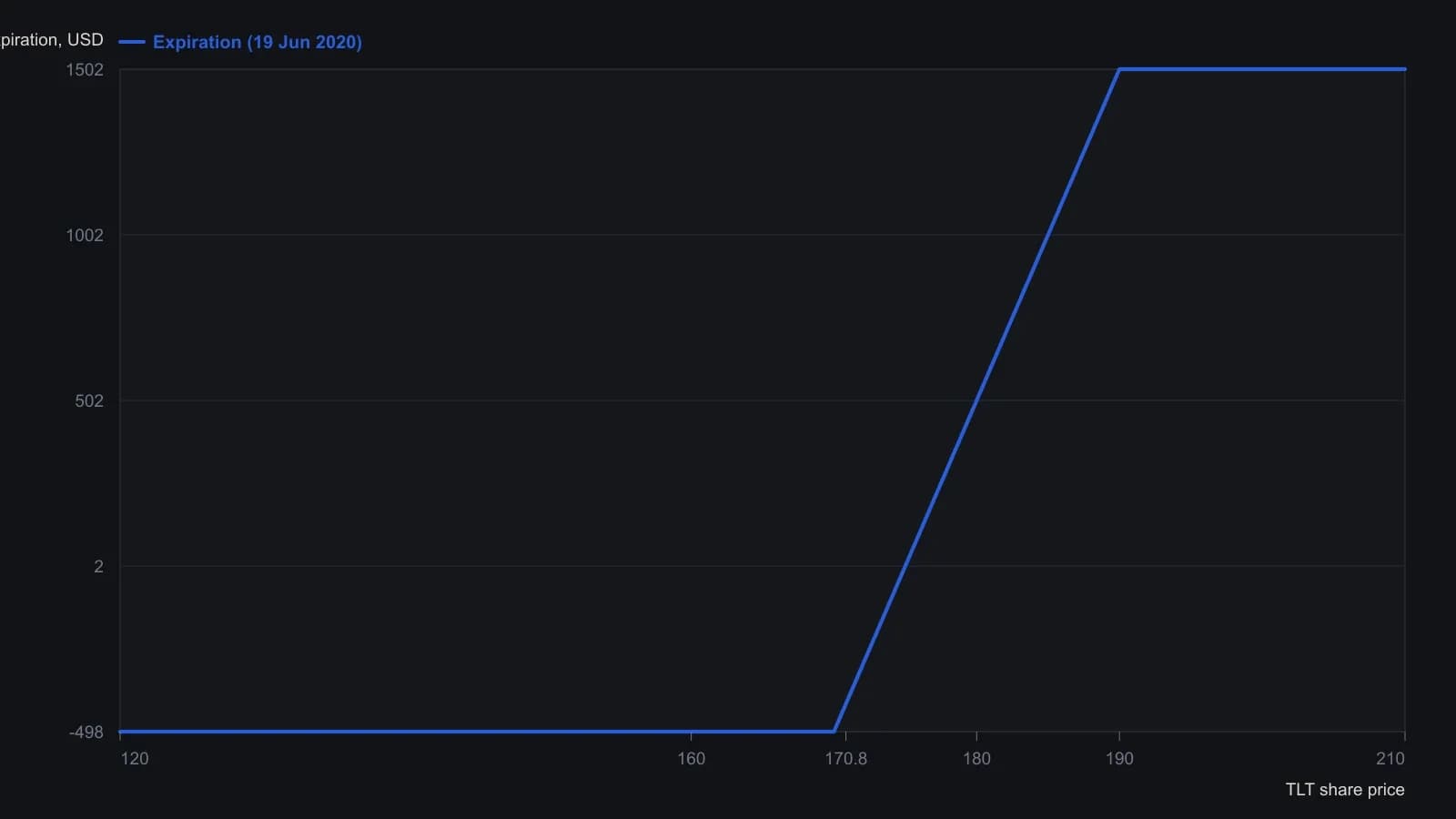
These points are the June 19 expiration payoff implied by the stated strikes and the $414 net option debit. The printed figure also draws a 31 May mark-to-market curve that is not restated in the text, so that curve is omitted rather than traced off the raster.
Strike selection and leftover upside
Strike selection can prioritize a sold call that pays for most or all of the put, which lowers cash outlay but can compress the payoff toward an even reward-to-risk split. Strike selection can instead keep more upside, which usually means paying a net debit for the overlay and can produce a more lopsided reward-to-risk profile, described in the example as about three to one.
Overlay ratio and later lifts
A one-call and one-put overlay per 100 shares is the standard overlay ratio, but selling fewer calls than puts on a larger holding leaves more upside uncapped and raises the net cost of the hedge.
The overlay can be held to expiration, closed before then, or reduced to a stock-plus-put by buying back the call if that short option cheapens after a decline. That residual book is a married put: uncapped upside is restored while the downside bound stays in place. The construction is often intended only for a defined risk window and can be removed so the holder returns to unhedged shares once that window has passed.
All readings on this track · 19 readings
- 2002Rebuilding a long-stock book with calls, puts and collars
- 2004Constructing protective collars and reading cheap premia
- 2004Protective collar, straddle exits, and index settlement
- 2005Collar and backspread construction as a pairing problem
- 2006Protective collar, net delta, and implied volatility
- 2007Interest as a sizing filter on collared stock
- 2008Collar versus bull call spread: capital and inventory
- 2008A long-stock case that sizes cash risk, then stays open with a protective put, covered calls, and a collar
- 2008Assignment as a planned handoff from put spread to collar
- 2008Protective collar rolls and straddle entry in extreme volatility
- 2010A margin call is a late exam in position size
- 2011Protective collars and covered calls after a volatility shock
- 2011Mid-life butterfly and collar adjustments across range and correction
- 2012Stacking a 1-by-2 overlay and a collar on underwater stock
- 2013Odd-lot mini-options for covered calls, puts, and collars
- 2014Zero-debit call-ratio repair for a broken long stock
- 2014An open collar funds the puts without capping every share
- 2018A protective collar as an event-risk budget
- 2020Constructing position-level collars around unsold holdings