2010issue C0955
A margin call is a late exam in position size
If overnight equity cannot carry a futures book, remaining loss is still too large. The yen-futures walkthrough met that call by buying a call, selling a put, or building a collar so required deposits fit the cash already on hand.
- A close below maintenance-margin creates a call that can be met by adding cash or by changing the live book so remaining loss fits available equity.
- A purchased option spends debit from the margin pool and is not extra-margined beyond that debit, but the long option cannot be posted to meet the call.
- Short-option-credit raises the equity used to measure margin while adding a theoretically unlimited liability, and a lower position-delta is how leverage-control shrinks overnight exposure.
- A protective-collar bounds remaining loss and remaining gain at the same time, and option-expiry-cutoff removes both the protection and the margin relief the moment the option disappears.
The call measures leftover size
The yen-futures walkthrough produced a margin call when closing equity fell below maintenance-margin. Overnight initial-margin was 5400 and maintenance-margin was 4000. A close below 4000 created a call that could be met by adding 1400 or by changing the position's risk.
Margin-management is changing the live book so required deposits and remaining loss stay inside available equity, instead of treating a call as a cash-only event. Position-delta is how fast the combined book changes value relative to a one-point move in the underlying futures. A standalone futures contract has a delta of 1.
Bought insurance spends debit
A purchased option used on its own is not charged extra margin beyond the debit paid. That debit leaves the margin pool, and long options cannot be posted to satisfy a call.
Buying a July call about 100 points out of the money for about 600 in the late-June 2010 illustration cut initial-margin to 2957 and was expected to bring maintenance-margin near 2000. Remaining loss was limited to the premium plus the futures-to-strike gap.
Sold premium cuts delta and remaining profit
Selling an option credits collected premium, after costs, into the equity used to measure margin. That short-option-credit raises measured equity, while the short option remains a theoretically unlimited liability.
Selling a put about 200 points below the market for about 1100, with a 30 percent delta, was shown reducing futures delta from 1 to 0.70 and likely pulling required margin under 4000. Remaining profit was sharply capped. Leverage-control is cutting effective overnight exposure, usually by lowering position-delta, so the same account can keep a smaller risk open.
A collar bounds both sides
A short futures position paired with a long call and a short put is a protective-collar. It simultaneously limits remaining loss and remaining profit, and it was described as lowering position volatility.
Protection ends at expiry
When the option expires, both the protective effect and any associated margin reduction disappear immediately. Option-expiry-cutoff is that instant: the option no longer exists, so the protection and the related margin relief vanish together.
Yen futures margin before and after buying call insurance
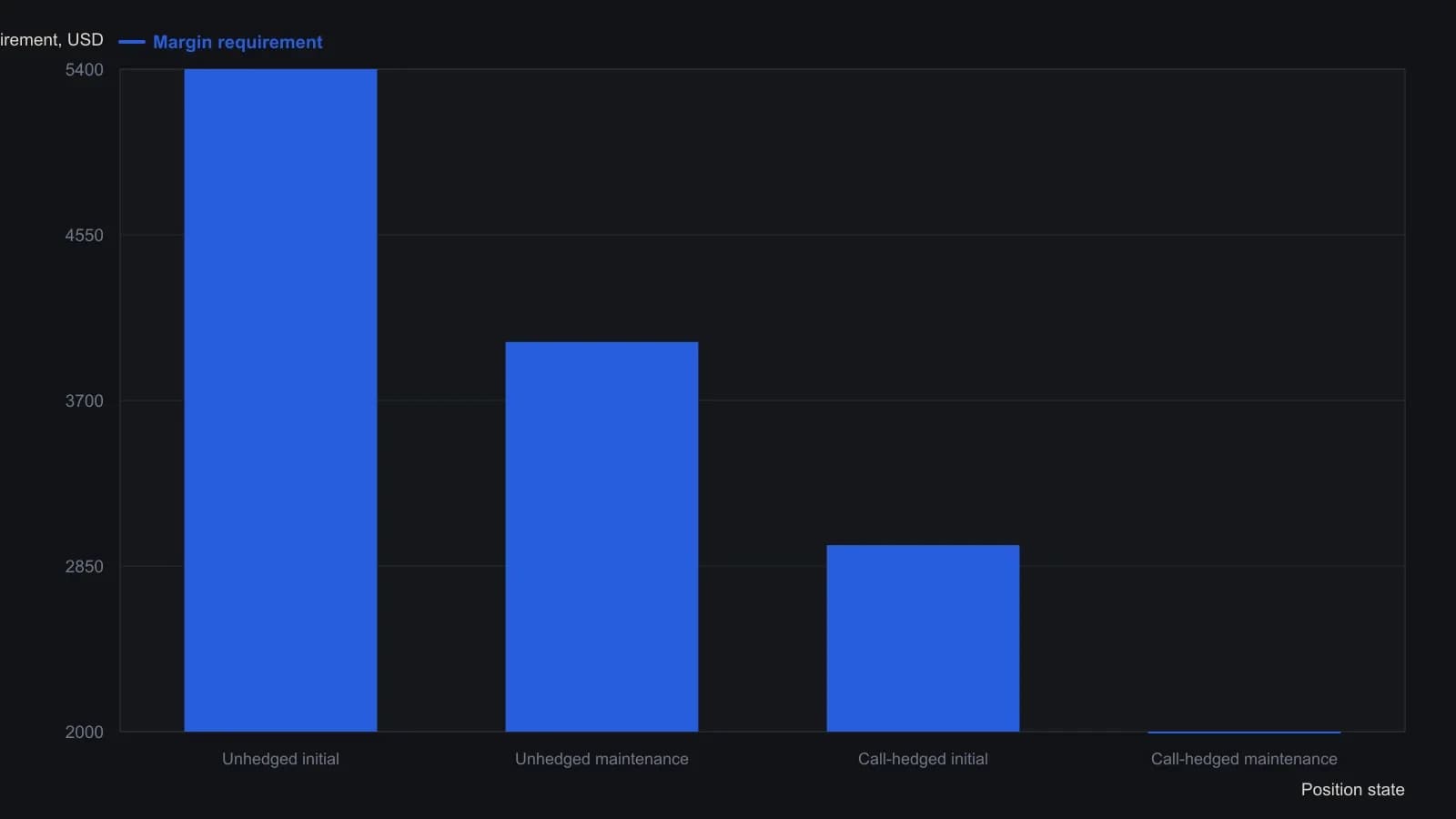
After-hedge maintenance is the column’s “likely closer to $2,000” figure. The sold-put case was only described as likely under $4,000, so it is omitted rather than filled in.
All readings on this track · 19 readings
- 2002Rebuilding a long-stock book with calls, puts and collars
- 2004Constructing protective collars and reading cheap premia
- 2004Protective collar, straddle exits, and index settlement
- 2005Collar and backspread construction as a pairing problem
- 2006Protective collar, net delta, and implied volatility
- 2007Interest as a sizing filter on collared stock
- 2008Collar versus bull call spread: capital and inventory
- 2008A long-stock case that sizes cash risk, then stays open with a protective put, covered calls, and a collar
- 2008Assignment as a planned handoff from put spread to collar
- 2008Protective collar rolls and straddle entry in extreme volatility
- 2010A margin call is a late exam in position size
- 2011Protective collars and covered calls after a volatility shock
- 2011Mid-life butterfly and collar adjustments across range and correction
- 2012Stacking a 1-by-2 overlay and a collar on underwater stock
- 2013Odd-lot mini-options for covered calls, puts, and collars
- 2014Zero-debit call-ratio repair for a broken long stock
- 2014An open collar funds the puts without capping every share
- 2018A protective collar as an event-risk budget
- 2020Constructing position-level collars around unsold holdings