2014issue C1032-37
An open collar funds the puts without capping every share
Three standard hedges for a long stock position are covered-call writing, protective puts, and a collar. An open collar writes calls on only part of the shares so put cost can be offset while some upside stays uncapped.
- Three standard option hedges for an existing long stock position are writing covered calls, buying puts, and combining both into a collar.
- Writing calls against the entire share lot caps upside at the call strike and reduces downside only by the premium received.
- A closed collar buys puts and sells calls on the full share lot, so call premium can offset put cost while also capping all remaining upside.
- An open collar buys puts on the full position and writes calls on only part of the shares, aiming to keep most of the hedge self-funded while leaving some stock uncapped.
Treat a pullback scare as a construction problem
Editorial reading: a near-term pullback scare on an existing long stock position is first a hedge-construction problem. Compare the three standard stock hedges, then set how much of the lot has calls written against it.
Three standard option hedges for an existing long stock position are writing covered calls, buying puts, and combining both into a collar.
Covered-call writing on the full lot
Covered-call writing is selling calls against shares already held, collecting premium while capping upside at the call strike.
A covered-call write keeps the collected premium if the stock finishes below the call strike, but a rise through that strike forces a choice between buying the call back or having the shares called away.
Writing calls against the entire share lot caps upside at the call strike and reduces downside only by the premium received.
A protective put paid in cash
A protective put is buying puts against a long stock holding to set a floor on how far the combined position can fall before expiration.
Buying puts against the full stock holding sets an absolute downside limit before expiration, at the cost of paying the put premium in cash.
Closed collar and open collar
A protective collar is a stock hedge that pairs long puts with short calls so put cost is offset by call premium.
A closed collar buys puts and sells calls on the full share lot so call premium can offset put cost, while also capping all remaining upside. A closed collar is a fully covered collar: puts and calls are both sized to the entire stock position, which funds the hedge but caps all upside.
An open collar buys puts on the full position and writes calls on only part of the shares, aiming to keep most of the hedge self-funded while leaving some stock uncapped.
How the open collar sits next to the other hedges
Relative to covered-call writing and a closed collar, an open collar is constructed so profit potential on the unwritten shares is not fully capped.
Relative to buying puts or using a closed collar, an open collar is constructed so the hedge can be put on without committing a large extra cash outlay.
Open-collar P/L versus Cisco stock price
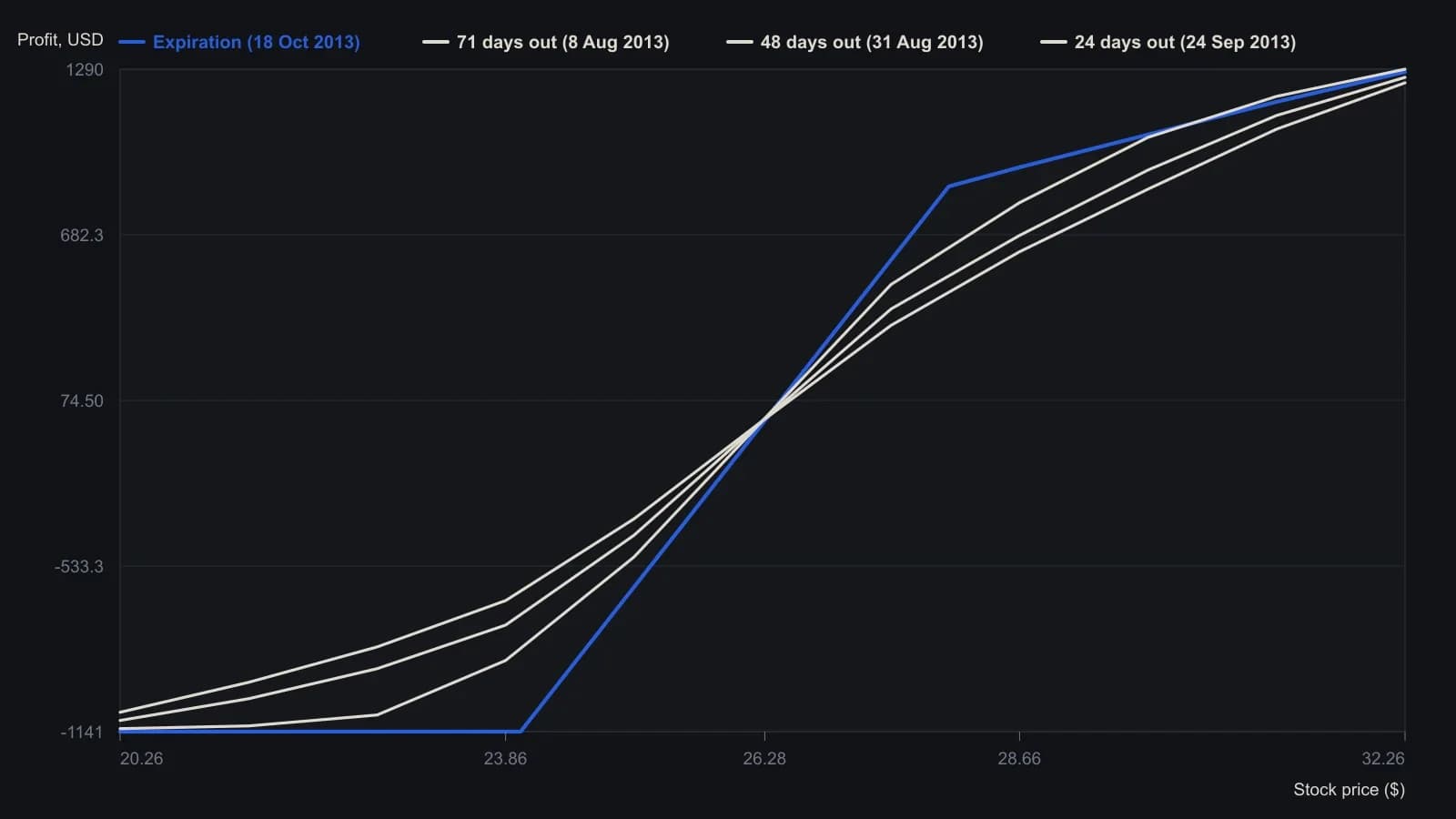
Worked example is long 500 CSCO, short four October 28 calls at $0.56 and long five October 24 puts at $0.47, entered for an $11 net debit. Profit is versus stock price, not calendar time; traces are model snapshots at the dated days-to-expiration.
All readings on this track · 19 readings
- 2002Rebuilding a long-stock book with calls, puts and collars
- 2004Constructing protective collars and reading cheap premia
- 2004Protective collar, straddle exits, and index settlement
- 2005Collar and backspread construction as a pairing problem
- 2006Protective collar, net delta, and implied volatility
- 2007Interest as a sizing filter on collared stock
- 2008Collar versus bull call spread: capital and inventory
- 2008A long-stock case that sizes cash risk, then stays open with a protective put, covered calls, and a collar
- 2008Assignment as a planned handoff from put spread to collar
- 2008Protective collar rolls and straddle entry in extreme volatility
- 2010A margin call is a late exam in position size
- 2011Protective collars and covered calls after a volatility shock
- 2011Mid-life butterfly and collar adjustments across range and correction
- 2012Stacking a 1-by-2 overlay and a collar on underwater stock
- 2013Odd-lot mini-options for covered calls, puts, and collars
- 2014Zero-debit call-ratio repair for a broken long stock
- 2014An open collar funds the puts without capping every share
- 2018A protective collar as an event-risk budget
- 2020Constructing position-level collars around unsold holdings