2015issue C0462-64
When loss aversion overrides testable hold and exit rules
Archive material presents loss aversion as a bias that weights losses more heavily than comparable gains and ties it to cutting winners early and holding losers too long. A late entry followed by a sudden decline is described as leaving the next action to that bias. Editorial view: treat the response as an unwritten veto and score the procedure at the first sudden adverse move, not at the setup.
- Loss-aversion weights the felt cost of a loss more heavily than the felt benefit of a similar-sized gain and distorts hold and exit choices.
- That bias is tied to the disposition-effect: winners are closed earlier than the planned exit and losers are retained past it.
- After a tempting late entry, a sudden decline is described as an adverse-move-freeze in which shock and delay replace the written next action.
- Editorial view: entry, exit, and standing aside are not a complete testable-procedure until that unwritten-veto is specified and checked with the same market-state and execution inputs as the signal.
What the archive describes
The archive presents loss aversion as a cognitive bias in which losses are weighted more heavily than comparable gains when decisions are made. In the terms used here, loss-aversion is that extra weight on the felt cost of a loss relative to the felt benefit of a similar-sized gain, and it distorts hold and exit choices.
The bias is tied to a disposition pattern of exiting winning positions too early and retaining losing positions too long. That follow-on pattern is the disposition-effect: winning positions are closed earlier than the planned exit and losing positions are retained past it.
The material reports that the pain of a loss is felt, on average, about 1.5 to 2.5 times as strongly as the pleasure of a gain. The same urgency that once favored rapid response to threat is described as more likely to impair than to help decisions when it is applied to markets.
When a sudden decline replaces the rule
After a tempting late entry in an established uptrend, a sudden decline is described as producing shock and indecision so that the bias, rather than the planned rule, governs the next action. That stall is an adverse-move-freeze: shock and delay replace the written next action.
Caterpillar daily price with 50-day moving average, June 2014 entry, and later gap-down
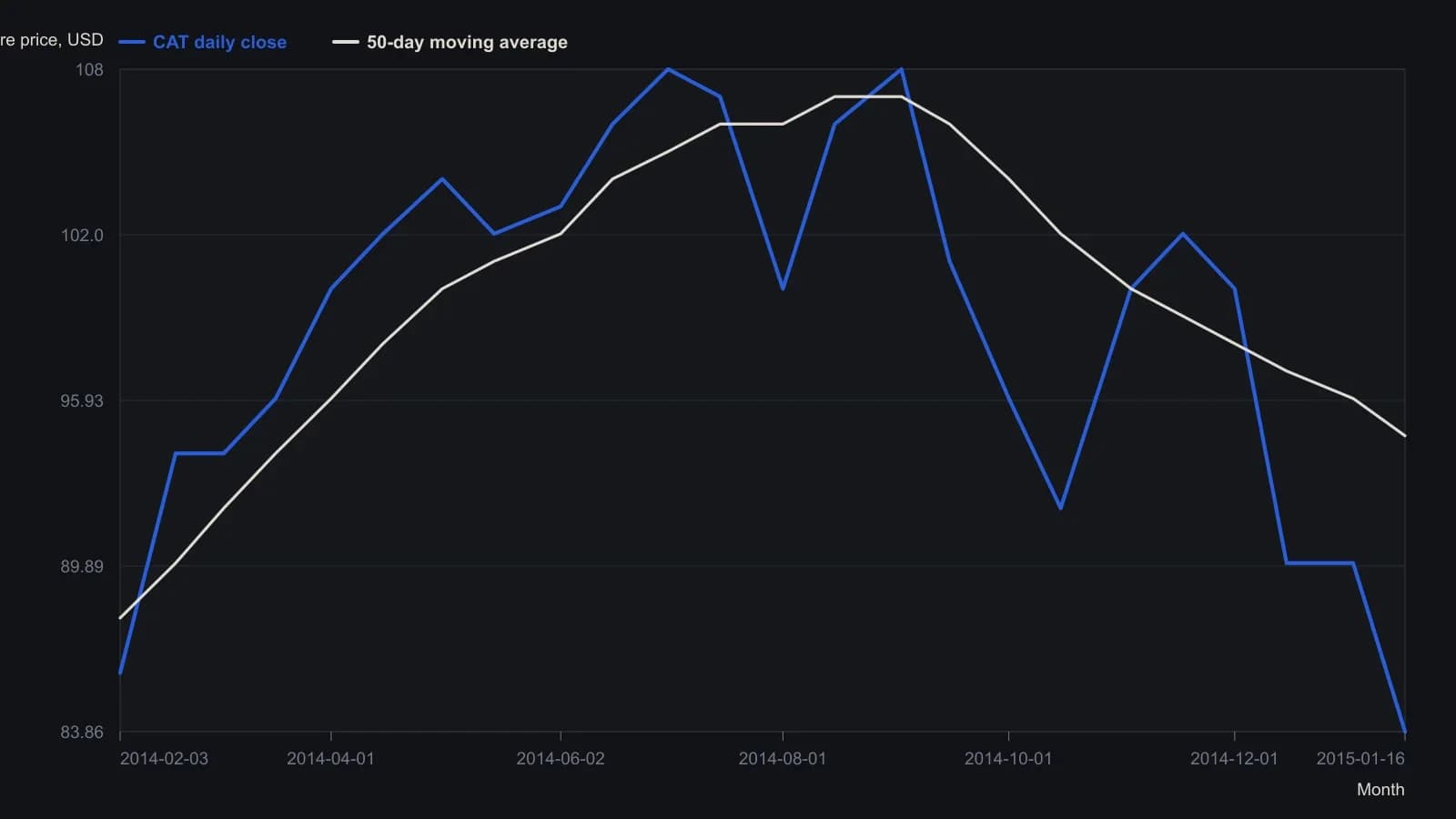
OHLC candles, volume, RSI(14), MA(50), and MACD(12,26,9) are shown on the source chart. Daily closes were sampled from the raster at roughly monthly spacing; they are approximate and were not taken from a printed table. Header quotes Open 84.24, High 84.32, Low 83.04, Close 83.86 on 16 Jan 2015.
Awareness and mapping
Awareness of these typical reaction patterns is framed as a first step toward reducing their influence on later choices. Mapping how the bias appears in entry, hold, and exit choices is presented as a way to offset some of the more damaging decisions it tends to produce.
All readings on this track · 89 readings
- 1988Habitual decision style can override a trading system's rules under stress
- 1988Abstention and self-checks complete the procedure
- 1988When packaged systems replace a testable decision process
- 1991Fighting market direction as a process failure
- 1993Replacing beliefs that override a testable trading procedure
- 1993Fear as a named constraint in entry and exit rules
- 1993Body state on the trading checklist
- 1994When fear vetoes a tested trading system
- 1994Slump recovery as a testable decision procedure
- 1994Hesitation as an incomplete decision process
- 1994Trading weaknesses as testable process inputs
- 1994Mental imagery as an unlogged execution filter
- 1994Comfort-zone overrides of testable trade rules
- 1995Emotion rebound as a system rule failure
- 1995Evaluating emotional overrides in a rule-based decision procedure
- 1995Construct centering into entry, exit, and abstention
- 1995Resistance-audit for trading rule construction
- 1995Single-mode thinking leaves gaps in trading decisions
- 1995Psychology is the trading system's execution layer
- 1995Operator burnout as decision-process failure
- 1995When success breaks the trading procedure
- 1996Between-trade recovery as one decision procedure
- 1996Isolation in a losing stretch belongs in the written procedure
- 1996When goal proximity overrides one trading procedure
- 1996When emotional overload breaks testable rules
- 1996Trader-created losses as decision procedure failures
- 1996Inner commentary as an unlogged system override
- 1997Inner forecasts that override system hold rules
- 1997A conscious rebuild of trading rules after change
- 1997Streamline trading rules until the signals agree
- 1998Happiness as a tradable decision process
- 1998Warfare metaphors as untested trading rules
- 1998Constructing a generosity gate for trade decisions
- 1998Why trading systems need a sensory decision base
- 1999Shock, abstention, and the decision handoff
- 1999Rewrite trading nightmares before they become rules
- 1999Anxiety as a trading-system construction checkpoint
- 1999When revenge replaces the abstention rule
- 2001Money beliefs that veto trading rules
- 2001Ignored sells need an execution filter
- 2001Courage fails unless trading rules are written and tested
- 2003When compulsion rewrites the trading procedure
- 2004When tested rules fail to fire
- 2004Precommit exits when regret outweighs pride
- 2005Audit personal stories before blaming the trading rules
- 2005Why tested systems still fail at execution
- 2007Losing streaks test the whole procedure
- 2007Pre-trade protection rules for surprise declines
- 2007Defensiveness rewrites testable trading rules
- 2008Observer-self as a filter for entry, exit, and abstention
- 2008The holding-period rule for post-fill arousal
- 2010Treat psychology as part of the trading procedure
- 2010Normalized volatility as a testable regime switch
- 2012Post-loss self-talk as an intraday rule-input
- 2012Write uncertainty into one trading procedure
- 2012Milestone rallies need entry, exit and abstention rules
- 2012Mental fitness as the missing decision rule
- 2012Session close is a flatten rule, not overnight hope
- 2012A signal without a sit-out is not a system
- 2012Beliefs that rewrite system entry and exit signals
- 2012Live loss rewrites the rule-based decision process
- 2013Market access as a missing system rule
- 2013Skipped exits and the unplanned hold
- 2013Test entry, exit, and abstention as one procedure
- 2013Crowd sentiment as one testable decision loop
- 2013Keep social noise outside the rule set
- 2014Community feeds versus testable decision rules
- 2014Outcome control versus testable execution rules
- 2014Liquidity eligibility as a testable system rule
- 2015When the fill replaces the hold rule
- 2015When loss aversion overrides testable hold and exit rules
- 2015Pause and objectify before trade decisions
- 2015Clutch delivery as the unfinished trading rule
- 2016The failure protocol inside a trading decision process
- 2016When trading psychology becomes a testable process
- 2016Psychology belongs inside the trading rule set, not beside it
- 2016Trader maturity stages as a critique of an unfinished decision process
- 2017Quiet volatility is not a complete trading process
- 2017The plan-trust gap after live-testing
- 2017When a winning hold is not system adaptation
- 2017Risk-first rules instead of year-ahead forecasts
- 2018Why-first stories leak the tape test for entry, exit and abstention
- 2018Replace intuition with a testable decision procedure
- 2018Make regret a testable stand-aside input
- 2018Exit rules over fear when volatility returns
- 2018When inherited instincts override trading-system rules
- 2018Averaging down as hope substitution after a seed loss
- 2018Click rankings cannot replace a testable decision procedure
- 2020Living-cost pressure as an untested trading constraint