1997issue C061-7
Streamline trading rules until the signals agree
A trading procedure can be built from a few noncorrelated methods. Keep those that do not repeat each other, wait until they agree, and treat a low-probable entry as a reason to sit out.
- Build the procedure from three noncorrelated methods rather than from one combined, increasingly complex approach.
- Take a trigger only when noncorrelated methods, including momentum, point in the same direction as a directional wave reading.
- Treat several open wave scenarios as a low-probable entry and a reason not to trade.
- Test a new technique only against a named problem, and skip the session if the required mindset is absent.
Build one procedure from fewer methods
The archive describes a trading-psychology-process: a decision procedure that turns rule inputs, market state, and execution constraints into an entry, exit, or abstention signal over the system's holding period.
A trading procedure can be built from three noncorrelated methods rather than from one combined, increasingly complex approach. Noncorrelated-methods are separate analytical tools kept because they do not repeat the same information.
Early study often adds many techniques into one approach. Later work is to drop redundant indicators and repair weaknesses in those that remain.
Judge a turn, then wait for agreement
An indicator-on-indicator applies a second reading to an existing indicator so a turn can be judged before the first indicator's usual signal. A composite index on a relative-strength reading is one case: it can show a signal before the first indicator does.
Wave counts are used after momentum and Gann work, and only when the count fits what those indicators already show. A trigger is taken only when noncorrelated methods, including momentum, point in the same direction as a directional wave reading.
Several open wave scenarios count as a low-probable-entry: a setup that should be skipped because competing scenarios remain open.
DJIA quarterly from 1962 through April 1997
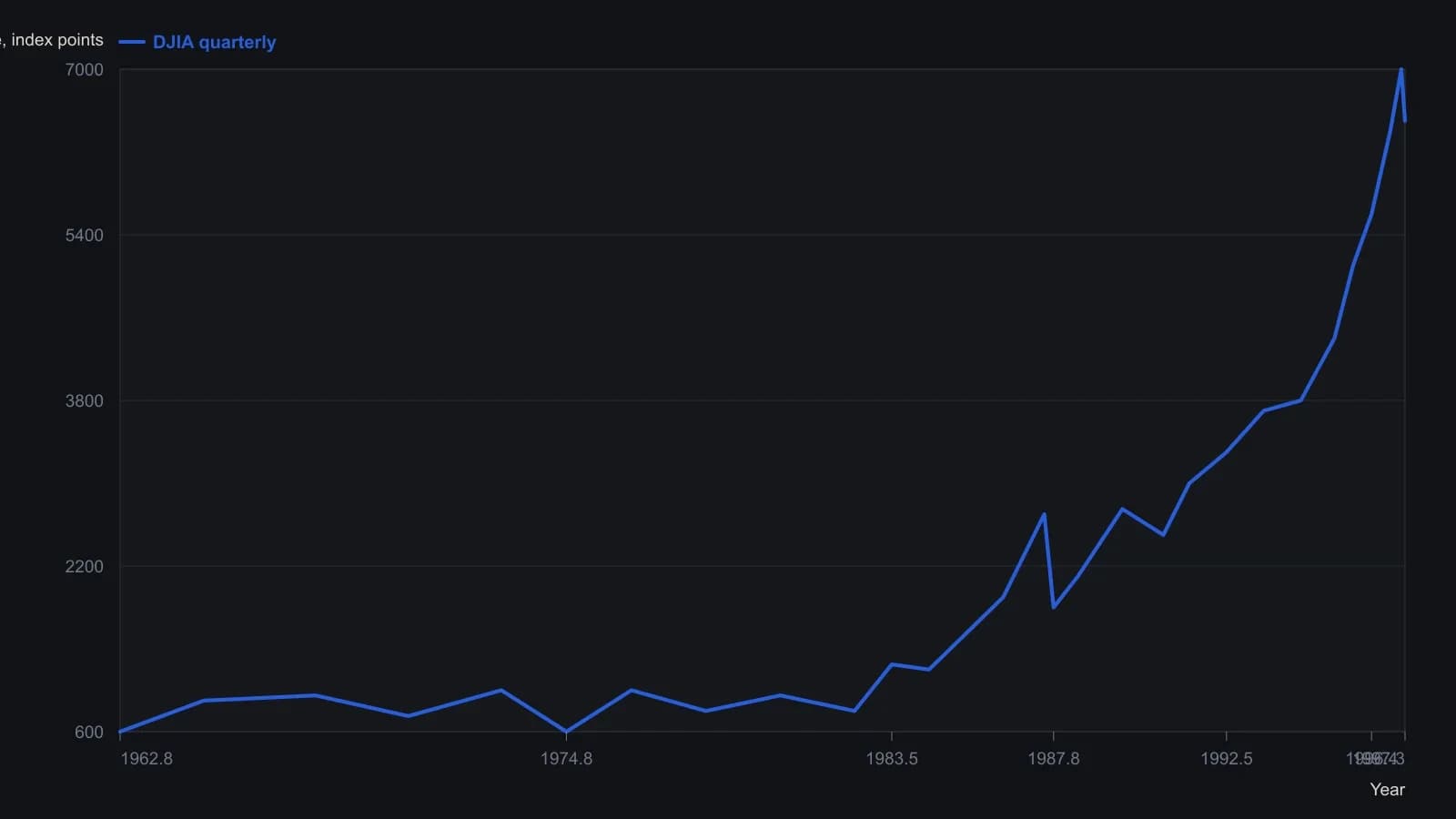
Elliott labels on the source treat 1987 as wave 2, not wave 4. A late spike toward 10000 past the last 1997 print looks like a projection and was not read as a printed price. Early 1962–82 bars sit in a narrow band on a 0–10000 scale, so those years are sampled coarsely.
Fix a named weakness
A new technique is tested only against a named problem and compared with the current procedure, not adopted because it is new. That is problem-first-testing: try the technique only when a specific weakness in the current procedure needs a fix, then compare it with what is already in use.
In some short-horizon markets, knowing methods that influence local participants is treated as required for competitive execution.
The decision process includes a daily fitness check. If the required mindset is absent, the session is treated as one the trader does not have the right to take. Abstention then belongs to the same procedure as entry and exit.
All readings on this track · 89 readings
- 1988Habitual decision style can override a trading system's rules under stress
- 1988Abstention and self-checks complete the procedure
- 1988When packaged systems replace a testable decision process
- 1991Fighting market direction as a process failure
- 1993Replacing beliefs that override a testable trading procedure
- 1993Fear as a named constraint in entry and exit rules
- 1993Body state on the trading checklist
- 1994When fear vetoes a tested trading system
- 1994Slump recovery as a testable decision procedure
- 1994Hesitation as an incomplete decision process
- 1994Trading weaknesses as testable process inputs
- 1994Mental imagery as an unlogged execution filter
- 1994Comfort-zone overrides of testable trade rules
- 1995Emotion rebound as a system rule failure
- 1995Evaluating emotional overrides in a rule-based decision procedure
- 1995Construct centering into entry, exit, and abstention
- 1995Resistance-audit for trading rule construction
- 1995Single-mode thinking leaves gaps in trading decisions
- 1995Psychology is the trading system's execution layer
- 1995Operator burnout as decision-process failure
- 1995When success breaks the trading procedure
- 1996Between-trade recovery as one decision procedure
- 1996Isolation in a losing stretch belongs in the written procedure
- 1996When goal proximity overrides one trading procedure
- 1996When emotional overload breaks testable rules
- 1996Trader-created losses as decision procedure failures
- 1996Inner commentary as an unlogged system override
- 1997Inner forecasts that override system hold rules
- 1997A conscious rebuild of trading rules after change
- 1997Streamline trading rules until the signals agree
- 1998Happiness as a tradable decision process
- 1998Warfare metaphors as untested trading rules
- 1998Constructing a generosity gate for trade decisions
- 1998Why trading systems need a sensory decision base
- 1999Shock, abstention, and the decision handoff
- 1999Rewrite trading nightmares before they become rules
- 1999Anxiety as a trading-system construction checkpoint
- 1999When revenge replaces the abstention rule
- 2001Money beliefs that veto trading rules
- 2001Ignored sells need an execution filter
- 2001Courage fails unless trading rules are written and tested
- 2003When compulsion rewrites the trading procedure
- 2004When tested rules fail to fire
- 2004Precommit exits when regret outweighs pride
- 2005Audit personal stories before blaming the trading rules
- 2005Why tested systems still fail at execution
- 2007Losing streaks test the whole procedure
- 2007Pre-trade protection rules for surprise declines
- 2007Defensiveness rewrites testable trading rules
- 2008Observer-self as a filter for entry, exit, and abstention
- 2008The holding-period rule for post-fill arousal
- 2010Treat psychology as part of the trading procedure
- 2010Normalized volatility as a testable regime switch
- 2012Post-loss self-talk as an intraday rule-input
- 2012Write uncertainty into one trading procedure
- 2012Milestone rallies need entry, exit and abstention rules
- 2012Mental fitness as the missing decision rule
- 2012Session close is a flatten rule, not overnight hope
- 2012A signal without a sit-out is not a system
- 2012Beliefs that rewrite system entry and exit signals
- 2012Live loss rewrites the rule-based decision process
- 2013Market access as a missing system rule
- 2013Skipped exits and the unplanned hold
- 2013Test entry, exit, and abstention as one procedure
- 2013Crowd sentiment as one testable decision loop
- 2013Keep social noise outside the rule set
- 2014Community feeds versus testable decision rules
- 2014Outcome control versus testable execution rules
- 2014Liquidity eligibility as a testable system rule
- 2015When the fill replaces the hold rule
- 2015When loss aversion overrides testable hold and exit rules
- 2015Pause and objectify before trade decisions
- 2015Clutch delivery as the unfinished trading rule
- 2016The failure protocol inside a trading decision process
- 2016When trading psychology becomes a testable process
- 2016Psychology belongs inside the trading rule set, not beside it
- 2016Trader maturity stages as a critique of an unfinished decision process
- 2017Quiet volatility is not a complete trading process
- 2017The plan-trust gap after live-testing
- 2017When a winning hold is not system adaptation
- 2017Risk-first rules instead of year-ahead forecasts
- 2018Why-first stories leak the tape test for entry, exit and abstention
- 2018Replace intuition with a testable decision procedure
- 2018Make regret a testable stand-aside input
- 2018Exit rules over fear when volatility returns
- 2018When inherited instincts override trading-system rules
- 2018Averaging down as hope substitution after a seed loss
- 2018Click rankings cannot replace a testable decision procedure
- 2020Living-cost pressure as an untested trading constraint