2014issue C1163-65
Liquidity eligibility as a testable system rule
Liquidity is a technical input for choosing commodity futures, and a measurement that selection procedures often skip. Editorial reading: fold liquidity rank, equal-dollar contract burden, and effective margin into the same procedure that emits entries, exits, and stand-aside signals.
- Liquidity is a technical input for choosing commodity futures, yet selection procedures often skip measuring it.
- Relative contract liquidity is a descending visual rank that is meaningful only against other markets in the same column. One or zero marks mean thin activity, treated as less desirable for speculative use.
- Equal-dollar contract count and effective percent margin convert contract burden and capital lockup into comparable columns.
- Editorial reading: treat a failed liquidity, margin, or contract-burden test as an abstention signal inside the same procedure that produces entries and exits.
A skipped technical input
Liquidity is framed as a technical input for choosing commodity futures. It is also a measurement that selection procedures often skip. Relative futures liquidity is shown as a descending visual rank in which more marks mean more activity and one or zero marks mean thin activity treated as less desirable for speculative use.
Editorial reading: thin-market participation is a failed system test, not a discretionary hesitation. A liquidity eligibility rule is a pre-trade gate that withholds a signal unless the chosen market clears a stated liquidity and execution-constraint test.
How the ranking was built
The ranking is built by multiplying contract point value, the largest price move judged conceivable from the prior three years, open interest, and a volume factor usually between 1 and 4. That largest move is the three-year price excursion, the common range input for ranking and equal-dollar sizing.
Relative contract liquidity is defined as the equal-dollar contract count times total open interest times a volume factor equal to the greater of 1 or the exponential of the natural log of volume divided by the natural log of 5000, minus 2. That volume adjustment factor lifts or floors the liquidity score when volume is unusually low or high, rather than treating every contract’s activity as interchangeable.
Equal-dollar size and effective margin
A companion column equalizes listed futures by stating how many contracts of each must be traded to match the same potential dollar excursion, using contract value times the largest price change seen in the last three years. That equal-dollar contract count is also specified as tick dollar value multiplied by the three-year maximum price excursion.
Effective percent margin is dollar margin divided by the three-year range of the contract’s dollar value, then multiplied by one hundred, so it can be compared with ordinary percent margin when allocating margin. It expresses capital locked per unit of historical range.
What the columns can say
Each column is a proportional comparison that is meaningful only against other entries in the same column. Markets at the top of the liquidity ranking are described as easiest to buy and sell and those at the bottom as most difficult.
Equal-dollar contracts to trade, ranked by futures liquidity
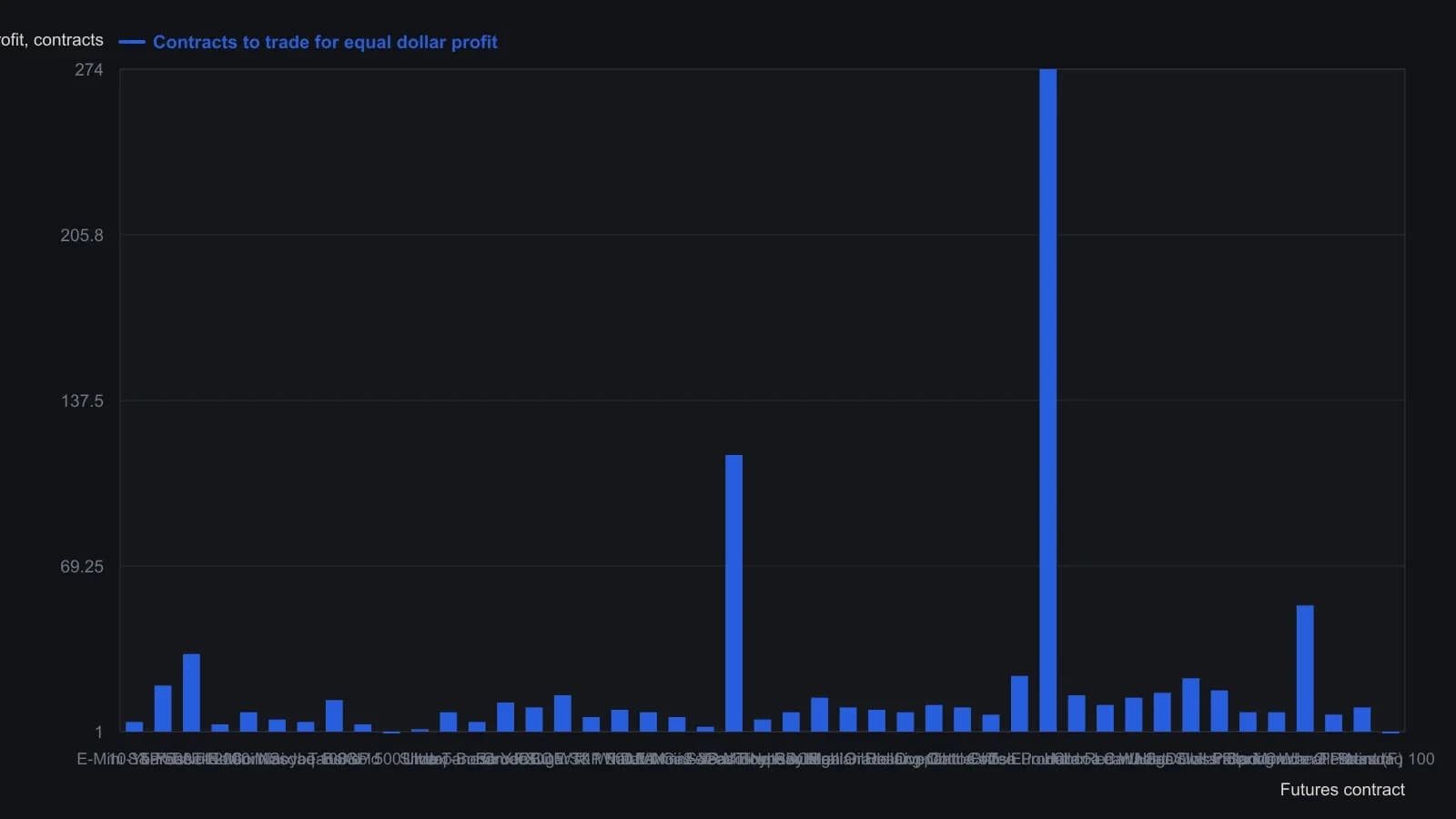
The source scales every listing by tick value times the three-year maximum price excursion so the bars are an equal-dollar comparison. Relative liquidity itself was printed only as a dot bar, so this chart uses the numeric contracts column rather than a counted-dot reconstruction.
One procedure for entries, exits, and standing aside
Editorial reading: fold relative contract liquidity, equal-dollar contract count, and effective percent margin into the same procedure that produces entries, exits, and an abstention signal. A market that fails the liquidity eligibility rule is rejected the way a failed setup is rejected. Standing aside when liquidity, margin efficiency, or contract burden fails the rule is an explicit system output, tested alongside long and short outcomes, not an after-the-fact judgment.
An equity stand-in
For equities, period volume as a percentage of shares outstanding is offered as a liquidity proxy and described as the turnover rate of those shares. That share turnover proxy is a stand-in for how completely the float is being transacted.
All readings on this track · 89 readings
- 1988Habitual decision style can override a trading system's rules under stress
- 1988Abstention and self-checks complete the procedure
- 1988When packaged systems replace a testable decision process
- 1991Fighting market direction as a process failure
- 1993Replacing beliefs that override a testable trading procedure
- 1993Fear as a named constraint in entry and exit rules
- 1993Body state on the trading checklist
- 1994When fear vetoes a tested trading system
- 1994Slump recovery as a testable decision procedure
- 1994Hesitation as an incomplete decision process
- 1994Trading weaknesses as testable process inputs
- 1994Mental imagery as an unlogged execution filter
- 1994Comfort-zone overrides of testable trade rules
- 1995Emotion rebound as a system rule failure
- 1995Evaluating emotional overrides in a rule-based decision procedure
- 1995Construct centering into entry, exit, and abstention
- 1995Resistance-audit for trading rule construction
- 1995Single-mode thinking leaves gaps in trading decisions
- 1995Psychology is the trading system's execution layer
- 1995Operator burnout as decision-process failure
- 1995When success breaks the trading procedure
- 1996Between-trade recovery as one decision procedure
- 1996Isolation in a losing stretch belongs in the written procedure
- 1996When goal proximity overrides one trading procedure
- 1996When emotional overload breaks testable rules
- 1996Trader-created losses as decision procedure failures
- 1996Inner commentary as an unlogged system override
- 1997Inner forecasts that override system hold rules
- 1997A conscious rebuild of trading rules after change
- 1997Streamline trading rules until the signals agree
- 1998Happiness as a tradable decision process
- 1998Warfare metaphors as untested trading rules
- 1998Constructing a generosity gate for trade decisions
- 1998Why trading systems need a sensory decision base
- 1999Shock, abstention, and the decision handoff
- 1999Rewrite trading nightmares before they become rules
- 1999Anxiety as a trading-system construction checkpoint
- 1999When revenge replaces the abstention rule
- 2001Money beliefs that veto trading rules
- 2001Ignored sells need an execution filter
- 2001Courage fails unless trading rules are written and tested
- 2003When compulsion rewrites the trading procedure
- 2004When tested rules fail to fire
- 2004Precommit exits when regret outweighs pride
- 2005Audit personal stories before blaming the trading rules
- 2005Why tested systems still fail at execution
- 2007Losing streaks test the whole procedure
- 2007Pre-trade protection rules for surprise declines
- 2007Defensiveness rewrites testable trading rules
- 2008Observer-self as a filter for entry, exit, and abstention
- 2008The holding-period rule for post-fill arousal
- 2010Treat psychology as part of the trading procedure
- 2010Normalized volatility as a testable regime switch
- 2012Post-loss self-talk as an intraday rule-input
- 2012Write uncertainty into one trading procedure
- 2012Milestone rallies need entry, exit and abstention rules
- 2012Mental fitness as the missing decision rule
- 2012Session close is a flatten rule, not overnight hope
- 2012A signal without a sit-out is not a system
- 2012Beliefs that rewrite system entry and exit signals
- 2012Live loss rewrites the rule-based decision process
- 2013Market access as a missing system rule
- 2013Skipped exits and the unplanned hold
- 2013Test entry, exit, and abstention as one procedure
- 2013Crowd sentiment as one testable decision loop
- 2013Keep social noise outside the rule set
- 2014Community feeds versus testable decision rules
- 2014Outcome control versus testable execution rules
- 2014Liquidity eligibility as a testable system rule
- 2015When the fill replaces the hold rule
- 2015When loss aversion overrides testable hold and exit rules
- 2015Pause and objectify before trade decisions
- 2015Clutch delivery as the unfinished trading rule
- 2016The failure protocol inside a trading decision process
- 2016When trading psychology becomes a testable process
- 2016Psychology belongs inside the trading rule set, not beside it
- 2016Trader maturity stages as a critique of an unfinished decision process
- 2017Quiet volatility is not a complete trading process
- 2017The plan-trust gap after live-testing
- 2017When a winning hold is not system adaptation
- 2017Risk-first rules instead of year-ahead forecasts
- 2018Why-first stories leak the tape test for entry, exit and abstention
- 2018Replace intuition with a testable decision procedure
- 2018Make regret a testable stand-aside input
- 2018Exit rules over fear when volatility returns
- 2018When inherited instincts override trading-system rules
- 2018Averaging down as hope substitution after a seed loss
- 2018Click rankings cannot replace a testable decision procedure
- 2020Living-cost pressure as an untested trading constraint