2020issue C1214-15
Weekly credit spreads: screen the week, then stop behind support
A one-week holding period leaves little time for an adverse move to reverse. This article walks through the historical workflow: skip earnings and waterfall declines, insist on tight markets, then place the stop only after a line in the sand sits between spot and the loss bound.
- Weekly options leave little time for an adverse dip to reverse, so a one-week credit-spread is framed as balancing a minimum acceptable return against the chance of expiring worthless without hitting a stop.
- Earnings before expiration and names in a waterfall decline are skip conditions, because a gap or another week of selling can jump a stop or pile up losses faster than a bounce can repair them.
- Tight bid-ask spreads matter more when an adverse move forces a market-order exit than they do when a limit order can be used to enter.
- A line in the sand should sit between current price and the planned stop so ordinary noise does not trigger the loss exit. Once that support breaks, the trade thesis is gone.
A week is too short to wait out a dip
A one-week or shorter option holding period leaves little time for an adverse move to reverse. A brief dip that a multi-month long option might survive can still finish as a loss.
Buying one-week premium is mainly a timing bet. A wrong-direction move loses. A right-direction move still needs enough travel past the strike plus the premium paid.
A one-week credit-spread is framed as balancing enough potential return against a high enough chance of expiring worthless without hitting a stop placed during the week.
Skip the week that can jump the stop
Earnings before expiration are treated as a skip condition for one-week credit-spreads. A gap can jump well past a stop-loss and enlarge a defined-risk loss.
Names in a sharp waterfall decline are avoided for the same holding window. Another week of selling can pile up losses faster than an oversold bounce can repair them.
Tight bid-ask spreads matter more on one-week short spreads when an adverse move forces an exit with a market order than they do when a limit order can be used to enter.
Place the stop only after the line in the sand
A support level, trendline, or moving average is used as a line in the sand. That line should sit between current price and the planned stop so a loss exit is not triggered by ordinary noise.
The AMD one-week bull-put example
In the AMD one-week bull-put spread example, midpoint fills imply about 18.34% maximum profit on a $31 credit versus $169 maximum risk, with spot at $78.06, breakeven at $73.69, and a 5.6% cushion to expiration.
Recent AMD support at $73.85 sat just above the $73.69 breakeven. A stop at or below breakeven is described as reachable only after that support breaks, at which point the trade thesis is gone.
AMD 72/74 weekly bull put: profit at the 2 Oct 2020 expiration
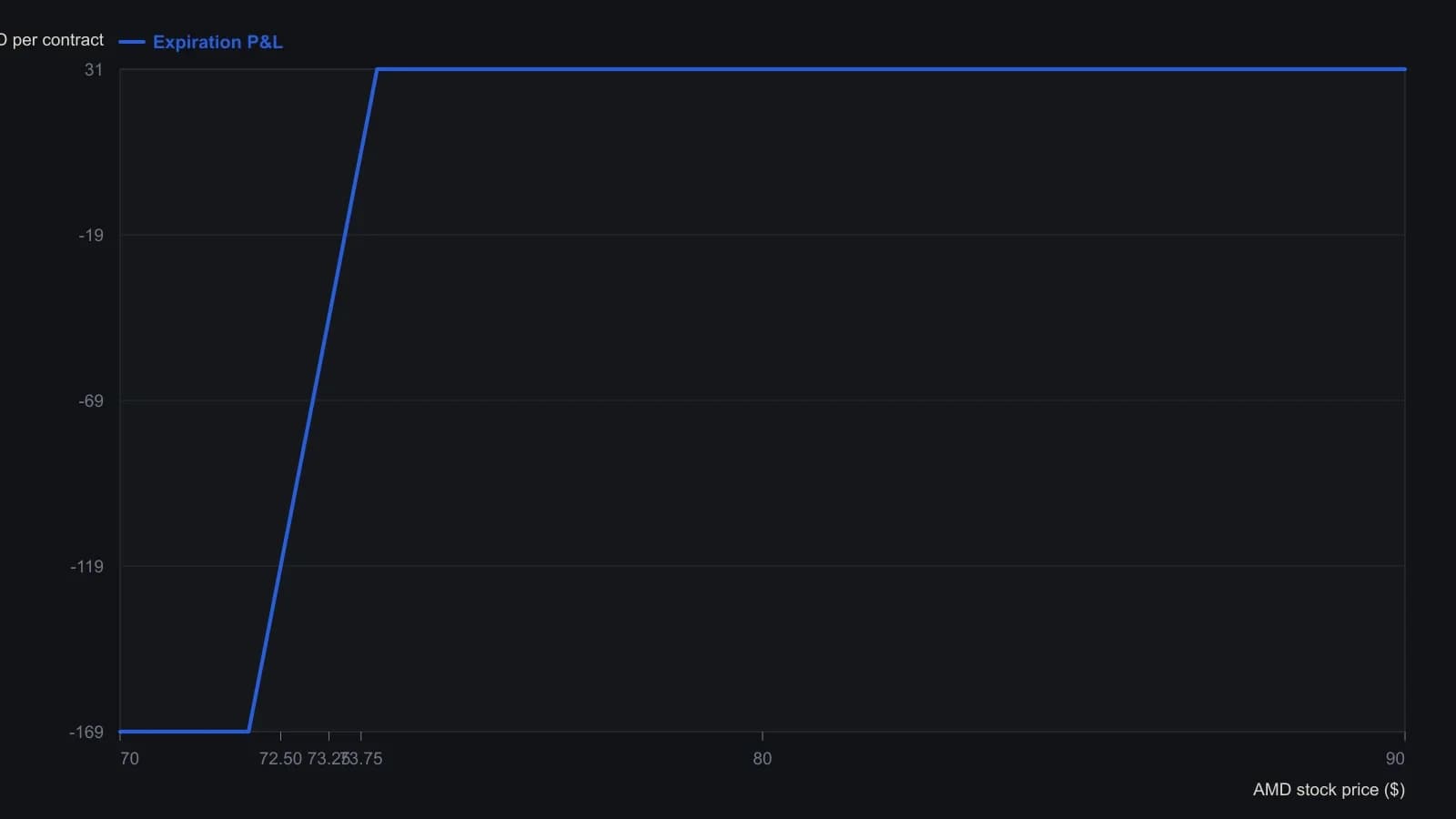
Payoff uses the ticket’s $31 credit, $169 max risk, and 73.69 breakeven. The source risk graph also drew a 3-day mark; that curve is not in the table and is omitted.
All readings on this track · 5 readings
- 1988Credit verticals for modest index moves
- 1990Inflexible option spreads, psychology, and neglected stops
- 2020Two-week paired stops with an options-flow filter
- 2020Long-dated call ratio backspread with implied volatility as one procedure
- 2020Weekly credit spreads: screen the week, then stop behind support