2020issue C106-7
Long-dated call ratio backspread with implied volatility as one procedure
A longer-horizon call ratio backspread is treated here as a single specified procedure: sell one in-the-money call, buy at least two higher-strike calls, record the cash outlay and maximum risk, and treat implied volatility at entry as a regime that later raises or lowers the position through vega.
- A longer-horizon call ratio backspread is formed by selling one in-the-money call and buying at least two calls at a higher strike.
- Relatively low implied volatility was framed as the preferred entry regime because a later rise was described as helping the structure and a later decline as hurting it.
- The archive's maximum-risk figure applied only if the position was held to expiration and the underlying settled exactly at the long strike.
- Editorial: capital outlay, the implied-volatility regime at entry, post-entry vega, and a pre-expiration exit rule belong in one procedure rather than being judged separately.
How the structure is formed
A longer-horizon call ratio backspread is formed by selling one in-the-money call and buying at least two calls at a higher strike. The in-the-money call is the short leg whose strike sits below the current underlying price and helps finance the long calls.
In this archive a ratio backspread sells a lower-strike option and buys a larger number of higher-strike options of the same type and expiration.
The worked example
The worked example used two January 2022 calls struck at 27 against one January 2022 call struck at 22.
That example's cash outlay, and the loss labeled as maximum risk, equaled 414. The same example collected a credit of 86, so at expiration the structure would be profitable below 22.86 and would keep the full credit at or below 22.
The stated maximum loss applied only if the position was held to January 2022 expiration and the underlying settled exactly at 27. Maximum risk is the largest defined loss if the structure is held to expiration and the underlying finishes at the long strike.
Implied volatility at and after entry
After entry, a rise in implied volatility was described as helping a ratio backspread and a decline as hurting it, so relatively low implied volatility was framed as the preferred entry regime. Implied volatility is the volatility priced into options and is used here as a regime variable that can raise or lower a backspread's value after entry.
Entry vega for the example was given as 10.61, implying about 106.10 of value change for a 10-percentage-point move in implied volatility. Vega is the estimated change in position value for a one-point change in implied volatility.
XLF price and 90-day ATM implied volatility
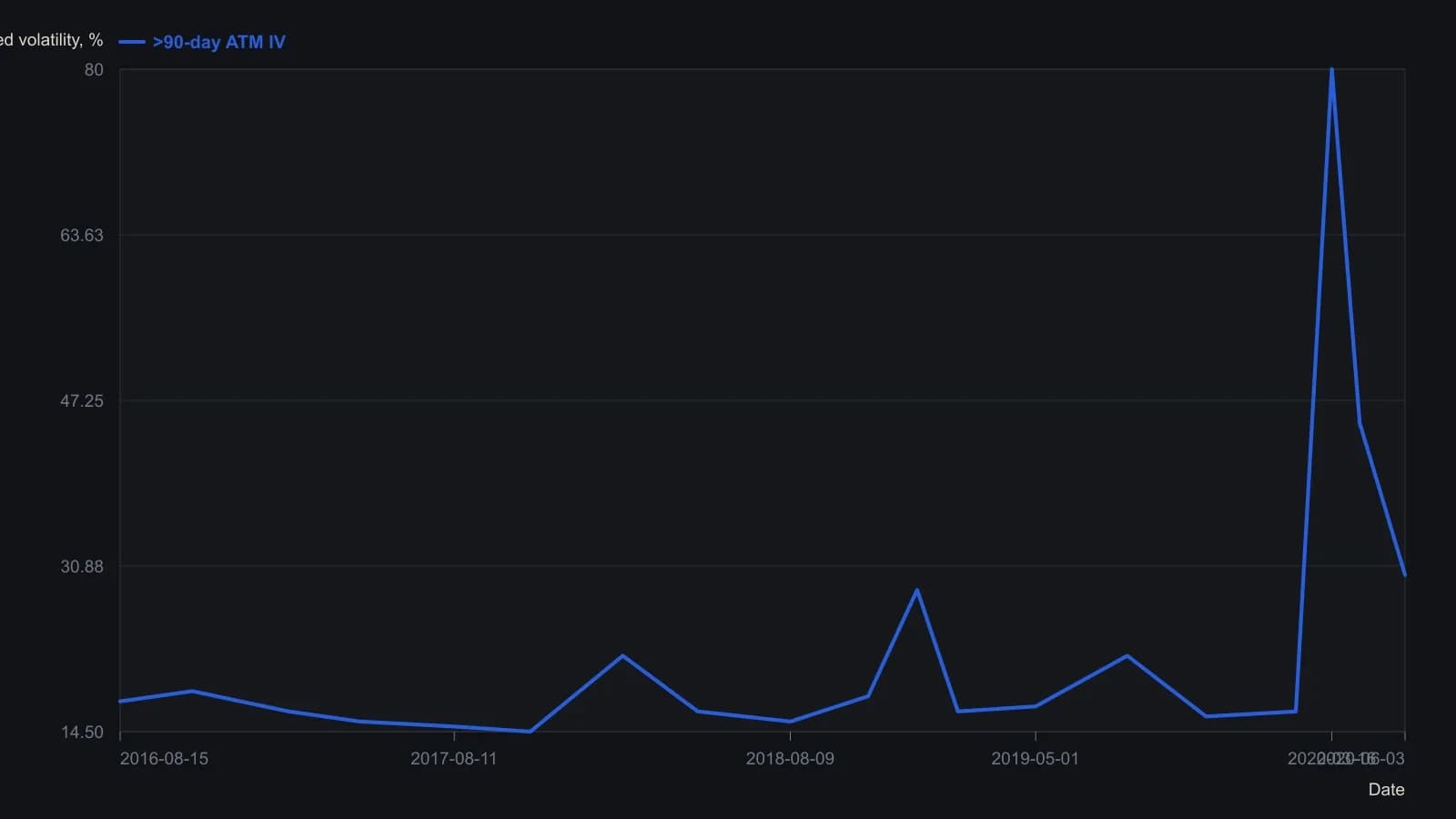
The source chart is a dual-axis plot of XLF price (left) and greater-than-90-day ATM IV (right). Price is shown only as context; the recovered series is IV, the quantity the article uses to judge the entry regime. Raster labels and the 14–30 percent / 80 percent / 30 percent ranges stated in the text were used as anchors. Values are approximate.
Risk shown before expiration
Risk curves dated 31 July 2021 showed expected maximum risk of about -128 if implied volatility was unchanged and about -71 if implied volatility rose 50 percent.
Editorial: those dated curves belong in the same procedure as the entry outlay, not as a separate later judgment. Time decay, the shrinkage of remaining option premium as expiration approaches, works against moderate upside in this structure until a high enough price is reached, which is why a pre-expiration exit belongs with the entry rules.
All readings on this track · 5 readings
- 1988Credit verticals for modest index moves
- 1990Inflexible option spreads, psychology, and neglected stops
- 2020Two-week paired stops with an options-flow filter
- 2020Long-dated call ratio backspread with implied volatility as one procedure
- 2020Weekly credit spreads: screen the week, then stop behind support