2020issue C0226-29
Two-week paired stops with an options-flow filter
This case study writes opposite pending stops, a precommitted first loss, and a two-week close as one rule card. Editorial reading: a short-horizon put-versus-call imbalance is logged as the options-market vote on that same hold, used to confirm the fill or keep the book flat.
- The archive workflow reads a market along price, time, momentum, and sentiment, not from price patterns alone.
- The written card places a buy-stop and a sell-stop together, cancels the unfilled side after the first fill, bounds the position with a stop set before either order is live, and closes after two weeks with no take-profit target.
- Position size steps with account equity, and one May 2018 case filled the sell-stop the next day, cancelled the buy-stop at once, and exited on the two-week rule.
- Editorial reading: a contrary put-versus-call print is treated as an option-spread signal on the same holding period, a vote that can confirm the fill or keep the book flat.
Four dimensions, not patterns alone
A market can be read along four dimensions, price, time, momentum, and sentiment, rather than from price patterns alone.
Sentiment tools fall into two groups. One group polls trader and analyst opinion. The other measures how those participants actually trade or position.
Opinion polls and positioning reports
Extreme opinion-survey readings are treated as potential turning points. The share that counts as extreme is market-specific. One equity-index futures range is given as 65% to 75%. An energy market is described as able to print above 90%.
A weaker survey reading at a higher price high, or a weaker reading at a higher price low, is treated as a divergence. That divergence can argue against a simple continuation of the prior swing.
Commercial futures positioning is used as a turn alert that can take several weeks to resolve. The same report is described as a poor timing tool for one equity-index contract. It is described as more useful in soybeans, where a long book near 100,000 contracts is treated as a bottom-area alert.
The written paired-stop card
One written procedure places both a buy-stop and a sell-stop. After the first fill, it cancels the unfilled side. It applies a stop 40,000 pips from entry. It sets no take-profit target. It closes the position after two weeks.
That procedure sizes the position at 0.02 per 5,000 units of account equity, 0.04 at 10,000, and 0.08 at 20,000.
The card is a rule-based entry: it states when to place, fill, cancel, or stand aside, so entry, exit, and abstention can be checked as one sequence. The 40,000-pip stop is a precommitted distance that bounds loss and exposure before either pending order is live and while the position is held.
A put-versus-call vote on the hold
A short-horizon contrary options reading compares put volume with call volume. A put-heavy print is treated as a possible low. A call-heavy print is treated as a possible high. The same reading is described as more effective at bottoms than at tops.
Editorial interpretation: that put-versus-call imbalance is logged as an option-spread signal over the system holding period, not as a separate forecast. It is the options-market vote on the same two-week horizon. It can confirm the fill or keep the book flat. The archive case did not attach a stated directional view to the pending orders.
A May 2018 fill
In a May 2018 case, both pending orders were placed without a stated directional view. The sell-stop filled the next day at 9,150.00. The buy-stop was cancelled at once. A protective stop sat at 9,550.00. The trade was closed two weeks later at 8,350.00.
The fill, the cancelled opposite stop, the protective stop, and the two-week close can be checked against the written card. The archive note does not state that an options print was required before those orders were placed.
Bitcoin sell-stop fill and two-week exit, May 2018
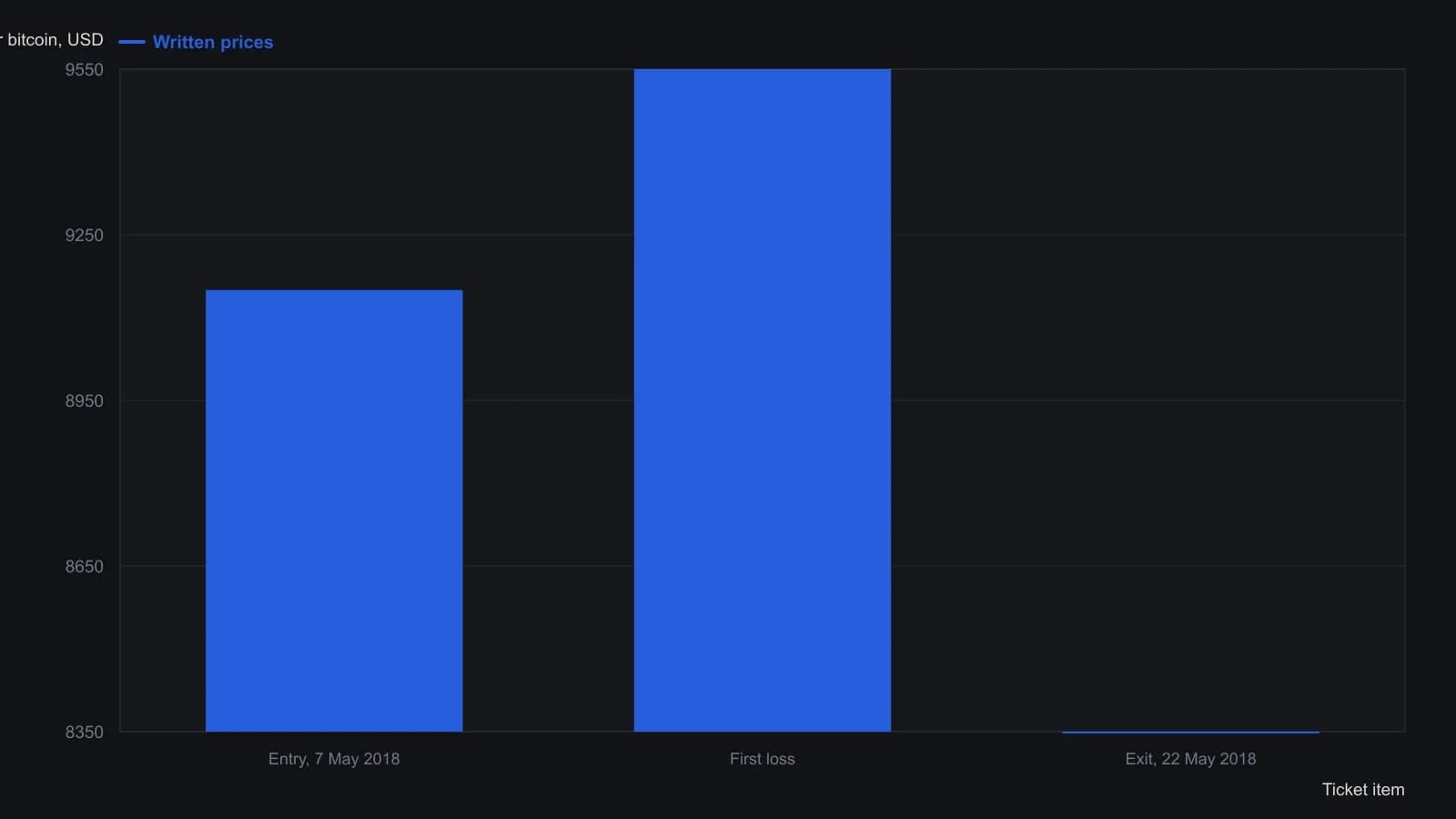
The card also prints a 40,000-pip stop offset and a 50,000-pip result; those pip counts are the author's and are not converted here.
All readings on this track · 5 readings
- 1988Credit verticals for modest index moves
- 1990Inflexible option spreads, psychology, and neglected stops
- 2020Two-week paired stops with an options-flow filter
- 2020Long-dated call ratio backspread with implied volatility as one procedure
- 2020Weekly credit spreads: screen the week, then stop behind support