2001issue C081-4
Rewrite a seasonal crude signal as a put credit spread
A seasonal crude-oil long was armed by a calendar window and a three-channel breakout. When the live protective channel failed a pre-set 1:1 risk/reward floor, the same breakout trigger was kept and the ticket was rewritten as a put credit spread so the maximum debit was known before the stop was armed.
- Seasonal trading is a calendar-constrained procedure that arms an entry only inside a pre-specified window and then lets a breakout rule time the fill.
- A stop-loss is a protective channel that must be acceptable before the position is taken. A possible re-entry near 22.07 against a three-day low at 20.59 implied about 1.48 of futures risk per barrel and was rejected for failing a 1:1 floor.
- When an outright futures stop is too wide, a put credit spread (long a lower-strike put and short a higher-strike put for a net credit) is a two-strike substitute so maximum debit is known before entry.
- The credit spread was not placed until the next session, when November crude printed through the same 22.07 seasonal breakout the futures rule used.
A calendar window, then three channels
A seasonal crude-oil long was defined first by a calendar window and then overlaid with a three-channel breakout so that entry, protective exit, and trailing exit each used a separate channel length. Seasonal trading is a calendar-constrained procedure that arms an entry only inside a pre-specified window and then lets a breakout rule time the fill.
The overlay was a three-channel-breakout: separate lookbacks for the entry stop, the protective stop, and the trailing profit stop, each governed by its own calendar rule.
For the crude-oil seasonal labeled trade #2, the entry channel was five trading days and armed only from August 3 through September 1. The protective stop used three trading days. The trailing profit stop used eight trading days. The calendar exit was the close on September 27.
The live stop failed the floor
On the evening of August 30, 1999, a possible re-entry near 22.07 against a three-day channel low at 20.59 implied about 1.48 of futures risk per barrel. That futures ticket was rejected because it failed a pre-set 1:1 risk/reward floor.
A stop-loss is a protective channel or price bound that must be acceptable before the position is taken and that remains in force after entry. The three-day channel did not pass that test, so the outright was not taken.
A call discarded, a put credit spread substituted
A long November 22 call was discarded after its 1.02 premium left almost no residual payoff if crude only rallied about 1.00 toward 23.
The substitute was a put credit spread: long a lower-strike put and short a higher-strike put for a net credit, used when an outright futures stop is too wide. The structure was a November 22 long put versus a November 23 short put taken for a 61-cent credit, so maximum loss equaled 0.39. The full credit remained only if both puts expired worthless with crude at or above 23 by the October 15 expiration.
An option spread is a two-strike options structure used as a substitute instrument for the same directional signal, so maximum debit is known before entry.
The overlay waited for the same breakout
The credit spread was not placed until the next session, when November crude printed through the 22.07 seasonal breakout, so the option overlay inherited the same entry trigger as the futures rule.
On the September 27 seasonal exit date, November crude was above 24 and the same spread that had been sold at 61 cents was marked at 11 cents. TradersWeek editorial: those marks belong to the historical workflow and are not a performance claim.
November 1999 crude daily with put-spread value
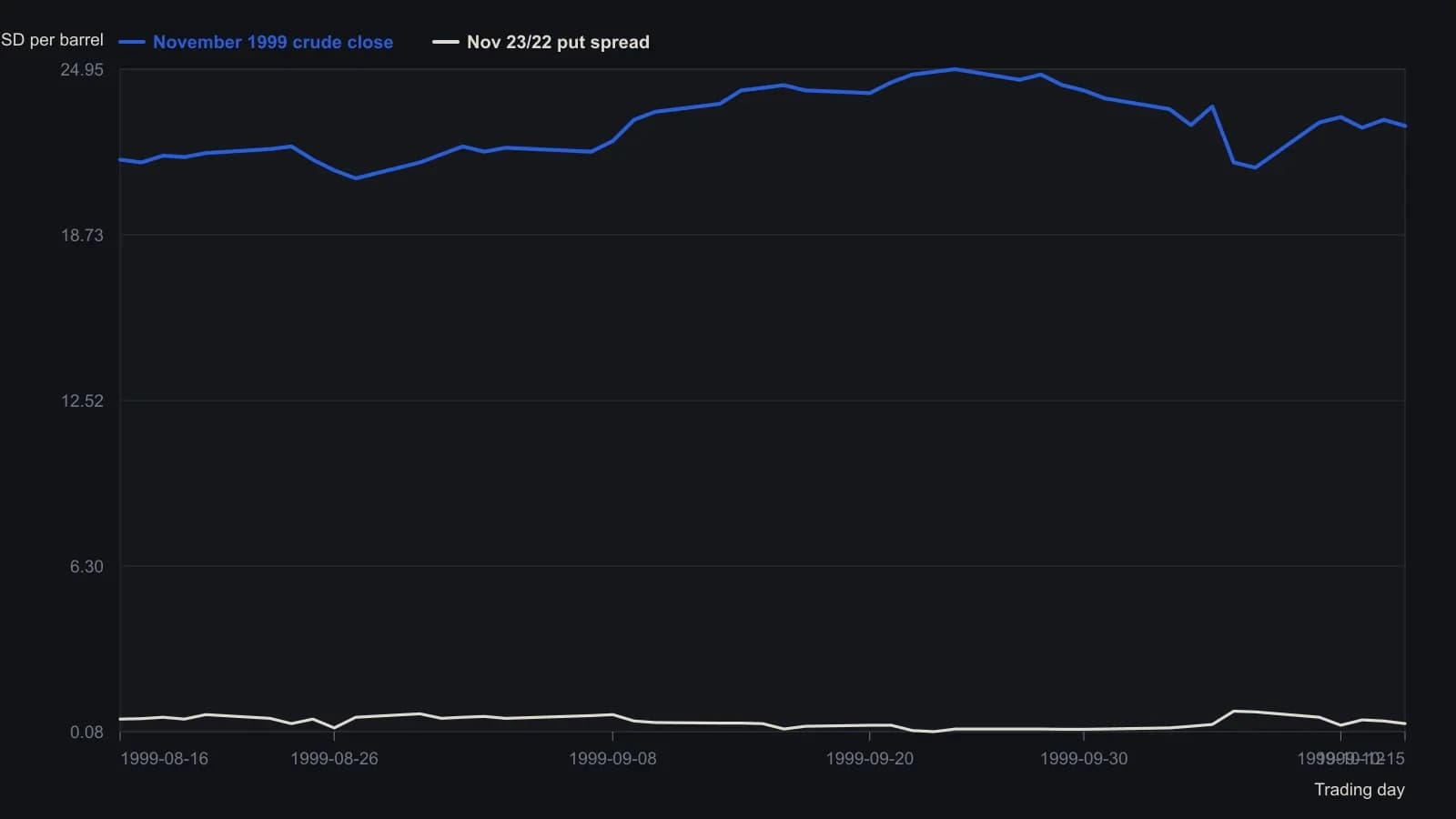
OHLC bars and the red spread trace were digitized from the published daily pane; y-values are approximate to about 0.1 dollar (price) and 0.05 dollar (spread). Header last print is 15 October 1999 at 22.82. Volume and open fields on the header are blank.
The coded futures procedure
The coded futures procedure bought next bar on a stop one point above the five-day high in August, protected with a stop one point below the three-day low that was inactive on the entry day, trailed with a stop one point below the eight-day low, and flattened on the close after September 26 or in any October session.