1990issue C021-8
Two-bar narrow range as a countdown to the next open
A two-bar narrow range is the tightest two-session span in the prior twenty market days. The archive waits for the following session, then uses one opening-range breakout, one open-failure abstention, and one stepped trail that can also host a Wyckoff takeoff reading and a five-minute Elliott check.
- A two-bar narrow range is a relative contraction: the tightest two-session span compared with every other two-session span in the prior twenty market days, and it can form even when the surrounding market is already volatile.
- The procedure waits for the session after the squeeze, then takes an opening-range breakout a preset distance above or below that session's opening range.
- A one-way leave from the open that later returns through the opening price fails the trend-day open test, and a five-minute first thrust that lacks a clear five-wave structure, or that is retraced by more than 61.8 percent, is treated as a suspect breakout.
- The same pause can stand in for a Wyckoff takeoff, and a shared trail can sit first at the open, then at the wave-two pivot after wave one is exceeded, and later beyond a low-volume pocket if price accelerates.
The two-bar rank
A two-bar narrow range is the tightest two-session high-to-low span when compared with every other two-session span in the prior twenty market days. Relative contraction is defined by that range rank, not by how quiet the surrounding market looks. The same two-bar squeeze can therefore form even when the surrounding market is already volatile.
The paired hypothesis is that this measured pause is followed by expansion in the breakout direction, and that the expansion can persist for several sessions.
The next-session order
The mapped procedure waits until the session after the two-bar squeeze has printed. It then takes an opening-range breakout a preset distance above or below that session's opening range.
The next-open breakout is treated as stronger when the two-bar squeeze holds at a significant support or resistance angle, including a trendline, or when that next session opens at such an angle.
Soybeans hit rate after a 2-bar NR opening-range breakout
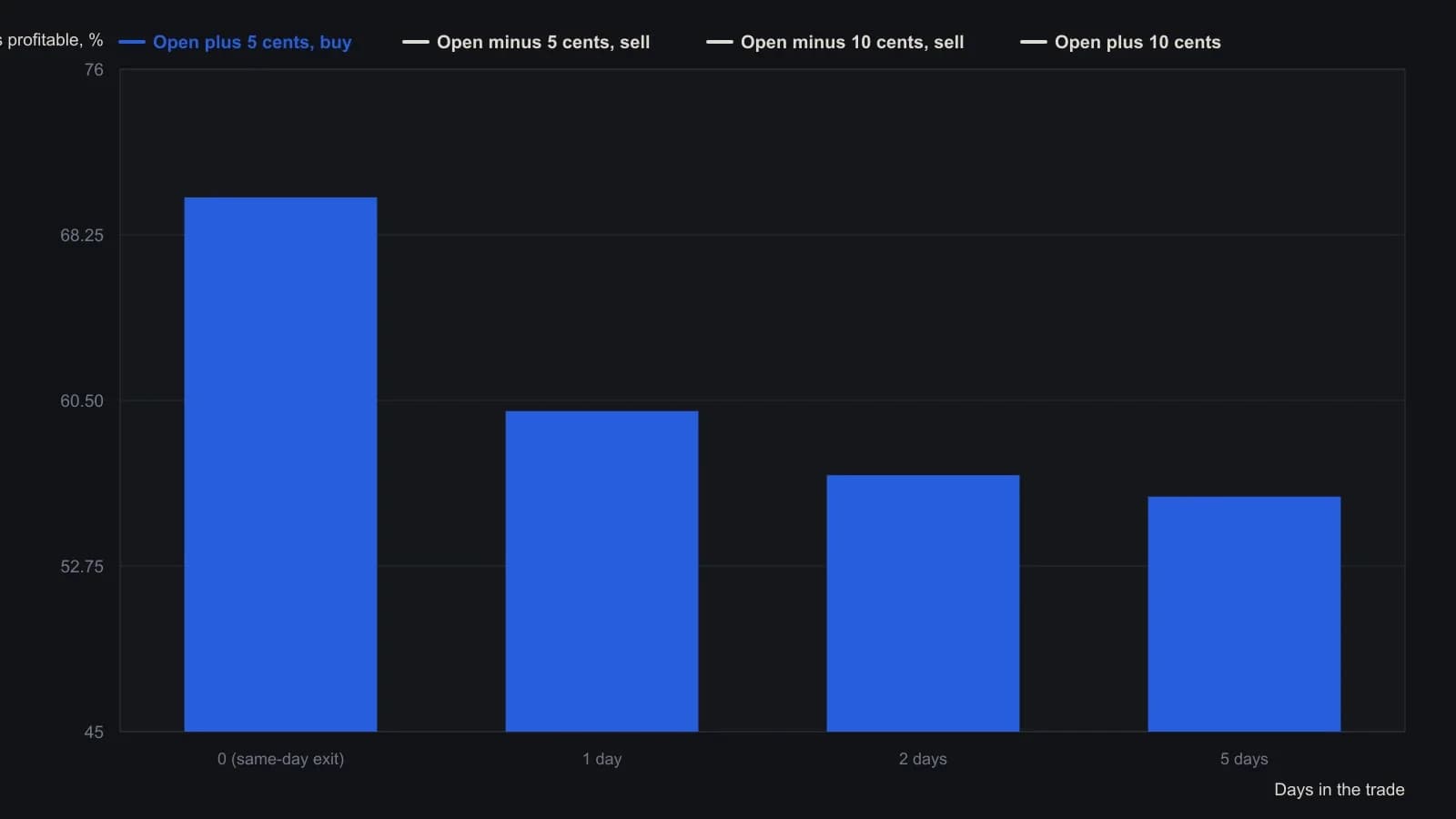
No stops were used. The source chose buy versus sell by which side produced more gross profit. Commission and slippage are excluded from the table.
Wyckoff takeoff and Elliott check
The two-bar squeeze is used as a countable stand-in for a Wyckoff takeoff: a narrow, quiet pause after accumulation or distribution, and just before markup or markdown. In that reading the squeeze is a last point of support or supply.
After the squeeze, a one-way departure from the open that later returns to the opening price fails the trend-day open test. Price that leaves the open in one direction should not trade back through that open if the session is still to be treated as a trend day.
On a five-minute Elliott breakout check, a first thrust that lacks a clear five-wave structure is treated as a suspect breakout. A second wave that retraces more than 61.8 percent of that thrust is treated the same way.
Trail and market context
A shared trail can sit first at the open after the initial departure. After wave one is exceeded, the trail can move to the wave-two pivot. If price later accelerates, the trail can sit beyond a low-volume pocket.
Applying the squeeze still requires full market context: trend, price action, pattern work, and support or resistance. Trend takes precedence over the other parts.
Editorial reading: a later session that gaps with the position and then leaves its own open in the same direction is treated as an impulse-continuation clue that the expansion is still underway. That reading is editorial.
All readings on this track · 21 readings
- 1986Figure-chart construction, counts, and halfway tests
- 1986Constructing Wyckoff trendlines on vertical and figure charts
- 1987Stand down or rehearse on paper when a Wyckoff read fails
- 1987Wyckoff campaign phases as one enter, exit, or stay-out procedure
- 1990Two-bar narrow range as a countdown to the next open
- 1991Channel location as a remaining-room test
- 1991Swing relative strength versus an index proxy
- 1991After a Wyckoff bias, rank leftover cause and keep three-to-one stops
- 1991Timing individual issues to general-market turns
- 1991Constructing a halfway volume map for range resolution
- 1998Wyckoff action sequence as a classroom chart drill
- 1999Hand-plotted point-and-figure trendlines and Wyckoff counts
- 2000Constructing volume confirmation from recent activity
- 2007Diagnose the range on bars, then count it on point and figure
- 2011Wyckoff cause count and spring tests
- 2014Reading the 2008-14 DJIA as a Composite Operator campaign
- 2015Confirm a price-action pivot only after independent signals agree
- 2016A double top stays unfinished until candles show control
- 2016Wyckoff's early clerkship as a campaign-reading case study
- 2016Reading campaign phases as a live drill
- 2017Three clocks on the same crowd life cycle