1987issue C061-4
Write the danger-point stop before the trade is accepted
A stop-order writes the invalidation of a chart idea before the ticket is accepted. The danger-point is located on structure, the position is taken only when that distance is cheap relative to the remaining swing, and the bound is then given a live duration in the book.
- Choose the stop price before entry and require a stop-order on every long and every short.
- Park the stop at the danger-point beyond structure, then accept the trade only when expected reward is at least three times the loss that stop implies.
- Leave stops good-till-cancelled unless a week or month limit is used to clear leftover working orders, and park them on odd fractions outside the usual clusters.
- Treat frequent stop hits as a process fault. Keep using stops, and if the pattern persists, flatten all risk until the error is found.
The bound is written before entry
A stop-order is a standing instruction to sell a long or cover a short at the market once a stated price is touched. Election is judged from the round-lot-print even when the ticket is an odd lot.
The stop price is chosen before entry. A stop is required on every long and every short.
Locate the danger-point, then test the distance
The danger-point is the chart location, usually just beyond support, resistance, a halfway retrace, or a support or supply line, at which the trade idea is treated as wrong. The protective stop is parked there.
The stop is set one to five points beyond that structure, not from a fixed offset to the fill. The buffer is then scaled by price level and by whether the intended swing is a short 3-to-5-point move or a 10-to-20-point intermediate move.
A position is accepted only when expected reward is at least three times the loss implied by that pre-chosen stop. Editorially, that test is how the remaining swing is judged cheap enough to justify the bound.
July cotton with danger-point stops
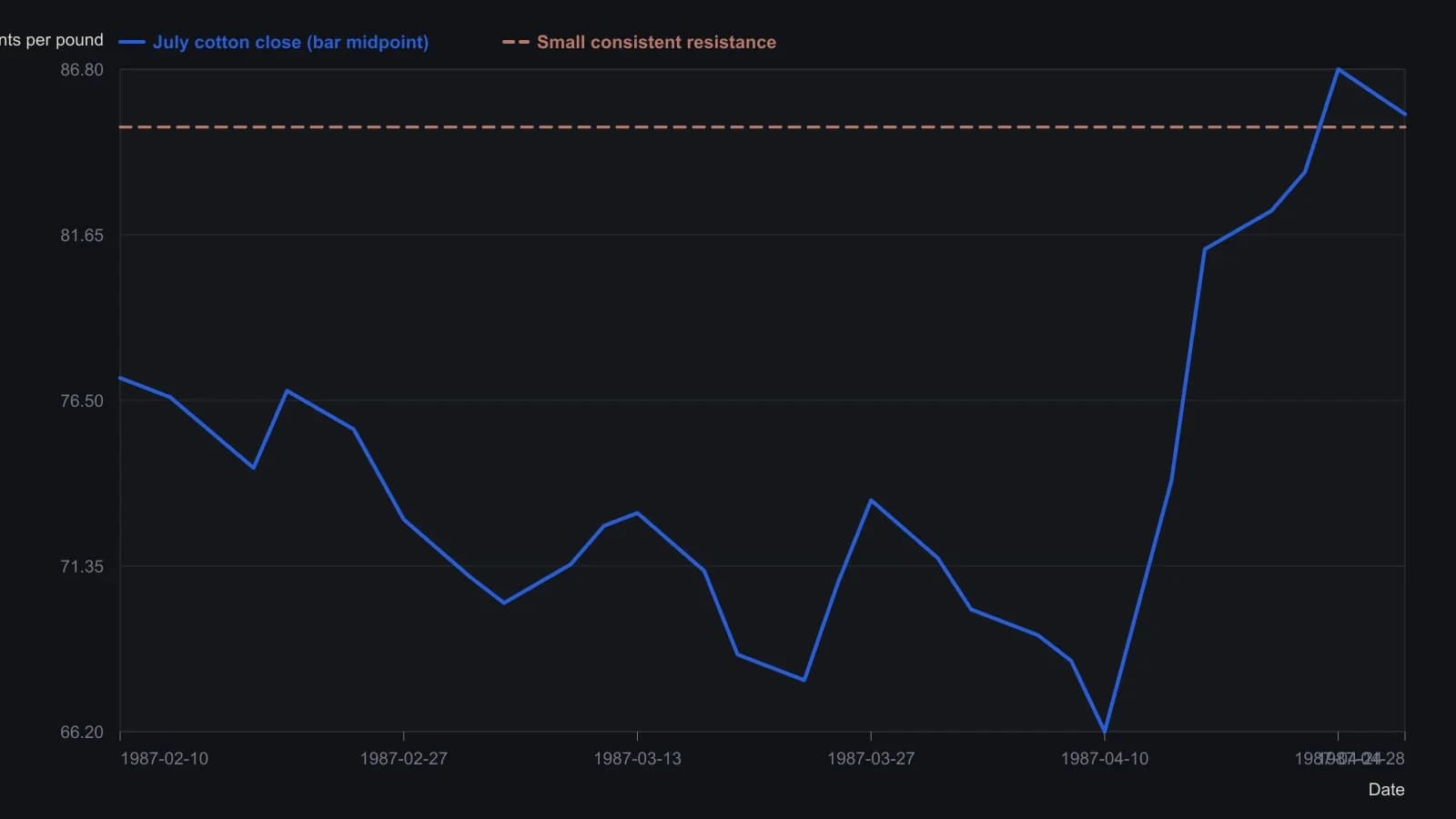
High-low vertical bars digitized from the printed figure; midpoints of each bar are plotted. Week ticks on the time axis are approximate. Price scale is inverted on the scan (73 at the top of the frame, 90 at the bottom), so values were read from the printed ticks, not from page position.
Park outside clusters and choose the order life
Stops cluster at whole numbers, then half-points, then quarters. A long stop is parked on an odd fraction just under a round figure. A short stop is parked on an odd fraction just over a round figure. Both placements sit outside the cluster.
Stops are ordinarily left good-till-cancelled, so the bound keeps working across sessions until it is filled or explicitly cancelled. Limiting the order to the current week or month reduces leftover working orders after a position change, provided the shorter duration is renewed on time.
After the fill, and when a stop starts the trade
After a fill, the stop may be advanced a half to three-quarters of a point through the entry as soon as that shift adds no extra risk, to recapture commission. As price comes within three to five points of the implied swing end, the stop is tightened toward the market, including to about one point away.
An office-or-buy-stop that opens a long or a short only after price reaches a trigger is treated as an advanced tactic around a springboard or hinge. A conventional protective stop must still be placed at once. That pair usually leaves a wider unprotected gap than a stop on an already-open trade.
A run of hits is a process alarm
Stops that are hit unusually often are treated as evidence of premature entry, trading against the prevailing move, or faulty placement and follow-up. The prescribed response is to keep using stops.
If the pattern persists, all risk is flattened and the book stays flat until the process error is found.
All readings on this track · 8 readings
- 1982Swing charts, stop-loss orders, and good-till-cancelled covers in a bond-market coil
- 1982Park good-till-cancelled targets after commissions at the chart bands
- 1987Write the danger-point stop before the trade is accepted
- 1989Christmas tree construction as a five-week monthly procedure
- 2006Constructing the single-price open from overnight flow
- 2008Overnight session routing for good-till-cancelled, limit, and market orders
- 2013Session cutoffs, good-till-cancelled orders, and exchange margin
- 2013Depth of market ladder versus resting order ticket