1992issue C041-12
Sizing capital from degraded records and volatility
The archive first reduces a timing record for a short sample and for extra control rules. Monte Carlo simulation then redraws the remaining profit-and-loss list so each starting stake can be tested against a stated profit goal. Volatility position sizing and historically implied risk keep loss exposure bounded before entry.
- A timing method is treated as usable for capital planning only after its profit-and-loss record still looks positive once results are reduced for a short sample and for the number of control rules.
- When two simulated records show the same profit over the same number of trades, the record built with fewer control rules is treated as the more credible candidate for later use.
- Monte Carlo simulation redraws historical trades so each capital stake can be tested thousands of times against a stated profit goal, and required starting capital is the stake at which the chance of reaching that goal stays high enough that the account is not expected to fail first.
- Volatility position sizing scales a funded base unit down toward a single unit at extreme three- or four-standard-deviation readings, and market-based exposure is set inversely to historically implied risk.
The capital-planning sequence
The archive uses a reduced profit-and-loss record to decide whether a timing method is usable for capital planning. Monte Carlo simulation then tests each starting stake against a stated profit goal. Volatility position sizing and historically implied risk keep the loss decision bounded before entry.
When a timing record is usable
A timing method is treated as usable for capital planning only after its profit-and-loss record still looks positive once results are reduced for a short sample and for the number of control rules.
When two simulated records show the same profit over the same number of trades, the record built with fewer control rules is treated as the more credible candidate for later use.
Testing stakes with Monte Carlo simulation
Monte Carlo simulation redraws trades from the historical profit-and-loss list with uniform random numbers so each capital stake can be tested thousands of times against a stated profit goal.
Risk of ruin and required starting capital
The chance of remaining solvent is estimated as successful goal-reaching runs divided by successful plus unsuccessful runs at that starting capital.
Required starting capital is the stake at which the simulated probability of reaching the goal stays inside sampling error and remains high enough that the account is not expected to fail first.
Round trips versus progress toward the profit goal
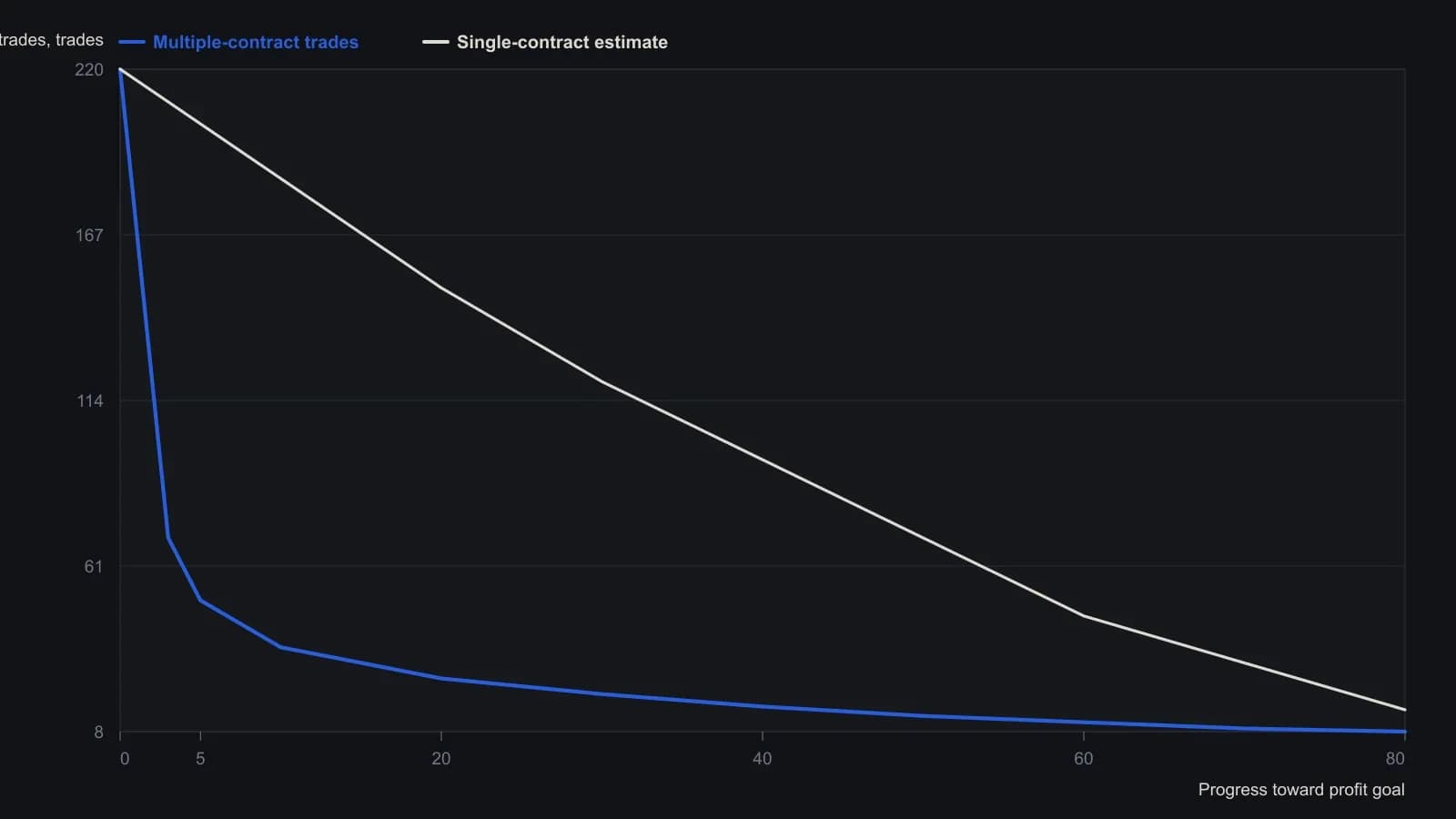
Pelletier first degraded the channel-breakout P&L list for sample size and parameter count. The printed two-window screen also shows survival probability and dollar equity on other axes; those series are omitted because they do not share the trade-count scale.
Volatility position sizing
Position size is scaled to a funded base unit at a neutral volatility reading, then reduced toward a single unit at extreme three- or four-standard-deviation readings so loss exposure stays bounded before entry.
Larger size is reserved for timing signals that occur at extreme volatility readings, and size is cut when the same signal appears near the opposite extreme.
Exposure from historically implied risk
Market-based exposure is set inversely to historically implied risk so a trade is not enlarged just because more contracts would raise the dollar outcome of a well-timed move.
All readings on this track · 24 readings
- 1985Forced-close odds from monthly edge and leverage
- 1986Constructing a pre-entry risk filter on price-ratio grids
- 1991Ratchet the halt floor and stage exposure against cash
- 1992Sizing capital from degraded records and volatility
- 1992Filter size by expected value and ruin
- 1995Risk of ruin as a pre-entry position filter
- 1995Filter leverage by sequence-loss odds
- 1996Grading track records by drawdown, expected value, and ruin
- 1998When quieter returns lose their survival edge
- 1999Loss response versus a precommitted trading process
- 1999Reauthorize ruin and drawdown filters after a winning stretch
- 2000Sold premium, survivorship, and ruin bounds
- 2001Monte Carlo drawdown risk and volatility position sizing
- 2001Alertness is a size filter, not a mood
- 2002A constant percent risk bound beats a higher win rate
- 2010Risk of ruin with fractional and reserve betting
- 2014Payout identity, expectancy, and path-dependent ruin
- 2015Spreading names is not a substitute for a ruin bound
- 2015Prestige labels versus one testable trade procedure
- 2015Closed-trade quality screens before sizing risk
- 2019Size mini futures from drawdown and leftover margin
- 2019Starting account size as a survival filter
- 2019Pre-entry ruin and volatility caps for short options
- 2020Forced margin, stop-loss, and ruin risk in 2020