2007issue C041-4
An index put as deductible insurance for an active stock book
A long put on an S&P 500 tracking ETF can sit on an actively traded stock book as bounded market insurance. The archive workflow first turns holdings into one beta-weighted hedge notional, then treats the gap to an out-of-the-money strike as the deductible the book must absorb.
- A long put on an S&P 500 tracking ETF can insure an active stock book against a broad market correction, and the put's loss is limited to the premium paid.
- Only strikes below the current index-ETF price belong in this insurance framing. The gap to the strike is the deductible, and farther out-of-the-money strikes cost less.
- Each holding's beta and weight sum to one portfolio beta that scales portfolio value into the dollar hedge notional and the number of puts.
- The overlay offsets market-correlated risk, not stock-specific swings. Historical three-month declines of 5% and 10% were used to judge how often a chosen drop had occurred.
A put on the index as book insurance
A long put on an S&P 500 tracking ETF can be used as insurance against a broad market correction that would otherwise drag an actively traded stock book lower. In the archive workflow the put is held as bounded downside cover for the book, not as a directional bet on the index itself.
The strike as a deductible
For this insurance framing, only puts with strikes below the current index-ETF price are treated as the hedge. In-the-money strikes require a different analysis.
The put premium functions like an insurance premium. The gap between the current index-ETF price and the strike functions like a deductible that the holder must absorb before the floor applies. Farther out-of-the-money strikes, which imply a larger deductible, are cheaper to buy, just as a higher insurance deductible lowers the premium.
Expiration profit of a long SPY put versus the index price
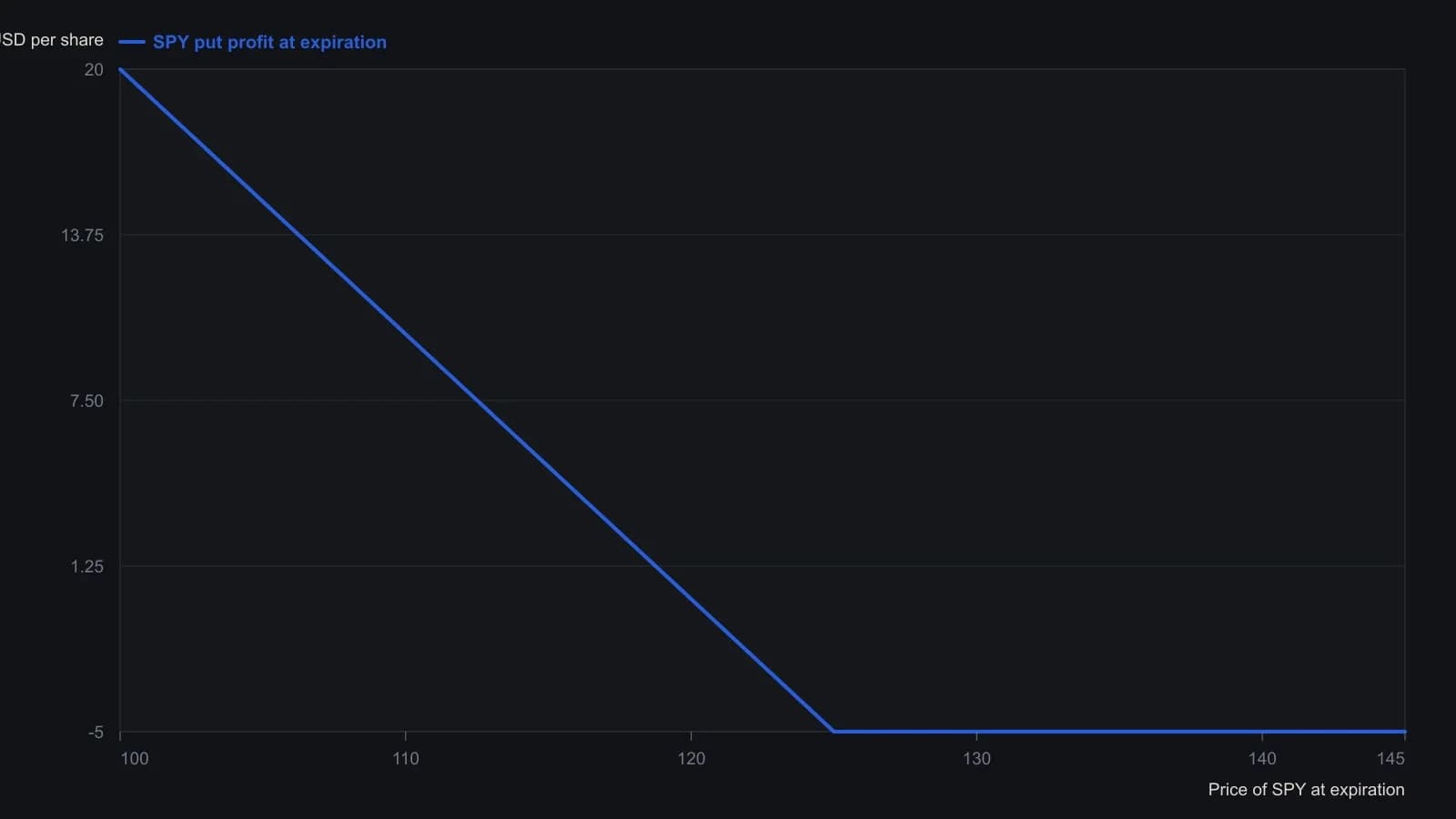
Schematic long-put payoff, not a live option quote. Strike 125 and premium 5 were read from the labeled kink, the deductible bracket between 125 and the 130 spot, and the premium mark on the -5 line.
One beta-weighted hedge notional
Hedge size starts from each holding's beta to the S&P 500 and its portfolio weight. Those products sum to a single portfolio beta that scales the book's market exposure.
In a worked six-name example totaling $50,000, the weighted portfolio beta was 1.30, so the book was treated as more sensitive than the index itself. In that workflow the dollar hedge notional is that portfolio beta times portfolio value. Dividing by the current index-ETF share price gives the number of puts needed to offset the same market move.
Three-month decline frequencies
From January 29, 1993 through June 16, 2006, three-month index declines of 10% occurred in 5.53% of observations and declines of 5% occurred in 11.61%.
TradersWeek editorial: those frequencies are a way to judge how often a given decline has occurred and whether a chosen strike's breakeven drop is worth the premium.
Market risk versus stock-specific risk
A beta-neutral index-put overlay offsets market-correlated risk, not the idiosyncratic moves of the individual stocks in the book. The long put's loss is limited to the premium paid, so it can cap market-linked downside while only modestly reducing upside if the index rises.
All readings on this track · 13 readings
- 1989Rank rotation opens the names; pairing keeps the hedge
- 1991Evaluating allocation sleeves against an index proxy
- 1991Construct an equity book by weakening residual co-movement, then setting a market slope
- 1992Sizing index futures to retarget portfolio beta
- 1992Portfolio beta overlays with index futures and puts
- 1997Construct a trailing stop from beta and price
- 1998An offense-defense matrix for regime-aware stock selection
- 1998Constructing a stock-book duration proxy from beta and bond markets
- 2007An index put as deductible insurance for an active stock book
- 2010Constructing option overlays for beta-adjusted portfolios
- 2014Long-only relative value with an index hedge and a crisis stop
- 2017Hedging a rising book with beta and ATR
- 2019Sizing micro index futures overlays for cash equity books