2019issue C0731
Sizing micro index futures overlays for cash equity books
A long cash-equity book can sell listed equity-index futures to transfer price risk. Editorial reading: build that overlay in three steps, matching the micro contract to the holdings mix, sizing it to cash notional, and leaving residual-exposure that a flexible-overlay can change.
- A sector-contract-map pairs the cash book with the closest micro index future: NASDAQ 100 for technology-heavy holdings, Russell 2000 for small-caps, Dow for blue-chip exposure, and S&P 500 for broad equity risk.
- A notional-match sizes the short overlay to the cash holding. At an S&P 500 level of 2,800, the micro e-mini S&P 500 is described as about $14,000 of notional, one-tenth the $140,000 standard e-mini, so books below $140,000 need not take an oversized overlay.
- A $50,000 S&P-allocated holding short three micro e-mini S&P 500 contracts is worked as about $42,000 of futures offset and about $8,000 of residual-exposure, while cash-flow-retention leaves dividends with the cash holder.
- A complete, permanent offset is treated as a textbook ideal. Hedge intensity is a flexible-overlay that should vary with perceived market risk, and near-full hedges are framed as more coherent when the market is judged expensive than when it is judged historically cheap.
What the overlay transfers
A long cash-equity book can transfer price risk by selling listed equity-index futures in a size intended to offset that cash holding.
At an S&P 500 level of 2,800, the micro e-mini S&P 500 contract is described as having about $14,000 of notional value, one-tenth the $140,000 notional of the standard e-mini. That smaller notional is presented as making index-futures hedges usable for cash portfolios below $140,000 without forcing an oversized overlay.
Match the listed contract to the holdings mix
Contract choice is mapped by holdings mix. The sector-contract-map pairs a cash book with the micro index future whose composition is closest to the holdings.
A technology-heavy book is paired with the micro NASDAQ 100. A small-cap book is paired with the micro Russell 2000. Blue-chip exposure is paired with the micro Dow. Broad equity risk is paired with the micro S&P 500.
A diversified $50,000 multi-sector cash account is shown as a candidate for a combined overlay of micro Dow, Russell 2000, S&P 500, and NASDAQ 100 contracts rather than a single-index hedge.
Size the overlay to cash notional
A notional-match sizes a short index-futures overlay so its dollar exposure approximates the cash-equity holding being protected.
A $50,000 S&P-allocated cash holding short three micro e-mini S&P 500 contracts is worked as about $42,000 of futures offset and about $8,000 of leftover price exposure.
Leave residual-exposure and keep cash-market earnings
Residual-exposure is the unhedged slice of price risk that remains when contract size does not divide the cash book evenly. In the $50,000 S&P-allocated example that leftover slice is about $8,000.
Cash-flow-retention keeps dividend or other cash-market earnings with the holder while a portion of price risk moves through futures. In the worked example, cash-market dividends remain with the holder.
Micro S&P overlay versus a $50,000 cash book
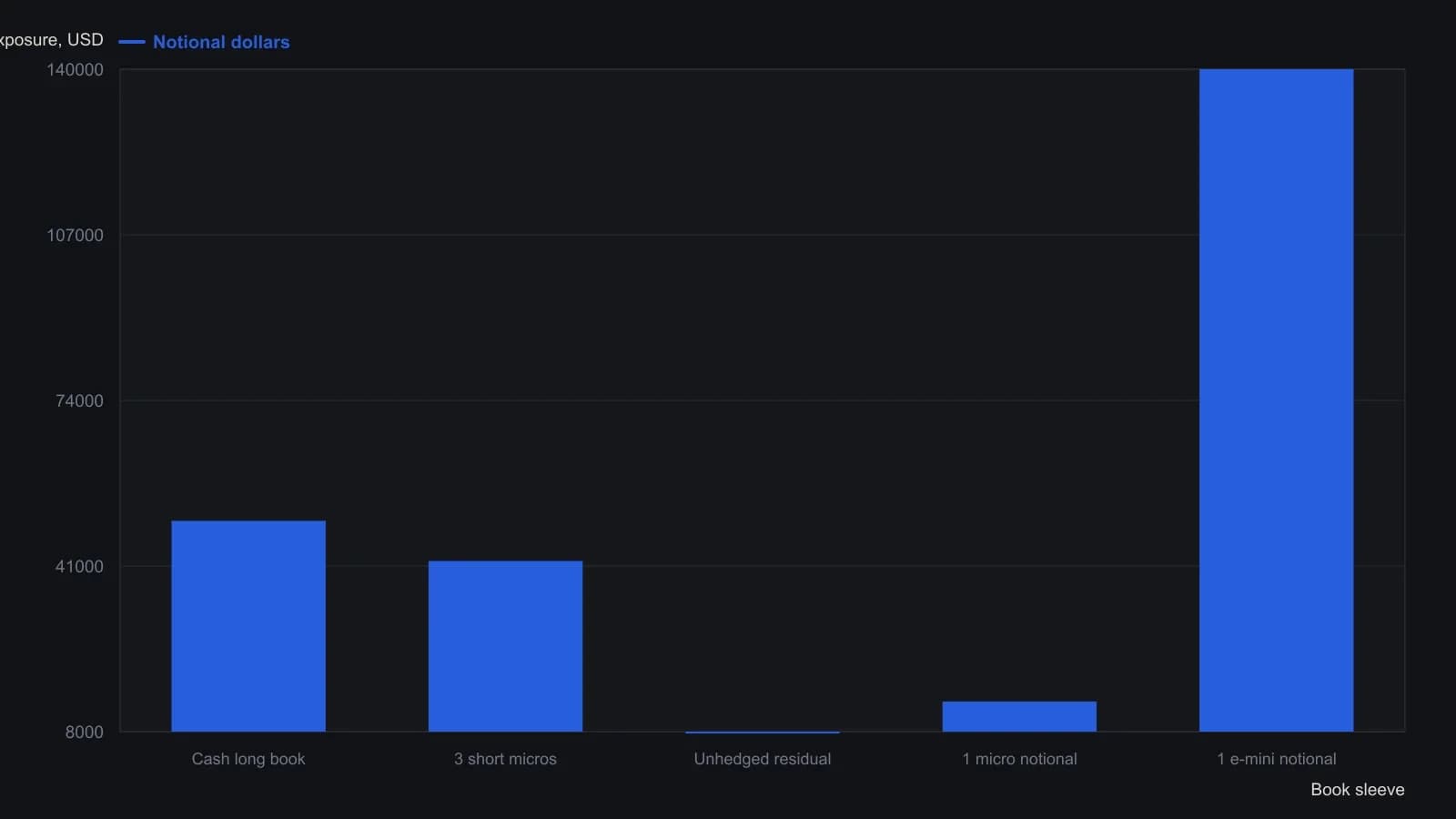
Notionals use the July 2019 example print of S&P 2,800 and the $5 micro multiplier. The $8,000 residual is the article’s own remainder ($50,000 minus $42,000). A full textbook offset is described as theoretical only.
Vary intensity instead of locking a full offset
A complete, permanent offset is treated as a textbook ideal rather than a practical constant, because a price hedge reduces volatility only by pairing a gain in one sleeve with a loss in the other.
Hedge intensity is described as a flexible-overlay that should vary with perceived market risk, with sharp-decline risk viewed as higher when prices are elevated.
Near-full hedges are framed as more coherent when the market is judged expensive than when it is judged historically cheap, with late 2018 cited as a cheap-market example in which a large overlay would have been less fitting.
Editorial reading: the leftover residual can be widened when the market looks cheap and tightened when it looks expensive. The archive describes intensity as flexible. It does not set a calendar for those changes.
All readings on this track · 13 readings
- 1989Rank rotation opens the names; pairing keeps the hedge
- 1991Evaluating allocation sleeves against an index proxy
- 1991Construct an equity book by weakening residual co-movement, then setting a market slope
- 1992Sizing index futures to retarget portfolio beta
- 1992Portfolio beta overlays with index futures and puts
- 1997Construct a trailing stop from beta and price
- 1998An offense-defense matrix for regime-aware stock selection
- 1998Constructing a stock-book duration proxy from beta and bond markets
- 2007An index put as deductible insurance for an active stock book
- 2010Constructing option overlays for beta-adjusted portfolios
- 2014Long-only relative value with an index hedge and a crisis stop
- 2017Hedging a rising book with beta and ATR
- 2019Sizing micro index futures overlays for cash equity books