2014issue C0527
Seasonal put spreads for index-linked portfolios
A historical column used a May-start seasonal window in two ways: as a protective-put overlay for long stock that moves with the broad market, and as a decline view that did not require shorting the cash index or its fund. Expiration was matched through October or November, then a 10% bear-put-spread made the cash outlay and leftover downside visible before the window opened.
- Listed S&P 500 fund puts were used as a protective-put overlay so several long holdings that move with the broad market could be covered if a pullback developed.
- Expiration-matching placed the last month between October and November so the hedge lasted through the May-to-November window, even though that longer life cost more than a shorter-dated put.
- A 10% protection-price-target set the short strike of a bear-put-spread, which lowered the cash spent on protection and capped how far the hedge would pay.
- If the market rose, the long portfolio could still gain, and the remaining cost was the amount paid for the hedge.
Two jobs in a May-start window
The column presented two option uses for a May-start seasonal window: hedge long stock that moves with the broad market, and express a decline view without shorting the cash index or its fund.
For several long holdings that correlate with the overall market, listed S&P 500 fund puts were treated as a way to cover most of those positions if a pullback developed. That overlay is a protective-put: a long put held against correlated long stock so a planned market drop has a bounded loss while upside in the holdings is retained minus the premium paid.
Match the last month to the window
When the hedge was meant to last through a May-to-November window, the suggested expiration sat between October and November, even though that longer life cost more than a shorter-dated put.
Expiration-matching is the step that selects the option's last month so coverage lasts through the planned seasonal window rather than a cheaper, shorter life.
Turn the expected drop into a spread width
A 10% expected drop was used as the protection-price-target: buy puts near the then-current market and sell the same number of puts about 10% lower to offset some of the hedge cost. The protection-price-target is the decline level used to place the short put, turning an expected drop into a finite spread width.
The result is a bear-put-spread, a debit put structure that buys a higher-strike put and sells a lower-strike put, lowering the cash spent on protection and capping how far that protection pays. As an option-spread, the paired long and short puts are one procedure so cost, payoff cap, and remaining risk can be checked together before entry.
What the worked case made visible
In the worked case, a portfolio marked at $185,480 was paired with a 180/170 put spread, ten contracts, booked at 28.10, or $2,810.
That 180/170 structure was described as remaining in force only until the fund reached 170, after which further downside was no longer covered by the spread. Replacing outright puts with a put spread was said to lower the cash spent on protection while also limiting how far the hedge would pay.
If the market rose instead, the long portfolio could still gain and the remaining cost was the amount paid for the hedge.
Expiration payoff of the 180/170 SPY put overlay
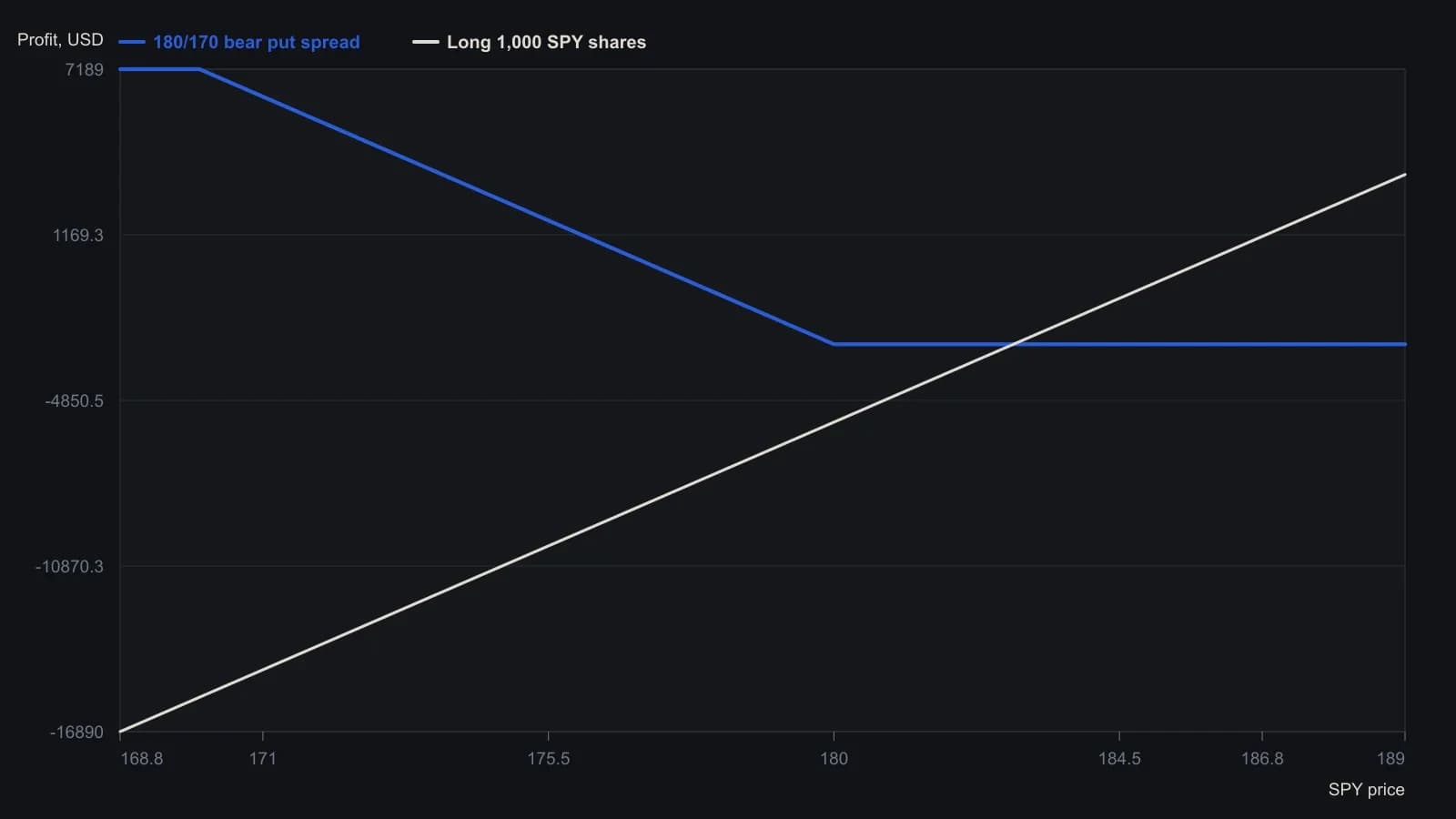
Expiration value of the 10-contract October 2014 180/170 SPY bear put spread on the platform ticket. The long series is the matching 1,000-share SPY book marked at 185.64; the column’s $185,480 portfolio value is that same notional.
All readings on this track · 15 readings
- 1988Two-sided cheap premium, volatility, and protective puts
- 2000Compare a Protective put and a Stop-loss order before entry
- 2007Sizing options by assignment, spread legs, and portfolio margin
- 2007Fund a put-hedged long by remaining package loss
- 2008Protective put sizing under broker insolvency
- 2008Seasonal regimes, index put overlays, and call-spread mechanics
- 2008Stops, protective puts, and financed spread risk
- 2008Three loss bounds: debit spreads, stops, and protective puts
- 2014Seasonal put spreads for index-linked portfolios
- 2017Option construction after a post-listing drawdown
- 2017A stop-loss is an execution request, not a loss ceiling
- 2018Objective-first construction of hedges and income
- 2018A protective put as a prepaid loss budget
- 2020When a futures gap-open voids stop-loss protection
- 2020Protective put loss budget by strike and tenor