2000issue C111-4
Compare a Protective put and a Stop-loss order before entry
Treat the planned Stop-loss order and a matching Protective put as two loss envelopes for the same setup. Check stop distance against current movement before the trade is placed, then decide again after the first favorable move whether to keep the option or convert the bound into a trailed stop.
- After a long or short is filled, a Stop-loss order sits at a swing extreme, a recent high or low, or the lowest low or highest high of a chosen lookback so a wrong read can force an exit.
- Stop distance has to be checked against current movement before the trade is placed, because a fixed money stop of 500 dollars can sit too close once volatility expands.
- A Protective put or call bought at or near entry can be compared with the planned stop-loss amount, then sold if price later allows the futures stop to be raised to breakeven and trailed.
- The pairing is limited to liquid options with nearby strikes that track the underlying, and a straight futures Stop-loss order can still be the tighter bound.
Place the stop, then check the distance
After a long or short is filled, a Stop-loss order is placed at a swing extreme, a recent high or low, or the lowest low or highest high of a chosen lookback so a wrong read can force an exit.
A fixed money stop of 500 dollars can sit too close once volatility expands, so stop distance has to be checked against current movement before the trade is placed.
Compare the Protective put with the planned stop
A Protective put or call bought at or near the entry can be compared with the planned stop-loss amount. In the worked long at 70.00 with a stop at 65.00, that stop equaled five points or 500 dollars, so a 70 put costing less than 500 dollars would set a smaller prepaid loss bound.
Decide again after the first favorable move
Once price has moved far enough to raise the futures Stop-loss order to breakeven, the protective option can be sold and the stop trailed under the advance. If price fails first, the futures loss is offset by the option gain.
Three historical pairings
On the December 31, 1999 British pound long, a sell-stop at the December 30 swing low of 1.6116 risked 0.84 ticks, while the 1.62 put cost 0.52 ticks. The long was filled at 1.6200, the close was 1.6394, and the 1.62 put was sold at a 0.38-tick loss, a smaller residual cost than the original 0.84-tick Stop-loss order.
For the January 6, 2000 S&P 500 inside-day long at the 1425.0 strike, a swing-low stop at 1387.00 risked 38 points and the matching put also cost 38.00. Unused premium could still be sold and coverage continued if price went through 1387.
A Treasury bond long was planned only after a five-day Stochastic oscillator positive divergence and a base near 89-16. The intended buy was 91-00, the swing-low stop was 89.5625, and the February 91-00 put cost 0.718. When that swing-low stop was hit, both the futures and the Protective put were exited together. The recorded combined loss was 27 ticks, versus an unhedged futures loss of 1.4375 points.
British pound stop-loss versus the matching 1.62 put
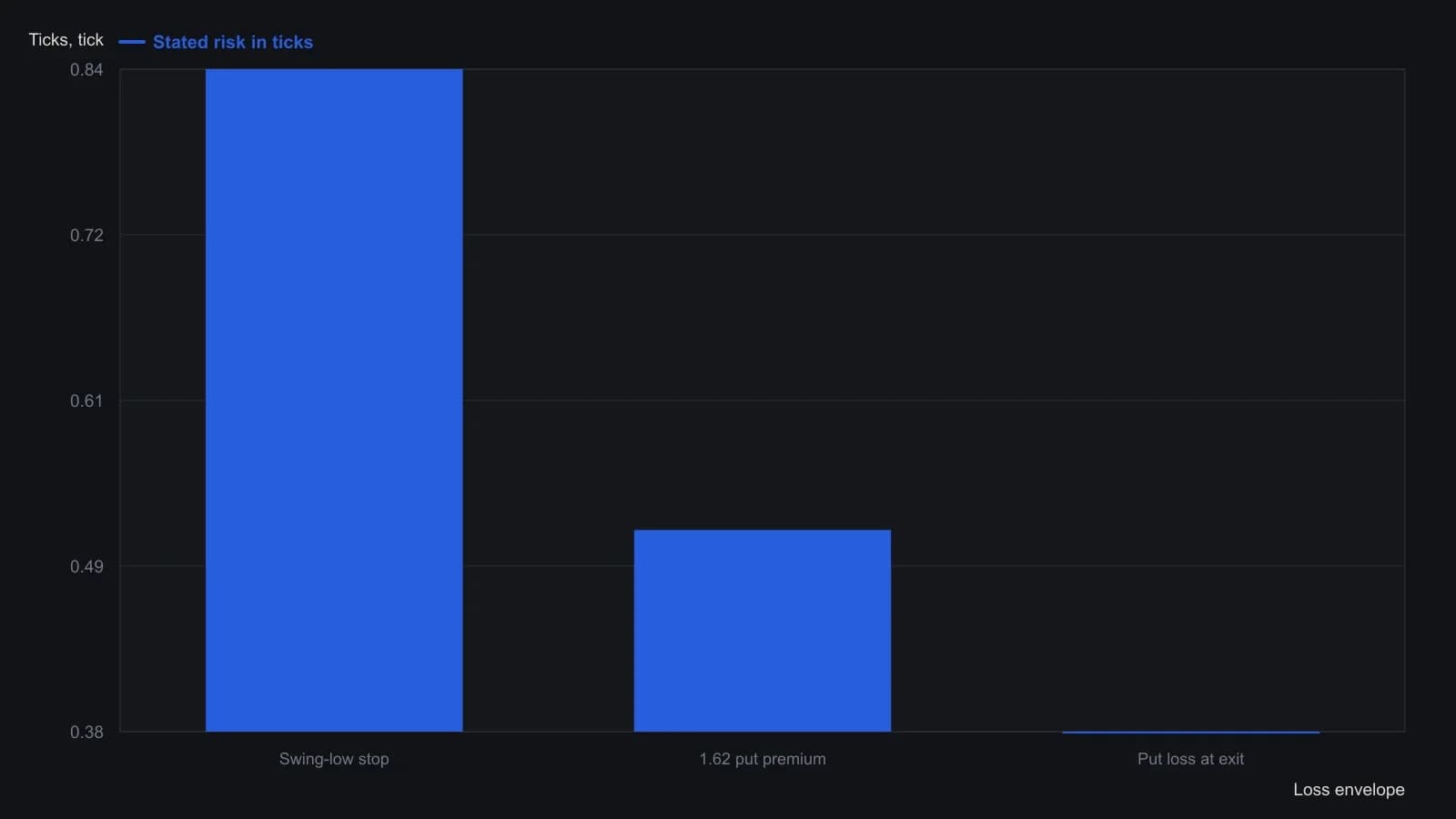
January options expired 7 January 2000. The setup was treated as a three- to five-day swing, so the short-dated 1.62 put still had time left.
When a straight stop stays tighter
The pairing is limited to liquid options with nearby strikes that track the underlying, and a straight futures Stop-loss order can still be the tighter bound after the two loss envelopes are compared.
All readings on this track · 15 readings
- 1988Two-sided cheap premium, volatility, and protective puts
- 2000Compare a Protective put and a Stop-loss order before entry
- 2007Sizing options by assignment, spread legs, and portfolio margin
- 2007Fund a put-hedged long by remaining package loss
- 2008Protective put sizing under broker insolvency
- 2008Seasonal regimes, index put overlays, and call-spread mechanics
- 2008Stops, protective puts, and financed spread risk
- 2008Three loss bounds: debit spreads, stops, and protective puts
- 2014Seasonal put spreads for index-linked portfolios
- 2017Option construction after a post-listing drawdown
- 2017A stop-loss is an execution request, not a loss ceiling
- 2018Objective-first construction of hedges and income
- 2018A protective put as a prepaid loss budget
- 2020When a futures gap-open voids stop-loss protection
- 2020Protective put loss budget by strike and tenor