2007issue C061-2
Fund a put-hedged long by remaining package loss
A same-strike protective-put and a long stock leave one remaining package loss. Separate-leg-margin added a half-price stock lock to the put debit, while combined-position-risk locked only that leftover loss.
- A margin-requirement withholds cash so a loss can be paid, and combined-position-risk sets that lock to remaining package loss rather than to isolated legs.
- Separate-leg-margin added a 22500 half-price stock lock to a 1000 put debit and implied as much as 46000 of isolated exposure, which overstated the packaged risk.
- A same-strike protective-put left the 1000 put outlay as the remaining decline loss, and combined-risk margin locked that 1000 instead of summing the two legs.
- Hedged-position-sizing sets share count and option cover by remaining package loss, but in 2007 combined-risk treatment had only limited pilot-availability above 100000 of account equity.
A long and a same-strike put share one remaining loss
A protective-put is a purchased put held against long stock. It grants the right to sell the shares at the strike and caps further downside. A long at 450 paired with a same-strike purchased put cancelled further share downside below that strike, leaving the 1000 put outlay as the remaining loss on a decline.
Hedged-position-sizing chooses share count and option cover so remaining package loss, not unhedged stock notional, sets how large the trade can be. The cash withheld against that package is a separate decision from the share count, and it can still treat the legs as if they were isolated.
What a margin-requirement withholds
A broker’s margin lock is cash taken up front so a loss can be paid. The margin-requirement is that withheld cash, held before entry and while the trade is open. A common stock-purchase lock was half the share price times the share count. A purchased put’s cash lock equaled its full debit.
One hundred shares bought at 450 therefore required a 22500 stock-margin lock under that half-price rule. A 10-priced contract covering one hundred shares required 1000.
Separate-leg-margin adds isolated locks
Separate-leg-margin is a funding rule that adds the stock down-payment to the full option debit even when one leg already bounds the other. Separate-leg funding added the 22500 stock lock to the 1000 put debit and produced a 23500 cash requirement for the package.
Treating the same legs as isolated implied 45000 of stock exposure plus the 1000 put debit, or 46000, which overstated the packaged risk. That isolated reading funds an unhedged stock down-payment and then adds the hedge on top.
Combined-position-risk locks the leftover loss
Combined-position-risk is the remaining maximum loss of a multi-leg package after offsets, used as the cash lock instead of summing isolated legs. Combined-risk margin therefore set the package cash lock to that remaining 1000 loss instead of summing the two isolated locks.
On a rise, the long stock still participates after the 1000 put outlay is recovered. That outlay remains the defined maximum loss of the package.
Cash locked on a same-strike put-hedged GOOG long
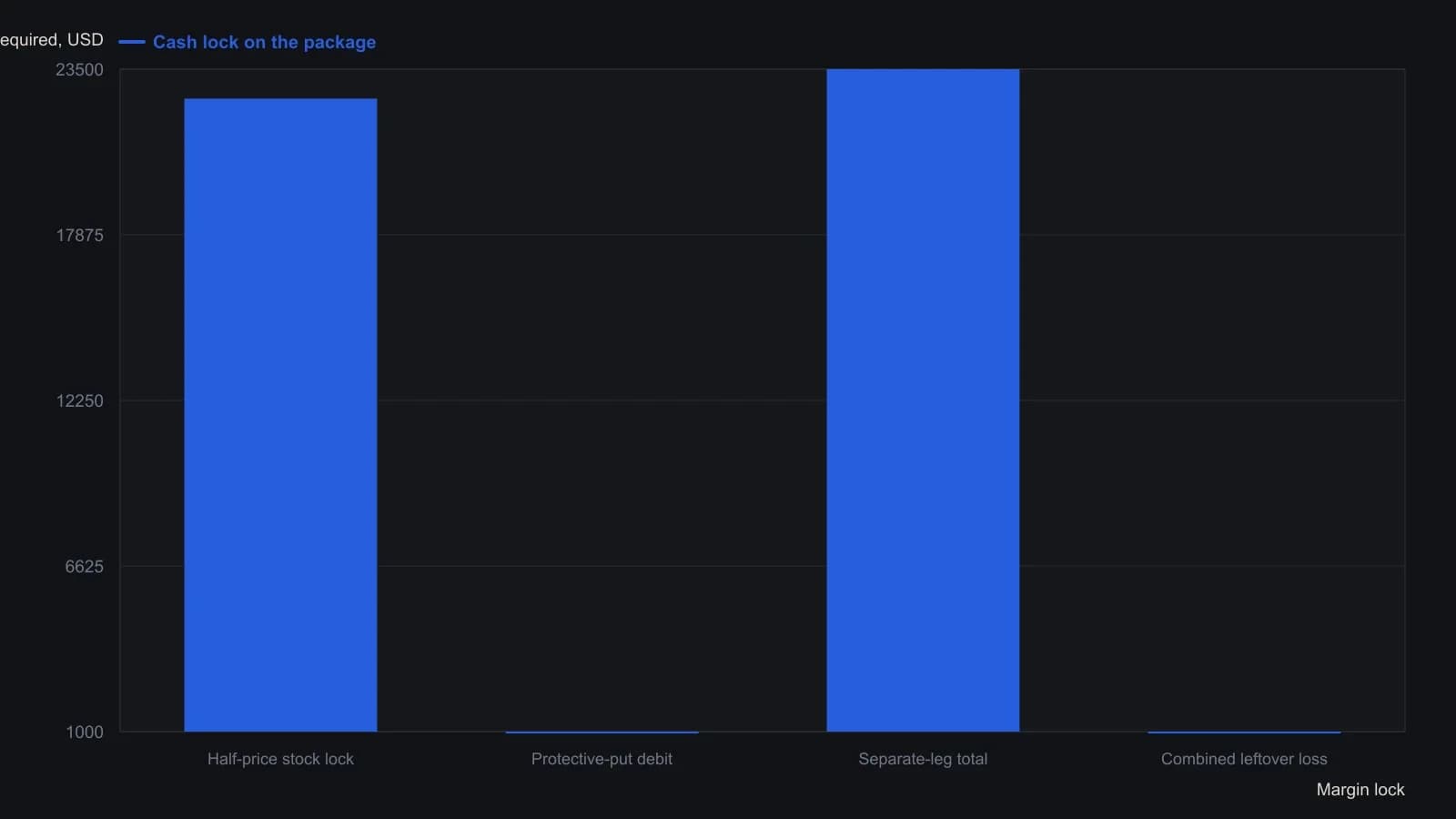
Example holds 100 shares at $450 and one 450-strike put at $10; the SEC permission is dated 2 April 2007.
Pilot-availability limited the combined lock
In 2007, retail brokers were permitted to base margin on combined position risk when one leg reduced another, but the treatment was still in a limited pilot and participating firms required 100000 of account equity. Pilot-availability was that limited rollout: only some brokers applied combined-risk treatment, and only above a stated account-equity threshold.
Where the combined lock was not applied, the cash withheld could still follow separate-leg-margin even though the protective-put had already bounded further share downside.
All readings on this track · 15 readings
- 1988Two-sided cheap premium, volatility, and protective puts
- 2000Compare a Protective put and a Stop-loss order before entry
- 2007Sizing options by assignment, spread legs, and portfolio margin
- 2007Fund a put-hedged long by remaining package loss
- 2008Protective put sizing under broker insolvency
- 2008Seasonal regimes, index put overlays, and call-spread mechanics
- 2008Stops, protective puts, and financed spread risk
- 2008Three loss bounds: debit spreads, stops, and protective puts
- 2014Seasonal put spreads for index-linked portfolios
- 2017Option construction after a post-listing drawdown
- 2017A stop-loss is an execution request, not a loss ceiling
- 2018Objective-first construction of hedges and income
- 2018A protective put as a prepaid loss budget
- 2020When a futures gap-open voids stop-loss protection
- 2020Protective put loss budget by strike and tenor