2020issue C0840-41
Protective put loss budget by strike and tenor
A married put can limit the illustrated loss on owned shares while the put is in force, and the hedge premium reduces net upside by that same cash outlay. Design starts from how much downside to remove, how much upside to give up, and how long protection is needed. Strike and tenor then follow those answers. A cheaper short-dated put can be compared with a longer-dated put only after roll cost is counted.
- A protective put, or married put, pairs owned shares with a purchased put so the loss on the combined position can be limited to a chosen amount while the put remains in force.
- Hedge design begins by stating how much downside to remove, how much upside to give up, and how long protection is needed. Those answers then select expiration month and strike.
- Repeating short-dated put purchases to keep protection in force can accumulate more premium than buying a longer-dated put at the outset.
- The source does not present one strike or tenor as universally best. The construction is the one that matches the stated risk, upside, and horizon objectives.
What a protective put does
A protective put, also called a married put, pairs owned shares with a purchased put so the loss on the combined position can be limited to a chosen amount for as long as the put remains in force. Once the put strike, premium, and share count are set, that largest illustrated loss is the loss cap.
The cash paid for the put is the hedge premium. That outlay reduces net upside on the paired position by the same amount, so the hedge is a trade-off between a bounded loss and lower profit potential. Combined breakeven is the stock price at which the share gain offsets the put premium on the paired position.
Set objectives before strike and tenor
Hedge design begins by stating how much downside to remove, how much upside to give up, and how long protection is needed. Those answers then select expiration month and strike. Tenor is the days remaining until the chosen put expires, and it sets how long one premium purchase covers.
The source does not present one strike or tenor as universally best. The construction is the one that matches the stated risk, upside, and horizon objectives.
Two strikes on the same 1,000 shares
In the 1,000-share XLF example bought at 26.24, each one-point move in the unhedged stock equals a 1,000 change in position value. With the same 1,000-share long, ten 26.5 puts at 49 days to expiration costing 1,390 limited illustrated downside to -1,130 and raised combined breakeven to 27.63. Ten 29-strike puts costing 3,150 limited illustrated downside to -390 and raised combined breakeven to 29.39.
Moneyness is whether the put strike sits at or above the current share price. That placement changes both the premium paid and the tightness of the loss cap. In this illustration the higher strike paid more hedge premium and produced a tighter loss cap.
Longer tenor versus a put that must be replaced
A third illustration buys ten 26-strike puts with 378 days to expiration for 3,200. That purchase can be compared with the cheaper 49-day put only after noting that the short-term put expires and must be replaced if the hedge is to continue.
Roll cost is the extra premium required if protection is extended by buying a new put after the first one expires. Repeating short-dated put purchases to keep protection in force can accumulate more premium than buying a longer-dated put at the outset.
XLF married-put expiration P/L at two 49-day strikes
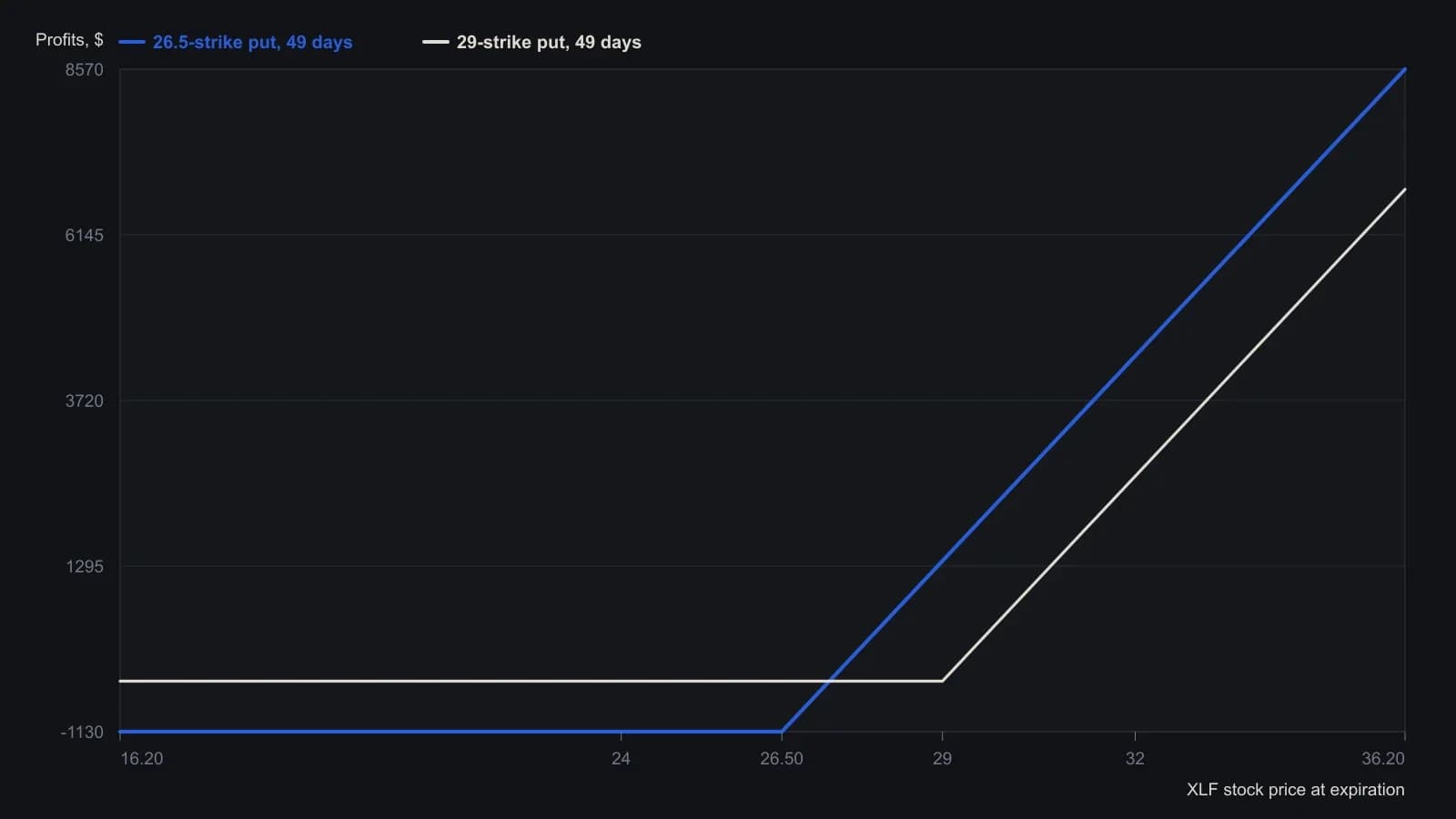
Both hedges are the article's ten-contract, 49-day puts (26.5s at $1.39 and 29s at $3.15). Payoffs are at those puts' expiration, which is the comparison drawn in Figure 2; the two strikes are an illustration, not a claim that they are optimal.
All readings on this track · 15 readings
- 1988Two-sided cheap premium, volatility, and protective puts
- 2000Compare a Protective put and a Stop-loss order before entry
- 2007Sizing options by assignment, spread legs, and portfolio margin
- 2007Fund a put-hedged long by remaining package loss
- 2008Protective put sizing under broker insolvency
- 2008Seasonal regimes, index put overlays, and call-spread mechanics
- 2008Stops, protective puts, and financed spread risk
- 2008Three loss bounds: debit spreads, stops, and protective puts
- 2014Seasonal put spreads for index-linked portfolios
- 2017Option construction after a post-listing drawdown
- 2017A stop-loss is an execution request, not a loss ceiling
- 2018Objective-first construction of hedges and income
- 2018A protective put as a prepaid loss budget
- 2020When a futures gap-open voids stop-loss protection
- 2020Protective put loss budget by strike and tenor