2017issue C0718-19
Option construction after a post-listing drawdown
A 2017 newly listed name traded near 30 on its second session, then fell below 19 within about two weeks. Archive overlays on the remaining stock include a one-for-one protective put, a cheaper put spread, a monthly covered call, and a ratio call spread. Editorial reading: treat the drawdown as a construction choice, not a reason to trust a cash-session stop or add another lot.
- A resting stock stop may not hold after the cash session, because a planned two-point exit fails if the name opens 5 dollars lower on an after-hours gap.
- A one-for-one protective put keeps upside open while bounding the remaining loss; a put spread is the lower-cost overlay when that put premium looks too large.
- An option income strategy sells one out-of-the-money call per 100 long shares on a monthly roll and collects premium whether the underlying rises, falls, or stands still.
- A ratio call spread can reset breakeven on the existing lot, while averaging down from 25 to 20 on a second 100-share lot raises capital at risk to 4,500 dollars.
The 2017 listing path
In the 2017 case, the newly listed name traded near 30 on its second session, then fell below 19 within about two weeks and later dropped more than 20 percent after its first public earnings report.
The remaining question in the archive workflow is how to rebuild the position on the shares already held. Editorial reading: treat that moment as a construction choice among a protective put, an option spread, and an option income strategy.
Floor the remaining loss with a protective put
A protective put is a long put sized one-for-one with long stock so a contractual sale price remains available if the underlying gaps.
The archive describes that overlay as keeping upside open while bounding the remaining loss. The worked figure prices a 23-strike put at 275 dollars against a 2,500-dollar stock lot and still allows a sale at 23 if the name later trades at 10.
A cheaper put spread when premium is large
When that put premium looks too large, a put spread is offered as a lower-cost way to keep downside protection on the long stock.
A put spread buys one put and sells another to cut premium while still limiting part of the downside. Editorial note: TradersWeek treats the put spread as an option spread, a multi-leg overlay used to change cost or risk without adding another stock lot.
July 23 SNAP put payoff at expiration
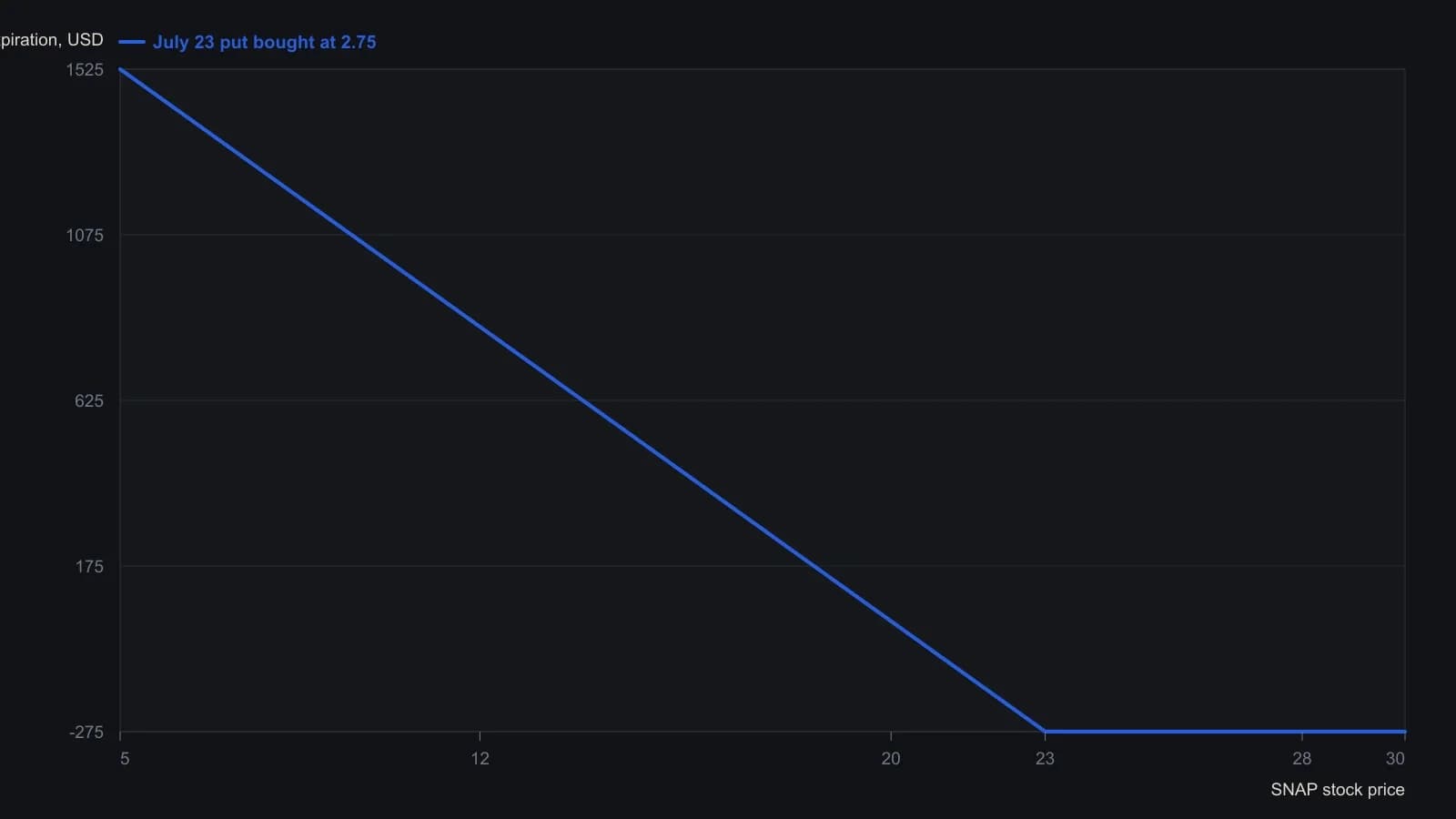
Expiration payoff only: 100 × max(23 − S, 0) − 275. The source plot also draws earlier-date risk lines (116d, 78d, 39d) that are not tabulated.
More shares raise capital at risk
Averaging down from 25 to 20 on a second 100-share lot raises capital at risk to 4,500 dollars. At 18 the first lot is still down 7 a share and the second is down 2.
Editorial note: the contrast is how much extra stock is at risk, not a verdict on which path wins.
A monthly covered call roll
An option income strategy is a repeating plan that sells premium against stock already owned. The archive construction sells one out-of-the-money call per 100 long shares on a monthly roll, collecting premium whether the underlying rises, falls, or stands still.
That short call is a covered call: a short call written against 100 shares already held, converting some upside into collected premium.
The worked income example uses a one-month call at 1.43, or 143 dollars before costs, against 100 shares bought at 25 for 2,500 dollars. Twelve identical months would total 1,716 dollars and leave a 784-dollar net outlay.
A ratio call spread to reset breakeven
A ratio call spread is a bull call spread plus one extra short call covered by existing stock, used to lower breakeven after a decline. Breakeven is the underlying price at which the combined stock-and-option construction returns to flat at expiration.
The archive overlay buys one 20-strike call and sells two 25-strike calls against the existing 100 shares. It is described as a bull call spread plus a covered extra short call, put on for about 14 dollars, with a July breakeven near 22.50 and a stated 250-dollar maximum if the name is at 25 or higher.
All readings on this track · 15 readings
- 1988Two-sided cheap premium, volatility, and protective puts
- 2000Compare a Protective put and a Stop-loss order before entry
- 2007Sizing options by assignment, spread legs, and portfolio margin
- 2007Fund a put-hedged long by remaining package loss
- 2008Protective put sizing under broker insolvency
- 2008Seasonal regimes, index put overlays, and call-spread mechanics
- 2008Stops, protective puts, and financed spread risk
- 2008Three loss bounds: debit spreads, stops, and protective puts
- 2014Seasonal put spreads for index-linked portfolios
- 2017Option construction after a post-listing drawdown
- 2017A stop-loss is an execution request, not a loss ceiling
- 2018Objective-first construction of hedges and income
- 2018A protective put as a prepaid loss budget
- 2020When a futures gap-open voids stop-loss protection
- 2020Protective put loss budget by strike and tenor