2006issue C111-5
Ruin odds, the Kelly fraction and optimal f as size filters
Protecting remaining equity comes first because a depleted account cannot continue. The next stake is converted into ruin odds, the Kelly and optimal-f fraction is treated as a ceiling, and a lower fraction is shown taking the same edge at a lower wipeout chance.
- Protecting remaining equity is the first system objective, because a depleted account cannot continue.
- Risk of ruin links the fraction of capital at risk to the chance of losing the entire stake; a 50 percent stake on a 10-unit bank still maps to a 44 percent chance of failure.
- For the illustrated two-to-one game, both the Kelly criterion and optimal f peak at 25 percent of capital and are used as an upper bound, not a target.
- Sitting at 15 percent instead of 25 percent is shown cutting illustrated profit from 18 units to 16 units while lowering ruin probability from 20 percent to 7 percent.
Protect remaining equity first
Protecting remaining equity is treated as the first system objective because a depleted account cannot continue. Seeking profit is framed as a secondary business objective.
Loss potential is named before entry. The capital at risk on the next trade, and the maximum drawdown that would force the system to be replaced, are decided in advance rather than left to chance.
Bound the next loss before entry
Two pre-trade controls bound loss: a position size that does not consume a large share of equity or margin, and a stop-loss whose dollar risk is only a small share of account value. The stop-loss is a pre-set exit that caps adverse move size so the dollar loss on one trade stays a small share of equity.
Convert the next stake into ruin odds
Risk of ruin is the chance that a chosen stake, relative to remaining equity, will exhaust the account after a losing streak. It is the link between the fraction of capital risked and the chance of losing the entire stake. With a 10-unit bank and 5 units risked, or 50 percent of capital, a favorable two-to-one game can still exhaust the bank after a short losing streak.
In the coin-toss illustration, ruin probability equals 1 divided by (1 plus expectancy) raised to the number of risk units. Expectancy is the average edge per trial used in the ruin and optimal-fraction formulas, and it is 0.5 in the even coin-toss case. The risk-unit count is starting capital divided by the amount risked on the next trial. A 50 percent stake maps to a 44 percent chance of failure.
Read the peak fraction as a ceiling
The illustrated optimal f, written as optimal risk percentage equal to expectancy divided by the risk-to-reward ratio, is 25 percent when expectancy is 0.5 and the payoff ratio is 2. That same fraction is the Kelly-criterion size for those inputs.
Optimal f is the risk percentage at which illustrated growth peaks for a given payoff. Larger fractions then cut profit and raise ruin odds. The Kelly criterion is a pre-trade equity fraction implied by expectancy and payoff, used as an upper bound on exposure rather than a size to chase.
That 25 percent fraction is shown producing 18 units of profit from 10 units of starting capital over 10 tosses, with a 20 percent ruin probability.
Ten-toss reward versus share of capital risked
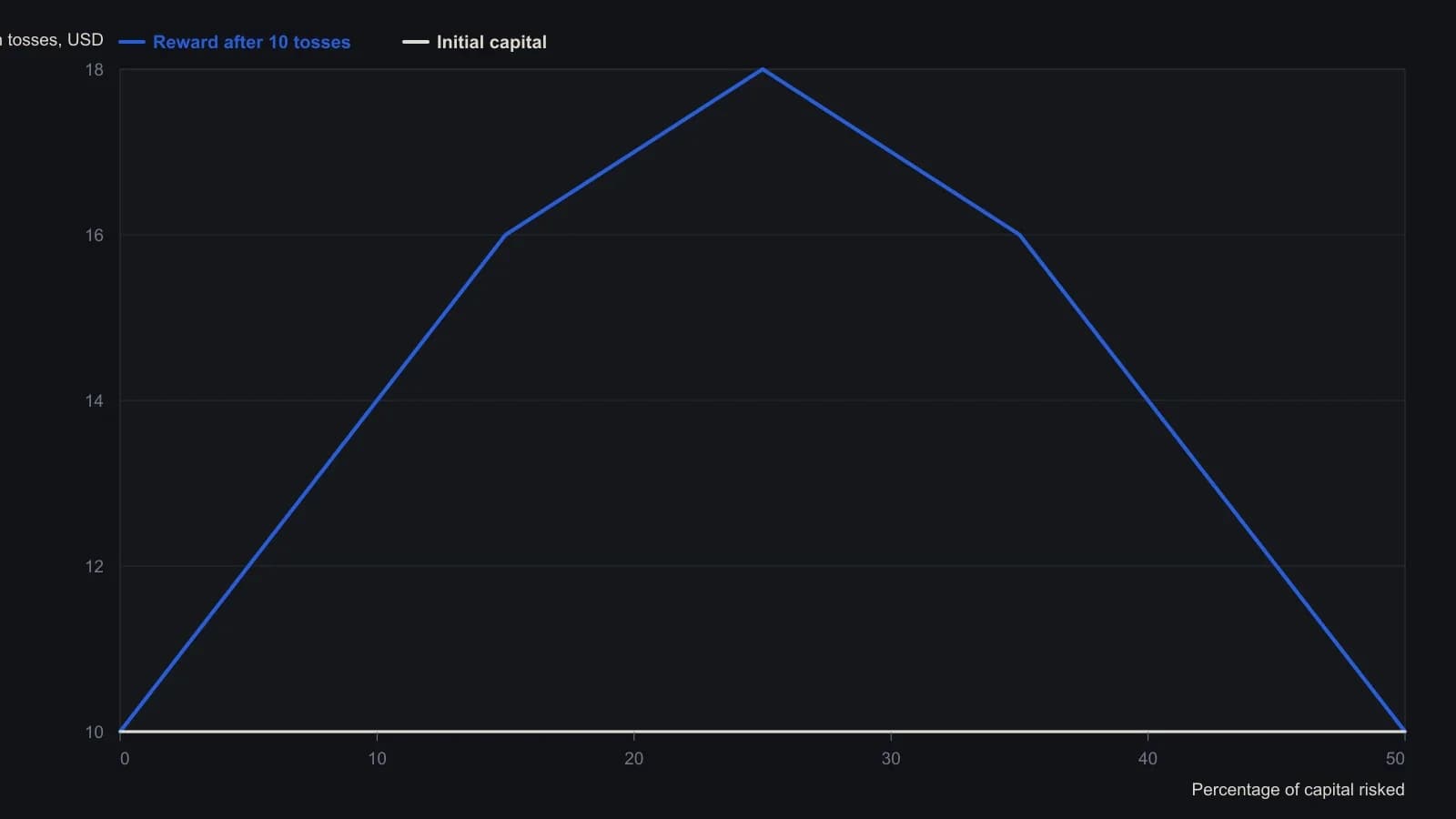
Even 50 percent win rate and each win pays twice the amount risked, starting from $10. Beyond about 50 percent the figure shows a solid $10 capital block rather than a declining tail, so that tail is not plotted.
Sit below the peak
Sitting below that peak, at 15 percent risk instead of 25 percent, is shown cutting illustrated profit to 16 units while lowering ruin probability to 7 percent. That is how the same edge can be taken at a lower wipeout chance.
A payoff edge is not enough on its own
Positive expectancy can exist when wins are larger than losses even if winning frequency is about 40 percent or lower. An even-money coin-toss stake reverts toward zero, while a two-to-one payoff on the same sequence is illustrated as about 500 currency units after 100 tosses.
A risk-to-reward ratio above 1.0 is necessary but not sufficient. That ratio is planned gain divided by planned loss on one trade. A planned ten-to-one payoff still loses if winning frequency is below 10 percent, and costs such as slippage and commissions shrink the gap between wins and losses.
Increase size only after gains exist
An anti-martingale stance increases size only after profits have already been earned, so added exposure is funded by gains rather than by the original stake.
All readings on this track · 12 readings
- 1990Constructing optimal f when trade sizes differ
- 1993Portfolio heat, optimal f, and drawdown limits
- 1994Construct historical-optimum-leverage from one equity-path
- 1995Optimal f as a leverage bound for commodity account growth
- 1998Secure f keeps Optimal f sizing inside a Drawdown limit
- 1998Optimal f contract counts versus equity fractions
- 1999Match futures starting capital to system risk
- 1999Search system inputs together with Optimal f sizing
- 2001Bounded crash risk with capital units and optimal f
- 2002Optimal f sizing and risk of ruin as exposure filters
- 2003Cap ruin and drawdown before optimal-f
- 2006Ruin odds, the Kelly fraction and optimal f as size filters