2004issue C071-3
A pretrade risk lockbox at Elliott ABC ends
This editorial reading treats Elliott wave labels as a lock-before-you-size ritual, not as a forecast that authorizes size. A trade exists only when a simple ABC correction has a frozen invalidation stop, the next impulse has a frozen target zone, and that pair clears a 2 to 1 risk-reward ratio.
- Cash risk is treated as known when entry is one tick beyond the latest bar and the invalidation stop is one tick beyond the correction extreme.
- Only a simple three-wave ABC correction is allowed, and candidate entries are limited to wave B into C, wave 2 into 3, and wave 4 into 5.
- A setup is entered only if the frozen impulse target zone versus the frozen invalidation stop meets a minimum risk-reward ratio of 2 to 1.
- The full pretrade exit map, including a first partial and a later remainder exit, is written before any order is placed.
The wave count is a scaffold
In this editorial reading, an Elliott wave count does not authorize position size. The five-wave map is only a scaffold that shows where a new impulse may begin and where its target zone can be fixed in advance.
The historical workflow specified a completed Elliott sequence as three impulsive trend waves joined by two corrective waves.
Only three correction endings are candidates
Candidate entries were limited to three correction endings: wave B into impulsive C, wave 2 into impulsive 3, and wave 4 into final impulsive 5.
Only a simple three-wave ABC correction was allowed. Complex corrections were excluded as a source of confusion.
Nine named Elliott degrees, from grand supercycle to subminuette, were treated as avoidable complexity. A present simple ABC did not need to be nested inside a larger degree.
Wave C is marked with fixed ratio bands
Wave C completion zones were fixed by measuring C as 0.618, 1.000, or 1.618 times wave A and as 1.272, 1.618, or 2.618 times wave B. Those Fibonacci wave multiples produced minimum, typical, and maximum bands.
A live reversal cue was required before the correction was treated as complete. The allowed cues were strong reversal action, an oscillator turn, an inside day, or a candlestick reversal.
Probability risk is the remaining uncertainty that the correction has actually ended. The historical workflow reduced that uncertainty by requiring the simple ABC shape, a ratio completion zone, and the live reversal cue.
Both locks are frozen before size is considered
Cash risk was treated as known when entry sat one tick beyond the latest bar and the invalidation stop sat one tick beyond the correction extreme. A print at that stop cancels the wave hypothesis and defines the money risk used for sizing.
The impulse target zone is a fixed price band for the next trend wave. It is calculated before entry and left unmoved once the position is live.
A setup was entered only if the frozen impulse target versus the frozen invalidation stop met a minimum risk-reward ratio of 2 to 1. Editorially, size is considered only after that filter clears.
Comerica ABC short with locked 58.42 stop
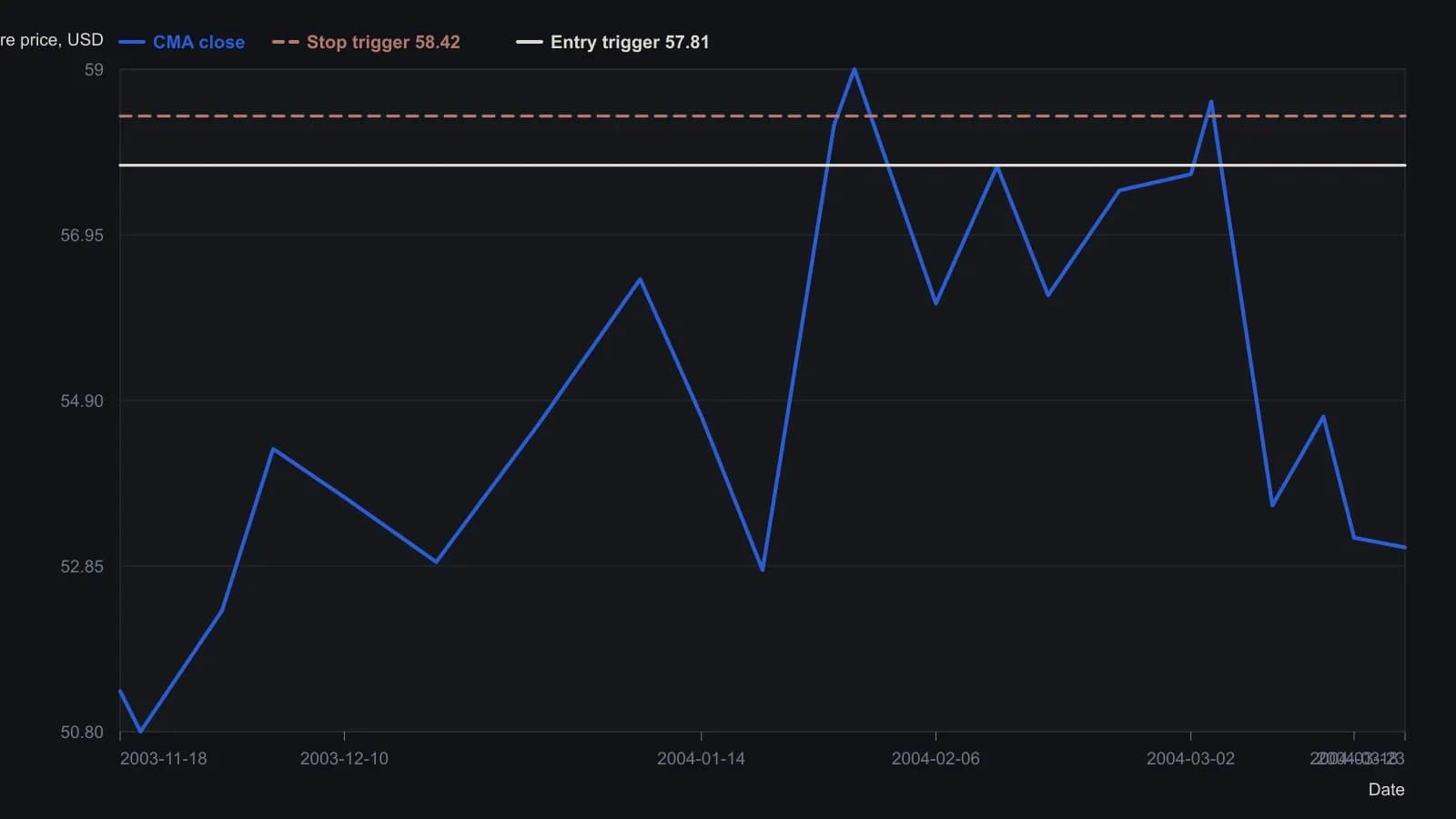
Beckwith allows only a simple ABC, with wave C at 0.618×, 1.000× or 1.618× of A, or 1.272×, 1.618× or 2.618× of B. Bars after 23 March 2004 are blank forecast space. Closes are approximate to 0.1 from the daily pane; 57.81 and 58.42 are printed triggers.
The exit map is written before the order
The entire exit-stop plan, the pretrade exit map, was written before any order was placed. It included a partial scale-out at the first reward zone and removal of the remainder at a second zone.
If price closed beyond the first reward zone, the remaining stop could be advanced into that first zone to protect leftover size.
All readings on this track · 18 readings
- 1986Copper wave degree and channel objectives
- 1987Constructing a price-time Fibonacci window for the ABC correction
- 1989Building entry and exit rules from pivots, channels, and abc-corrections
- 1989Constructing ABC Fibonacci expansion objectives
- 1990Calendar windows for three-wave pullbacks
- 1990Labeling wave 1, B, or X after a five-wave C
- 1991Constructing an Elliott zigzag with ABC Fibonacci checkpoints
- 2002Constructing Elliott wave ABC and triangle pattern counts
- 2003A bear-market bounce as a second wave, an RSI nonconfirmation, and an ABC relabel
- 2004A pretrade risk lockbox at Elliott ABC ends
- 2005Three-check identification of an ABC pause in an uptrend
- 2005The 61.8 percent Fibonacci line as a zigzag kill-switch
- 2005Constructing volume-float channels for ABC corrections
- 2008When monthly wave counts split, freeze the ABC and Fibonacci brackets
- 2012Fiery bull construction from sector thrust to wave count
- 2013Critiquing rigid Elliott wave ratios after computerized trading
- 2018V-wave count construction from impulse and ABC corrections
- 2018Constructing short hypotheses from completed ABC corrections