1990issue C051-3
Moving-average direction, range penetration, and a dollar stop
This construction stays long or short by comparing today's n-period simple moving average of closes with yesterday's average. A slope change becomes a position only if the next session penetrates that day's range by one point, and a stated dollar liquidation can exit the trade before the next close-based reverse.
- The position side follows only whether the simple moving average of closes rose or fell from the prior day's average.
- After that close-based slope signal, the next session enters only on a one-point buy stop above the high or sell stop below the low.
- A liquidation stop sized to a stated dollar loss, illustrated at 1,500, can close the trade; the average comparison is then rechecked for the next entry.
- Next-day range penetration is specified to block reversals when the average turns briefly but price never breaks the prior day's range.
Continuous positioning from the average
The construction stays continuously positioned by comparing today's n-period simple moving average of closes with yesterday's average. It signals a sell from long when the average falls and a buy from short when the average rises.
A 30-day simple moving average is the sum of the most recent 30 closes divided by 30. It is recomputed each day on that rolling window only. Here the average is used only to detect whether it rose or fell from the prior calculation.
Confirming the turn with range penetration
After the close-based slope signal, the next session enters only on a one-point penetration of that day's range. The order is a buy stop one point above the high or a sell stop one point below the low.
That range-penetration rule is specified to block reversals when the average turns briefly but price never breaks the prior day's range. The position flips only if price confirms.
A dollar stop as the intra-trade exit
A liquidation stop sized to a stated dollar loss, illustrated at 1,500, can exit the trade. After a stop-out, the moving-average comparison is rechecked to choose the next long or short entry.
That always-in-market procedure stays long or short except after a liquidation, then re-enters on the next valid confirmation. Because a reverse is evaluated only after the close, the dollar stop is the intra-trade exit. The archive describes that intra-trade exit as especially relevant in markets without daily limits.
Reading direction from two closes
Direction of a simple moving average can be read without recomputing the full average by comparing today's close with the close n days earlier. That earlier close is the observation dropping out of the window.
Recorded search bounds
The documented two-parameter search used moving-average lengths from 5 to 50 days and liquidation amounts from 500 to 2,000.
Moving Average Direction system: net profit and drawdown by market
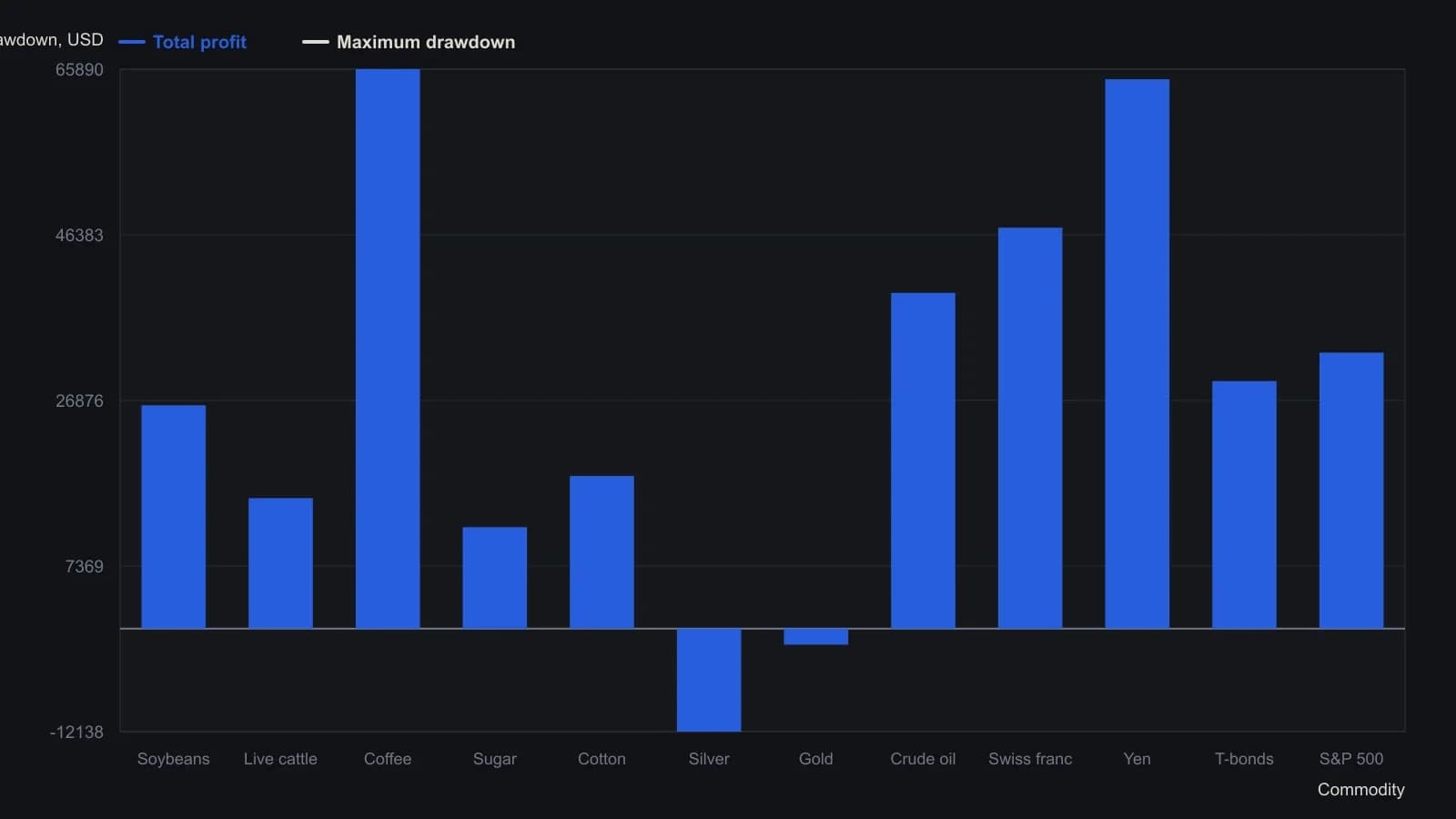
Each market uses the moving-average length and dollar liquidation stop Aan selected after searching 5–50 days and $500–$2,000. Results include $100 per trade for commissions and slippage.
All readings on this track · 14 readings
- 1990Moving-average direction, range penetration, and a dollar stop
- 1990Rally and reaction day signals as a mechanical stock system
- 1991Constructing steppable currency games with stop alerts
- 1995Trading as a business: a case study of preparation and rule-based entry
- 1997Bond timing rules as one testable procedure
- 2000Rule-based moving average commentary as a testable filter
- 2004Constructing a fifteen-bar trend trigger as a next-open system
- 2005State-locked rules for mechanical trading
- 2007Same-session long entry from a moving-average filter
- 2012Liquidity, share count, and stop-trigger costs
- 2012Monthly eight-bar average entry and exit rules
- 2012Constructing a simple moving average filter with fixed crossing rules
- 2014A two-average brick crossover is not yet a trading system
- 2020Reject long-bar entries driven by volatility fear of missing out