1985issue C041-5
Evaluating ARIMA envelopes as entry, exit and stop rules
A historical workflow converted separate high and low ARIMA forecasts into a probability envelope, then into explicit penetration, liquidation and stop rules. The evaluation that follows is a hindsight audit of whether those action prices can bound a procedure, not a check of how close the next expected print sat to the following observation.
- An ARIMA specification labels how many lagged prices, how many differences and how many lagged forecast errors enter the next-step forecast, and a level form can roll fitted coefficients forward after each new observation.
- Separate high and low forecasts plus a fifty-percent probability envelope were treated as action levels, including candidate stop placement for a trend-following procedure.
- Fully specified penetration-entry rules opened or reversed on a cross of an expected extreme or the outer band, either staying always in the market or using same-session liquidation, and day-trade versions were repeated with a one-point protective stop.
- The comparison was labeled complete hindsight, omitted commission, warned that simulated fills can misstate liquidity and was designed with knowledge of the sample.
The envelope as a complete procedure
Daily highs of an equity-index futures series were fitted as a stationary level model without differencing, even through a large advance, and a parallel coefficient set was produced for the lows. Separate high and low forecasts plus a fifty-percent probability envelope were meant to contain later price action a stated fraction of the time.
Editorially, that envelope is the object of evaluation only after it is written as a complete procedure. The next-step band has to become explicit rules for entry, exit and abstention. The question is whether those rules can bound action, not how close the point forecast sits to the next print.
What the three-integer label names
An ARIMA specification is a three-integer label for how many lagged prices enter the forecast, how many differences handle trend and how many lagged forecast errors are subtracted.
A level form of the model builds the next expected print from a constant, lagged actuals, lagged forecast errors and a current residual. Fitted coefficients can be rolled forward after each new observation.
High and low forecasts as a probability envelope
The fitted high model's mean error was reported inside a two-percent tolerance. A second recoding of the same equation stayed inside the fifty-percent band and usually within four ticks of the reference forecast, except on large breaks.
Forecast residuals were observed to lean with the short-run trend then underway. Envelope prices were proposed as action levels, including stop placement for a trend-following procedure.
Entry, exit and abstention rules
Several fully specified procedures opened or reversed on a cross of the expected extreme or the outer fifty-percent band. That penetration entry either stayed always in the market or used same-session liquidation and exited at that session's close. The rules included a four-tick buffer and a gap-open allowance.
A cross of an expected extreme or of the envelope was treated as added strength or weakness and as a candidate risk-control or short-horizon entry price. Those action prices rarely matched the session's actual high or low.
The same rules with a protective stop
The day-trade versions were repeated with a one-point protective stop on both sides. Editorially, the stop pass keeps the entry and exit rules identical and adds a pre-declared loss bound, so the audit can ask whether the same envelope still bounds action after a stop is imposed.
Limits of the hindsight audit
The comparison was labeled complete hindsight. It omitted commission and stated that simulated fills can misstate liquidity. The procedures were designed with knowledge of the sample.
Editorially, this is a hindsight audit: a same-sample walkthrough used to see whether action prices create testable opportunities, not a live trading record.
ARIMA envelope rules: captured S&P points versus travel left on the table
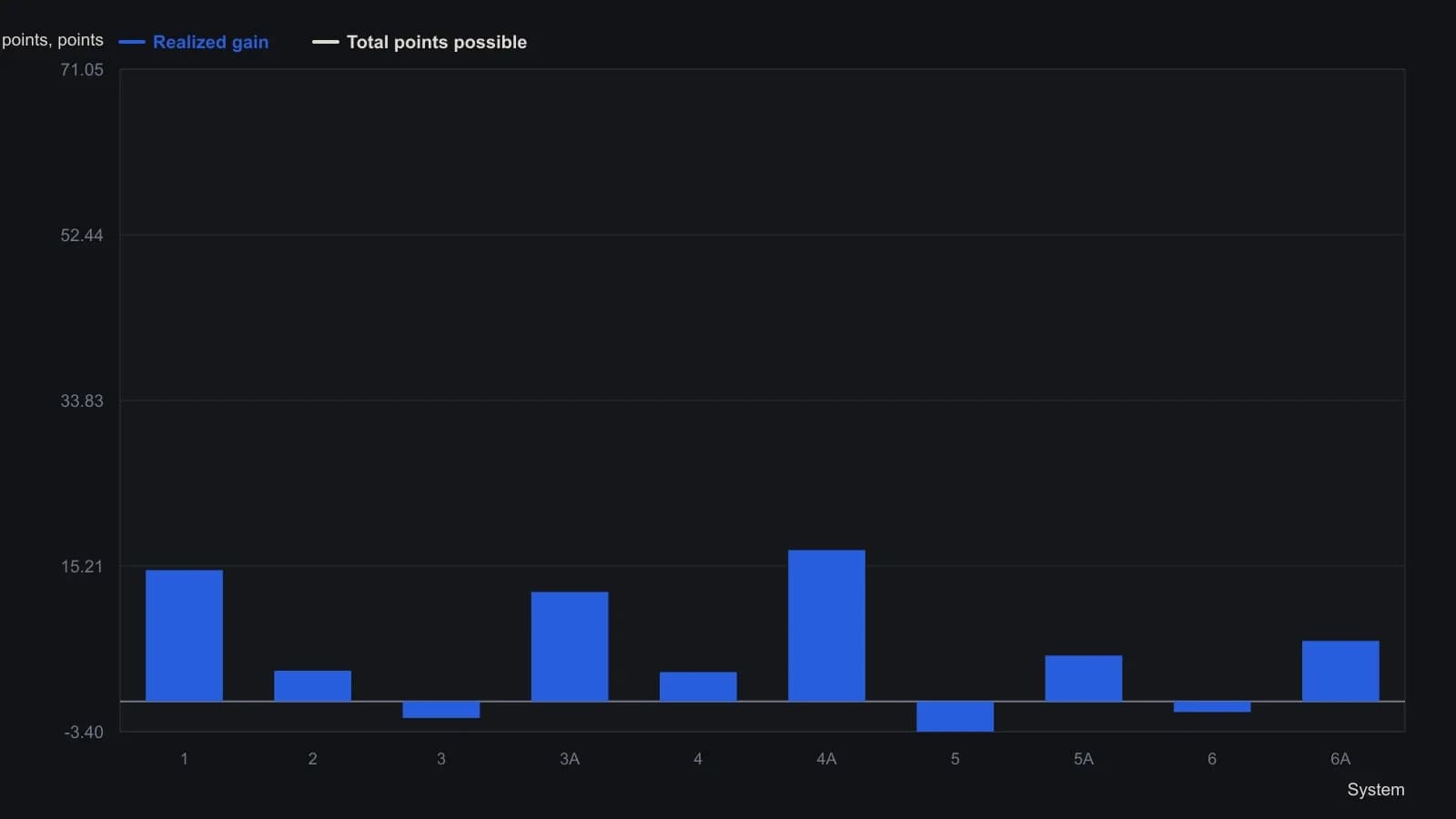
The source marks the test as full hindsight and does not deduct commissions. One index point equals $500. Systems 1 and 2 stay in the market with no stop; 3–6 exit on the close and the A variants add a 1.00-point stop on both sides.
All readings on this track · 6 readings
- 1982Construct ARIMA forecasts from lag diagnostics
- 1985Evaluating ARIMA envelopes as entry, exit and stop rules
- 1985Daily ARIMA range as a filter for intraday stochastic divergence
- 1990Constructing a short-horizon ARIMA from differenced wheat closes
- 2014ARIMA earnings forecasts versus the announcement-window price reaction
- What an early ARIMA commodity forecast teaches about model limits