1995issue C121-17
Trading as a business: a case study of preparation and rule-based entry
A trader case study puts mental preparation, discipline, and a business stance before technique. Entries were planned around seasonal windows and taken only when a chart pattern confirmed the timing, with a limited number of retries after a mistimed attempt.
- Early training in the case study emphasized mental preparation, discipline, and treating trading as a business before technique.
- Position entries were planned around seasonal windows and executed only when a chart pattern confirmed the timing.
- The described procedure allowed a limited number of retries after mistimed entries rather than abandoning a planned opportunity after one attempt.
- Editorial view: treat the workflow as one business procedure that prepares first, takes a Rule-based entry only on the rule, and keeps the exit bounded with a Stop-loss order before size increases.
Preparation before technique
The source presents a trader case study in which early training emphasized mental preparation, discipline, and treating trading as a business before technique.
The case study places the Trading psychology process before technique. Mental preparation, discipline, and a business stance came first.
A planned window and a confirming pattern
Position entries were planned around seasonal windows, then executed only when a chart pattern confirmed the timing.
Planning set the seasonal window. The chart pattern was the confirmation required before the Rule-based entry was taken.
Limited retries after a mistimed entry
The described procedure allowed a limited number of retries after mistimed entries rather than abandoning a planned opportunity after one attempt.
A mistimed try did not, by itself, cancel the planned window. The plan remained available only through that limited retry allowance.
December 1995 wheat, commercially driven uptrend
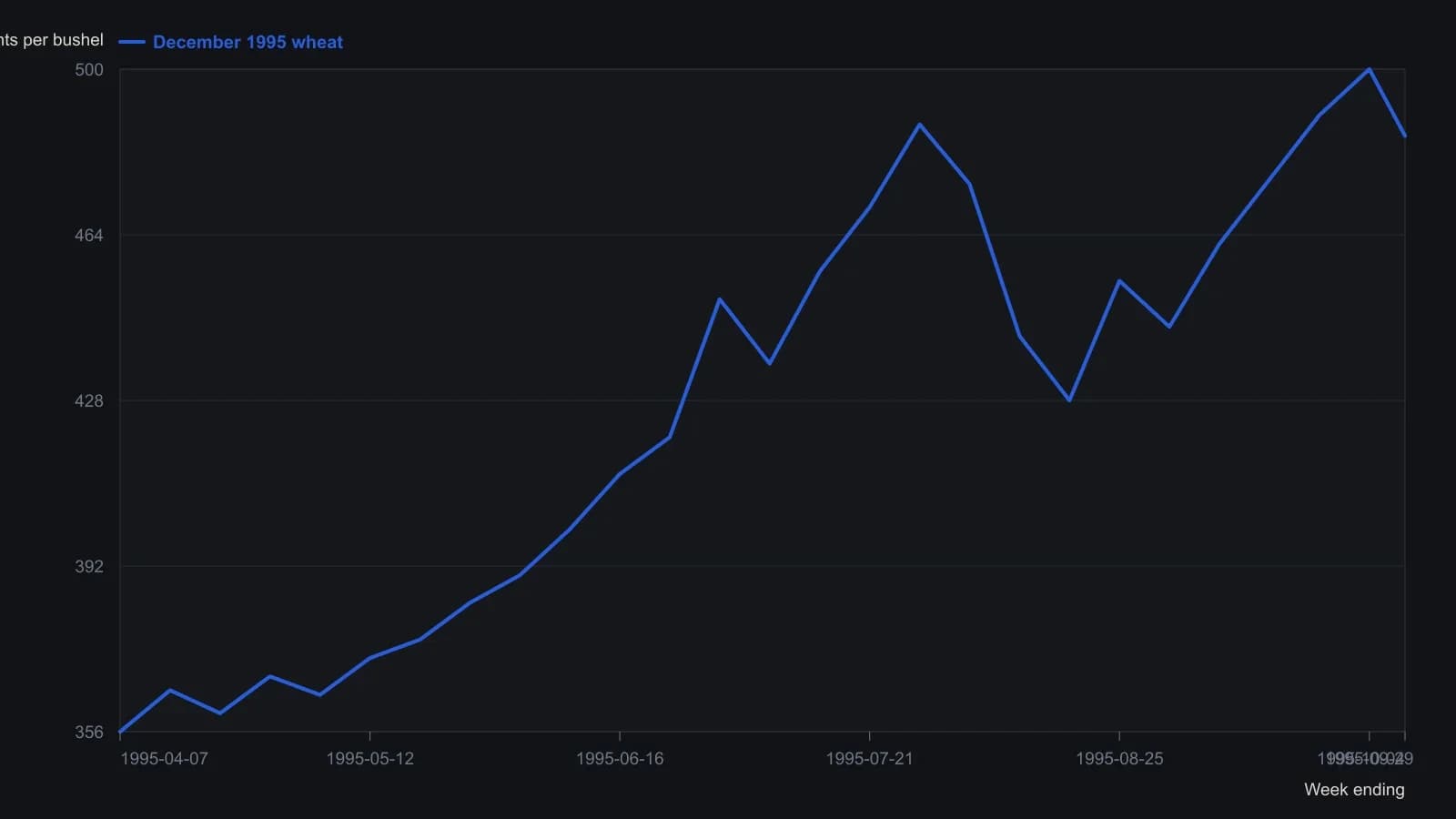
Digitized from daily OHLC bars at weekly intervals. Intraweek highs and lows are not carried over. Printed ticks are 7 cents apart, so weekly closes are approximate to a few cents except the final printed session.
All readings on this track · 14 readings
- 1990Moving-average direction, range penetration, and a dollar stop
- 1990Rally and reaction day signals as a mechanical stock system
- 1991Constructing steppable currency games with stop alerts
- 1995Trading as a business: a case study of preparation and rule-based entry
- 1997Bond timing rules as one testable procedure
- 2000Rule-based moving average commentary as a testable filter
- 2004Constructing a fifteen-bar trend trigger as a next-open system
- 2005State-locked rules for mechanical trading
- 2007Same-session long entry from a moving-average filter
- 2012Liquidity, share count, and stop-trigger costs
- 2012Monthly eight-bar average entry and exit rules
- 2012Constructing a simple moving average filter with fixed crossing rules
- 2014A two-average brick crossover is not yet a trading system
- 2020Reject long-bar entries driven by volatility fear of missing out