1990issue C121-8
Rally and reaction day signals as a mechanical stock system
A four-way high-low label does not place a trade. This archive article shows how rally, reaction, inside and outside days are chained with volume marks, a delayed pullback entry, abstention filters and a stop taken from the same objective so the whole workflow can be tested as one mechanical system.
- Each session is placed in one of four high-low classes by comparing that day's high and low with a comparison-day. The close is ignored, and inside days and outside days are skipped when a later session is classified.
- An up-signal is three successive rally days each marked plus on volume. A down-signal is three successive reaction days each posting larger volume than the last.
- Entry waits for a pullback-trigger and then for volume-confirmation. The signal is traded only if the trend-filter and the distance-filter both hold at entry.
- The half-objective-stop sits at half the point distance implied by the price-band-objective, so the protective stop is taken from the same rule as the target.
A label is not a trade
The archive workflow begins by placing each session in one of four high-low classes: rally, reaction, inside or outside. That class is a description of the day's range against a comparison-day. It is not, on its own, an entry or an exit.
Editorial: TradersWeek treats the rest of the workflow as construction. The labels become a mechanical trading system only after volume marks, a delayed pullback entry, abstention filters and a stop taken from the same objective are written as one procedure.
Four labels from highs and lows
Each session is placed in one of the four high-low classes using only that day's high and low versus a comparison-day high and low. The close is ignored.
A rally-day has a high that exceeds the comparison day's high and a low at least as high as the comparison day's low. A reaction-day has a high no higher than the comparison day's high and a low that undercuts the comparison day's low. An inside-day has a high no higher, and a low no lower, than the comparison day's range. An outside-day both exceeds the comparison day's high and undercuts the comparison day's low.
Inside days and outside days are skipped when a later session is classified. The comparison-day is the most recent prior session that is neither an inside-day nor an outside-day, so that later day's high and low are compared with the last session that was neither inside nor outside.
Volume marks and the two signals
A rally-day is given a plus volume-mark if its volume exceeds the volume of the last rally or reaction day, and a minus volume-mark if it does not. A reaction-day receives the opposite marks under the same volume comparison.
An up-signal requires three successive rally days, after inside days and outside days are skipped, each carrying a positive volume-mark. A down-signal requires three successive reaction days, after the same skip, each posting larger volume than the last.
Pullback and volume before entry
After a signal, entry does not occur on the signal day. The procedure waits for a pullback-trigger: a return to the high of the first rally-day in the three-day sequence after an up-signal, or a return to the low of the first reaction-day after a down-signal.
It then waits for volume-confirmation, meaning a later session whose volume exceeds the volume of the signal day. Only after both of those conditions are met does the workflow consider a trade.
Exxon 1990 price path around the July 13 up signal
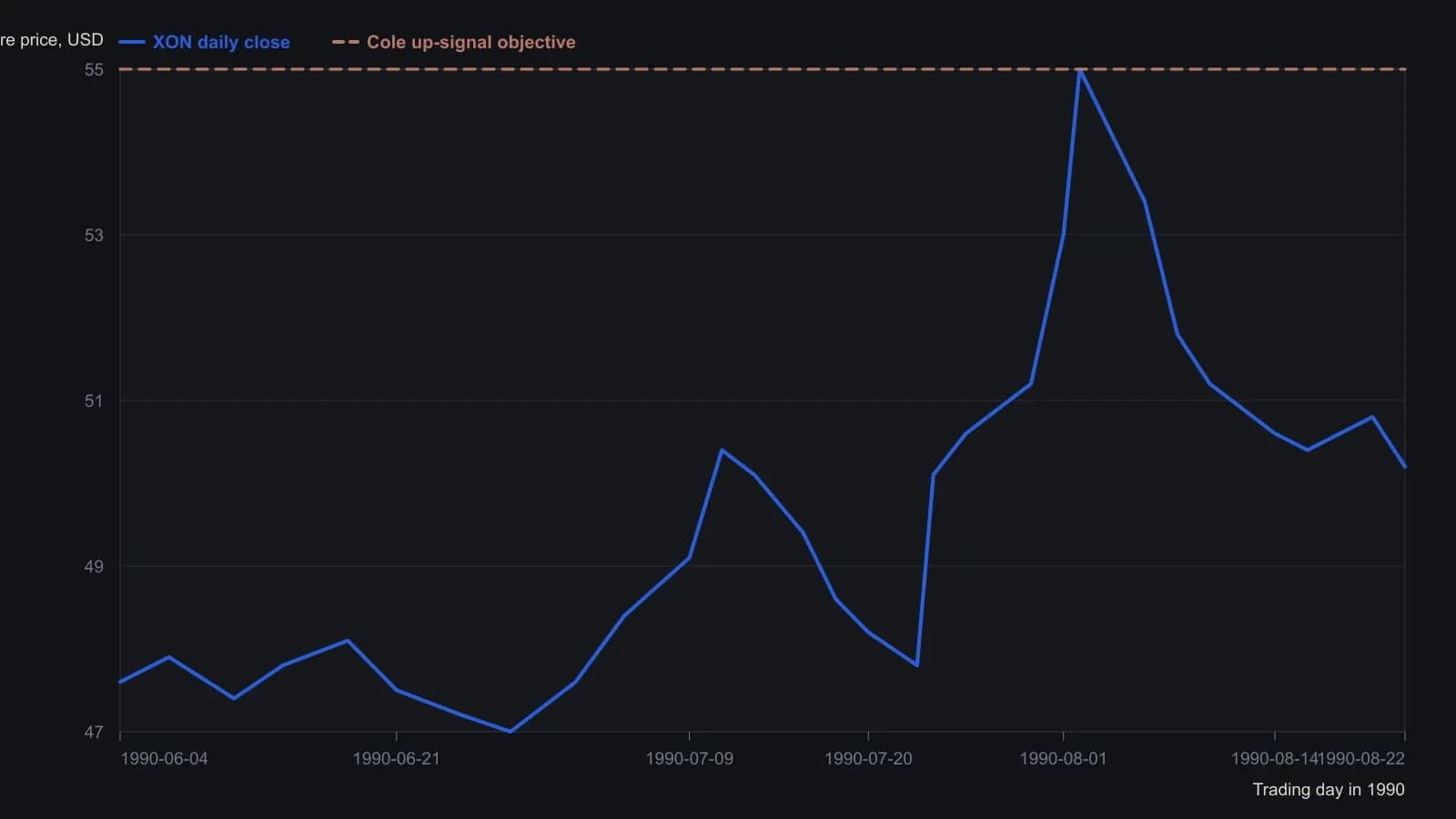
OHLC bars were reduced to one close per plotted session; prices are approximate to about a quarter-point because the raster is coarse. Volume of the signal day (2,109,800) and the July 23 pullback print (47 3/4) come from the article text, not from this price pane.
Filters, objective and stop
A signal is traded only if two abstention rules hold at entry. The trend-filter requires price above a 50-day moving average on an up-signal and below that average on a down-signal. The distance-filter withholds entry if the objective is more than 15 percent from approximate entry.
The price-band-objective adds two, five or ten points to the signal-day high on an up-signal, or subtracts the same amount from the signal-day low on a down-signal, according to whether the stock is priced 1-9, 10-99, or 100 and above. The half-objective-stop is placed at half the point distance implied by that objective.
Editorial: Taking the stop from the same objective keeps the exit bound inside the same mechanical procedure as the entry rules and the abstention filters. The archive states that chain as one workflow, not as a separate chart label plus a later discretionary trade.
All readings on this track · 14 readings
- 1990Moving-average direction, range penetration, and a dollar stop
- 1990Rally and reaction day signals as a mechanical stock system
- 1991Constructing steppable currency games with stop alerts
- 1995Trading as a business: a case study of preparation and rule-based entry
- 1997Bond timing rules as one testable procedure
- 2000Rule-based moving average commentary as a testable filter
- 2004Constructing a fifteen-bar trend trigger as a next-open system
- 2005State-locked rules for mechanical trading
- 2007Same-session long entry from a moving-average filter
- 2012Liquidity, share count, and stop-trigger costs
- 2012Monthly eight-bar average entry and exit rules
- 2012Constructing a simple moving average filter with fixed crossing rules
- 2014A two-average brick crossover is not yet a trading system
- 2020Reject long-bar entries driven by volatility fear of missing out