2013issue C0840-42
Hard stops and small bets to keep a portfolio alive
Account survival is framed as a pre-trade workflow: keep position-size small, place a hard stop-loss that is not moved against the trade, and use a break-even-stop or trailing-stop only to lock open profit the market has already given.
- Survival is framed as depending more on bounded loss, surviving losing streaks, and handling a position after entry than on finding a perfect entry method.
- Position-size stays a small share of equity: no more than 0.5% when taking about seven to 10 trades in a month, and no more than 1% when taking few trades.
- A hard stop-loss is required before entry, must not be violated or moved farther away, and should be neither so tight it exits early nor so wide it overexposes the account.
- A break-even-stop and a trailing-stop protect open profit that is already there; refusing a small, inevitable loss is described as letting that loss grow until exit is forced.
Survival depends on the loss, not the entry
The archive frames account survival as depending more on bounded loss, surviving losing streaks, and handling a position after entry than on finding a perfect entry method.
A positive-expectancy-system is a setup that aims for average winners larger than average losers, rather than a high win rate alone. The stated rule is to target more than the defined risk, with examples of risking 1 to seek at least 2 or 3, versus risking 5 to seek 1.
Keep position-size recoverable
Per-trade risk is capped at a small share of equity. That cap is no more than 0.5% when taking about seven to 10 trades in a month, and no more than 1% when taking few trades in a month.
Position-size is the fraction of account equity risked on one trade, kept small so a string of losers remains recoverable. A 10% bet on a 20,000-unit account is presented as an oversized stake that makes large losses hard to recover.
Place a hard stop-loss
A stop-loss is a hard, pre-placed exit that bounds loss or exposure before the trade is opened and is not moved against the position. Hard physical stops are required. They must not be violated or moved farther away, and they should be neither so tight they exit early nor so wide they overexpose the account.
On a four-hour EUR/NZD move of more than 2,500 pips from November 2011 to February 2012, refusing a hard stop of about 70 to 120 pips is used to show how an unbounded long can become a large loss. Refusing a small, inevitable loss is described as letting the market keep moving against the position until the loss becomes large enough that exit is forced.
EURNZD four-hour slide, December 2011–January 2012
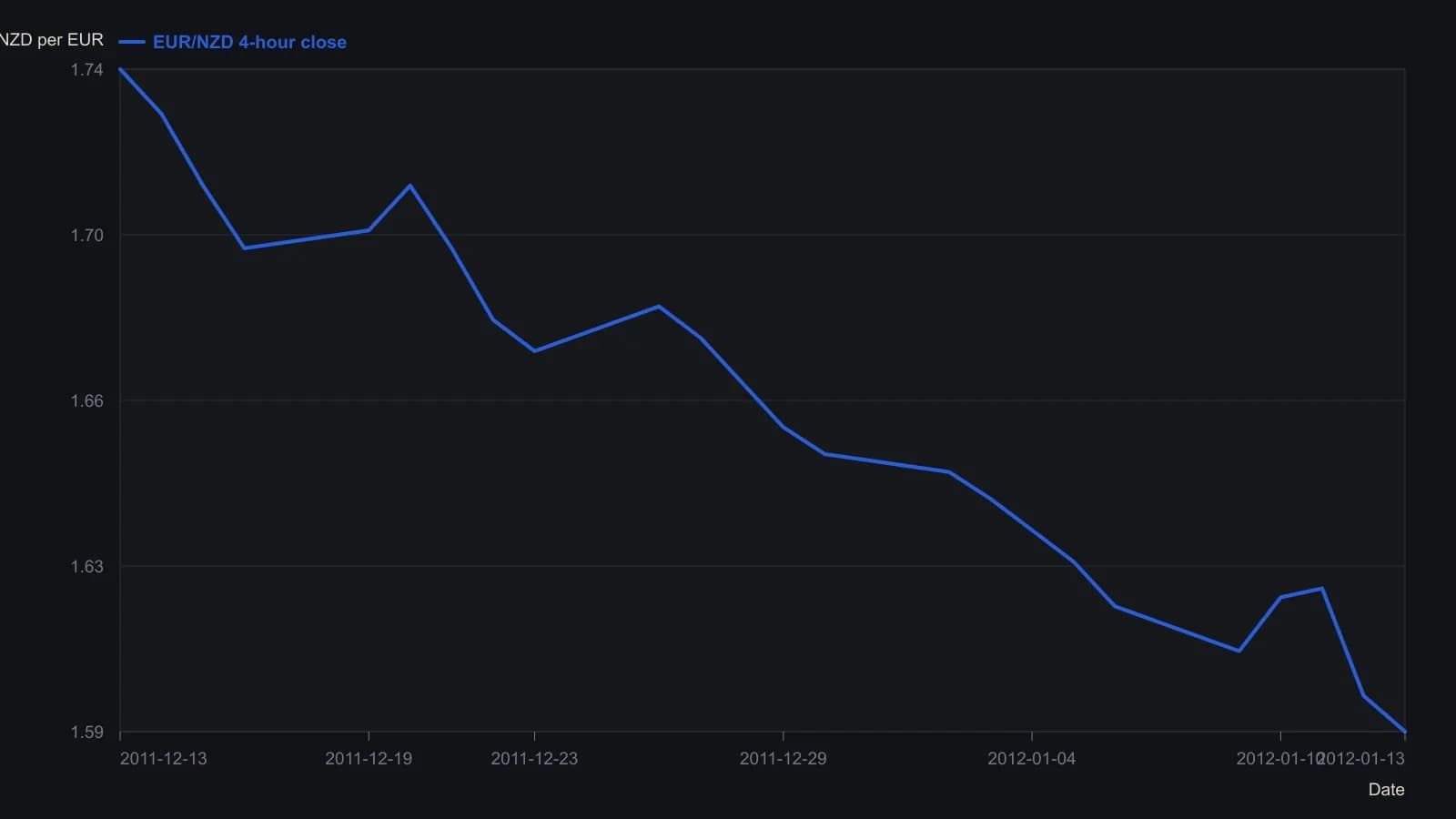
Closes estimated from the published four-hour candlesticks at roughly daily spacing; raster supports about 10-pip accuracy, not pip-exact prints. The source also states the broader November 2011–February 2012 drop exceeded 2,500 pips, which extends beyond this chart window.
Lock only open profit already there
A break-even-stop is an initial stop moved to the entry price so an open profit cannot become a net loss. That move is defined as a way to keep a decent open profit from turning into a loss.
A trailing-stop is a stop advanced in the trade's favor after open profit appears, used to keep some of that profit if price reverses. One example locks about 150 pips after a 300-pip open gain while the trade remains open.
Stand aside in two-sided ranges
Prolonged two-sided ranges, illustrated with EUR/CHF, are treated as markets to stand aside from because both sides can be stopped out without a usable trend.
All readings on this track · 9 readings
- 1986The stop, the size, and the acceptable loss as one pre-entry gate
- 1988Opening range breakout, stretch preference, and timed stops
- 2002Six-week reversal candles, next-week entry, and a break-even stop
- 2013Hard stops and small bets to keep a portfolio alive
- 2014Bounding losses with stops, leverage and break-even exits
- 2016Process-first swing trading and the break-even stop
- 2018Credit-spread risk budget beyond support
- 2019Break-even stops require a new invalidation
- 2020Momentum scale-in and midpoint break-even stops