2014issue C0732-35
Bounding losses with stops, leverage and break-even exits
A trade idea is not treated as strong enough to justify risking more than it can return. Historical retail currency trades often won at least half the time, yet still showed larger average losses than average wins, so stops, leverage limits and break-even exits were used to bound the cash at risk.
- A trade idea is not treated as strong enough to justify risking more than the amount that would be gained if the idea is correct.
- In a large historical sample of retail currency trades, most heavily traded pairs showed win rates at or above half, yet every pair still had a larger average loss than average win.
- Smaller accounts used much higher effective leverage, and higher leverage enlarges the tendency to hold a losing position and to exit a winning position too soon.
- Once a position is in profit, a break-even stop keeps a working trade from reversing into a cash loss and reduces the urge to exit the winner early.
Cap the cash at risk before entry
A stop-loss is a pre-placed exit that caps the planned cash loss at a chosen distance from entry. A trade idea is not treated as strong enough to justify risking more than the amount that would be gained if the idea is correct.
The risk-reward ratio is the planned loss if the stop is hit versus the planned gain if the target is reached. A minimum one-to-one ratio is implemented by placing a stop and a limit at least as large as the stop distance. One-to-two or one-to-three ratios lower the win rate needed for a net gain to about 30-40 percent.
Frequent wins did not offset larger losses
In a large historical sample of retail currency trades, most heavily traded pairs showed win rates at or above half, yet every pair still had a larger average loss than average win.
One pair combined a win rate near two out of three with an average loss of 122 pips against an average win of 52 pips, so frequent wins did not offset the larger average loss in that sample.
Keep leverage from erasing a run of wins
Leverage control is a limit on position notional relative to account equity so one or two adverse moves cannot wipe out many smaller gains. Effective leverage is position notional divided by account equity.
In the same historical sample, accounts of 0-999 used effective leverage around 26-to-1, while the 1,000-4,999 and 5,000-9,999 groups used about six-to-one and five-to-one.
Higher leverage enlarges swings in account equity and therefore enlarges the tendency to hold a losing position and to exit a winning position too soon. A leverage ratio above 10-to-1 is presented as an upper bound. The suggested sequence is to begin with position size no larger than equity and raise exposure only after consistent results at each step.
Move a winning stop to the entry
Once a position is in profit, moving the stop-loss to the original entry, a break-even stop, is used to keep a working trade from reversing into a cash loss and to reduce the urge to exit the winner early.
Average loss versus average profit by currency pair
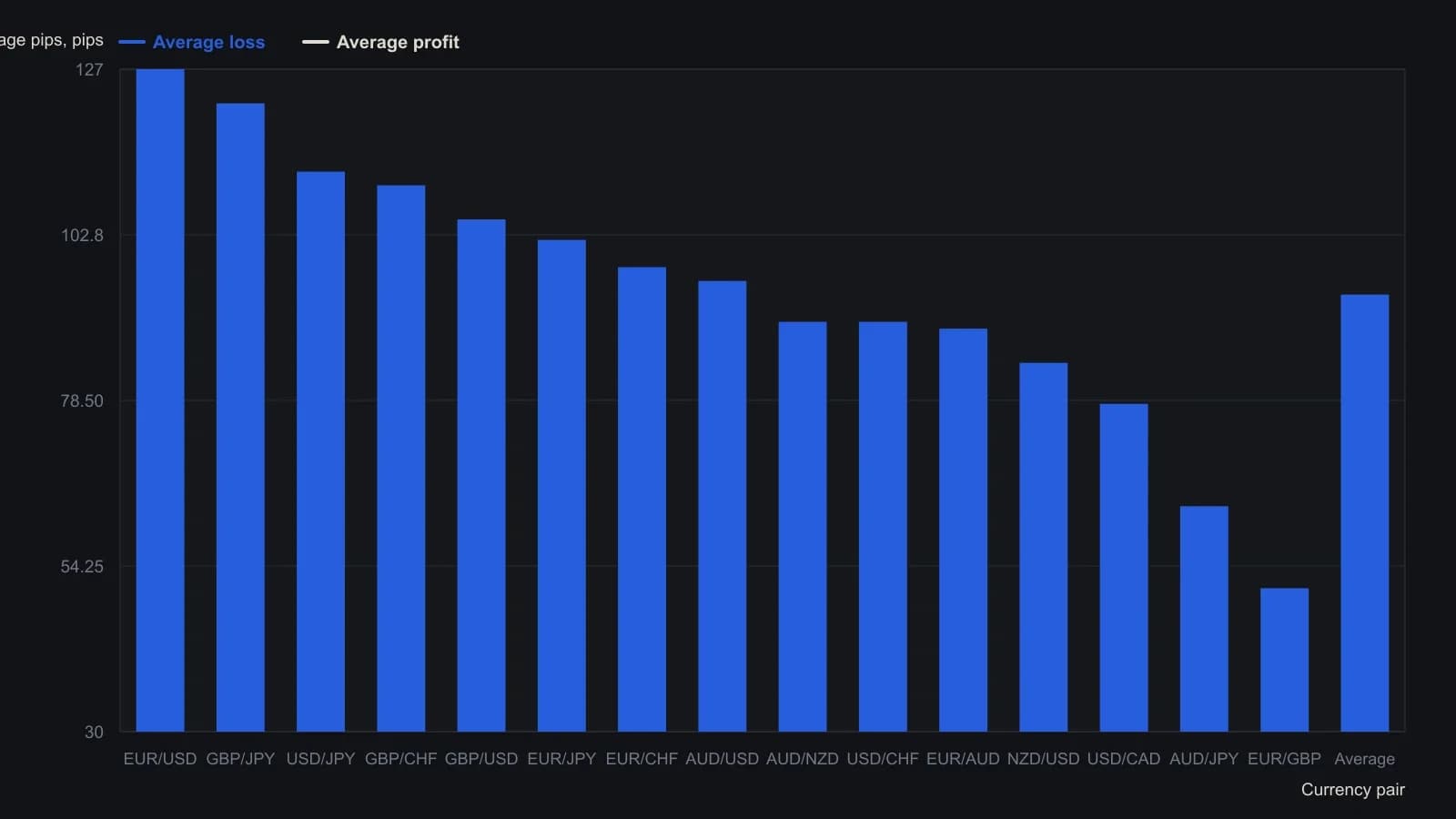
Values are the integer labels printed on each bar in the FXCM study chart, not estimates from bar height. Average is the cross-pair mean shown on the source graphic.
All readings on this track · 9 readings
- 1986The stop, the size, and the acceptable loss as one pre-entry gate
- 1988Opening range breakout, stretch preference, and timed stops
- 2002Six-week reversal candles, next-week entry, and a break-even stop
- 2013Hard stops and small bets to keep a portfolio alive
- 2014Bounding losses with stops, leverage and break-even exits
- 2016Process-first swing trading and the break-even stop
- 2018Credit-spread risk budget beyond support
- 2019Break-even stops require a new invalidation
- 2020Momentum scale-in and midpoint break-even stops