1996issue C011-5
Constructing volume-split and advance-decline breadth signals
Internals are assembled in order: confirm which extremes count, split which sessions update which running total, and smooth net advances. A breadth or volume-split hypothesis is the set of those construction choices.
- Peak-divergence and trough-divergence are scored only after swing highs or lows are confirmed by peak-strength, or by a zigzag-filter that keeps fewer extremes as its distance is raised.
- Both constructors compare range-normalized price extremes with a companion oscillator and carry the prior divergence-index reading forward if either local range is zero.
- Negative-volume-index and positive-volume-index accumulate the same daily percent price change on opposite volume conditions. On-balance-volume assigns volume by the direction of price change in that same family.
- Smoothed-advance-decline builds market-breadth as a seven-day average of advancing issues minus declining issues, then treats overbought and oversold zones as levels to measure.
Build internals as an assembly sequence
The archive workflow builds internals in a fixed order. First it confirms swing extremes and compares them with an oscillator. Next it splits daily percent price change by whether volume contracted or expanded versus the prior session. Last it can smooth advancing issues minus declining issues into one market-breadth series.
Confirm which extremes count
After a swing high is confirmed, the peak constructor compares the latest price-peak change, scaled by the high-low range of those peaks, with the matching oscillator-peak change scaled by its own range. That comparison is peak-divergence.
The trough constructor confirms swing lows and subtracts the normalized price-trough change from the normalized oscillator-trough change before applying the same scaling step. That comparison is trough-divergence.
Both constructors take a peak-strength count for how many bars must flank an extreme and an oscillator series as the comparison input. If either local range is zero, the prior reading is carried forward.
Replace bar-count strength with a zigzag-filter
A zigzag-filter that keeps only highs and lows separated by a minimum price or percent distance can replace bar-count peak-strength. Raising that distance retains fewer extremes.
Form a bounded divergence-index
Once the last two peaks and the range between them are identified on both price and the oscillator, the peak reading is fifty times the difference of those two normalized ratios. The divergence-index is described as ranging between -100 and 100.
Split which sessions update which running total
A negative-volume-index accumulates daily percent price change only on sessions when volume is lower than the prior session. A matching positive-volume-index accumulates the same percent price change only when volume is higher than the prior session.
A one-year average crossover is offered as one long-horizon reading rule for those volume-split series.
On-balance-volume is a signed-volume accumulation pattern in the same construction family as volume-split price totals, assigning volume according to the direction of price change.
DJIA with negative and positive volume-split indexes, April–October 1995
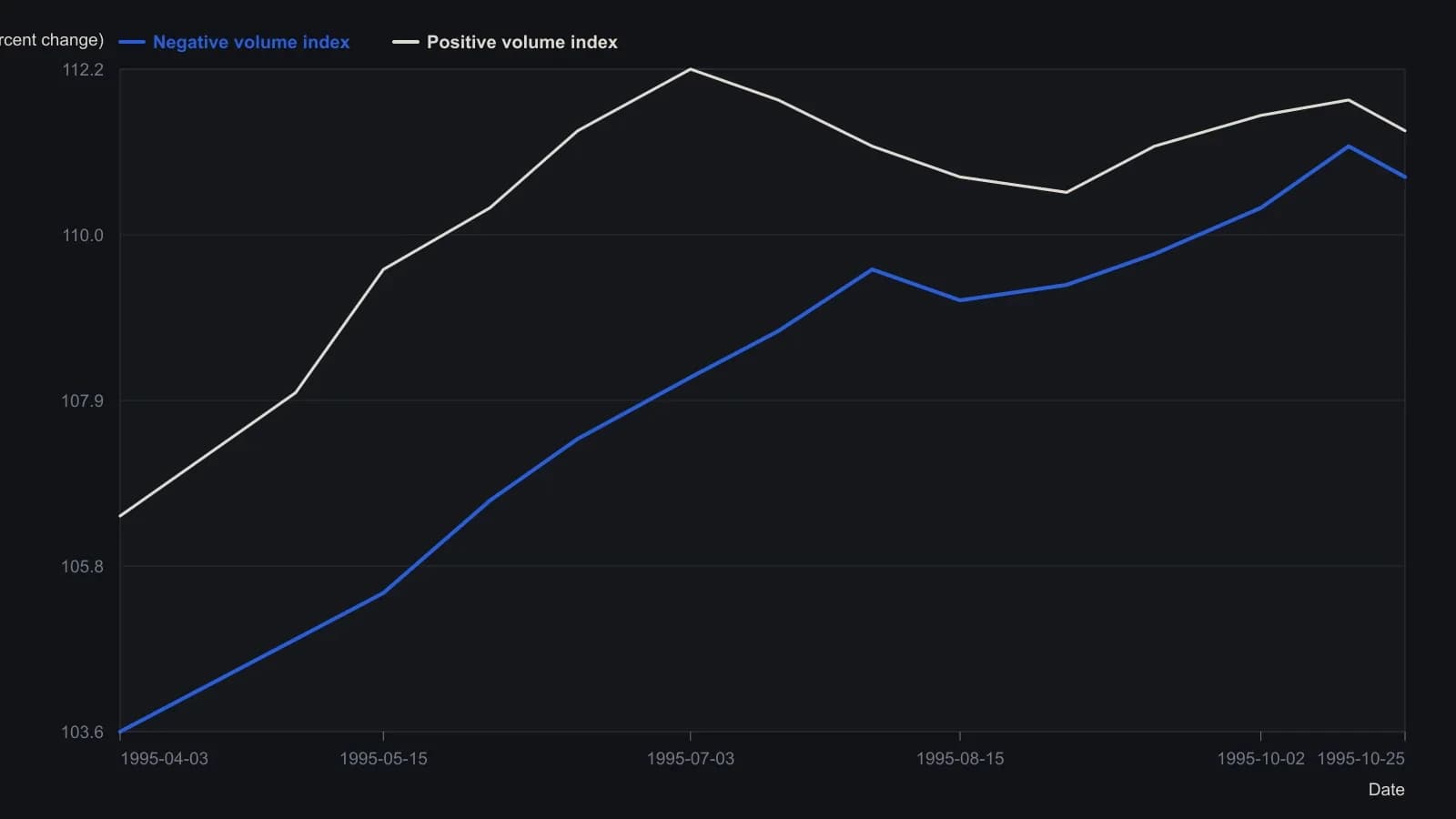
Daily percent change is accumulated only on the matching volume side (Dysart/Fosback construction as given in the SMARTRADER formulas). Digitized from the raster; indexes are approximate to about 0.2 index points and the Dow to about 20 points. The source figure does not plot the one-year average Fosback used as a bull-trend filter.
Smooth net advances into one series
Market-breadth is net participation measured from advancing versus declining issues, then optionally smoothed into a single series. A smoothed-advance-decline series is constructed as a seven-day average of advancing issues minus declining issues. After that step, overbought and oversold zones are treated as levels to be measured rather than assumed.
All readings on this track · 9 readings
- 1986Volume confirmation, the negative volume index, and divergence
- 1990Constructing a signed-range negative volume line
- 1990When quiet-day breadth fails a horizon test
- 1994Stacking scored filters into a hierarchical stock outlook system
- 1996Constructing volume-split and advance-decline breadth signals
- 1996Constructing on-balance volume, volume-price analysis, and the negative volume index
- 1996Constructing volume disparity from percent-b
- 1996Constructing a price-volume percent-B disparity
- 2003Constructing a negative volume index as a moving-average regime test