1987issue C081-7
Broken bias: stops, cash flow and unfilled gaps
Editorial: a broken market call is one written procedure, not a personality test. The stop is placed before the story, open-interest-cash-flow can veto and reverse the bias, and an unfilled-gap is a hypothesis to test rather than a license to fade.
- Place the protective stop before the market story. A reversal-stop closes the current side and opens the opposite side so a failed thesis can flip without a second discretionary debate.
- Let open-interest-cash-flow veto a short when the market state changes. An unusual rise in silver open-interest growth, with firmer prime rates, stronger meats and grains, and a renewed dollar decline, was treated as the reason to reverse to long inside one week.
- Treat post-error-hesitation as a process defect. Once indications change, the written recommendation follows the new side even when reversing inside a single week feels costly.
- An unfilled-gap is a chart hole that may later be revisited, not a requirement that price return. Under the commit-and-stick-rule, a buy thesis is taken as written and adds wait for the planned dip.
The classroom object is the sequence that can reverse or abstain after a broken call. Editorial: TradersWeek treats that sequence as a written procedure, not a personality test. The stop is placed before the story. Open-interest-cash-flow can veto and reverse the bias. An unfilled-gap is a hypothesis to test, not a license to fade for a few ticks.
The stop is placed before the story
In March 1987 a short-gold procedure used nearby resistance as a protective buy-stop and nearby support as the objective. After that stop was violated, the short had to be abandoned.
The protective buy-stop was the written exit. Editorial: the short thesis does not get a second vote once the reversal-stop is hit.
Cash flow can reverse the bias
An unusual rise in the rate of silver open-interest growth, together with firmer prime rates, stronger meats and grains, and a renewed dollar decline, was treated as the market-state reason to reverse from short to long inside one week.
Cash committed to a futures trend was described as initial plus variation margin scaled by open interest. The archive illustrated open-interest-cash-flow with 10 added contracts and a 5-dollar gold change producing 5000 dollars of variation margin plus initial margins.
A composite accumulation-distribution-oscillator built from price, volume, and open interest, with 20 percent of the index on open interest and 20 percent on volume, was used to judge whether cash still supported the prevailing direction. Its slope was expected to flatten when cash entered more slowly.
Price-only oscillators line up with price
After the metals moved into new-high territory without visible consolidations, price-only oscillators were described as exiting well before a top and as lining up with price rather than leading it, especially during limit moves.
Editorial: those oscillators are not a reason to invent a contrary scalp while cash is still entering. They are a reason to watch whether cash is still arriving at the same pace, which the archive expected to show up as a flattening slope on the accumulation-distribution-oscillator.
A turn uses a reversal-stop
A silver turn plan specified a reversal-stop a fixed distance under the high and trailing-protection on any new short. Later panic after a fill was treated as a reason to adjust strategy when a turn becomes possible, rather than to defend a top call.
The same process named post-error-hesitation as a failure mode. Once indications changed, recommendations were required to follow the new side even when reversing within a single week felt costly. Editorial: that hesitation is a process defect, not a personality flaw.
An unfilled gap is a hypothesis
An April cattle upside gap between 60 and 61 cents was faded against higher-price fundamentals in an attempt to pick a slightly better bottom.
The later critique was that gaps need not fill and that a buy thesis should be committed as written, with adds only on planned dips. An unfilled-gap is a condition that may later be revisited, not a requirement that price must return. The commit-and-stick-rule takes the written side and adds only on the scheduled retracement instead of inventing a contrary scalp.
June 1987 gold: the 417.60 buy-stop is taken
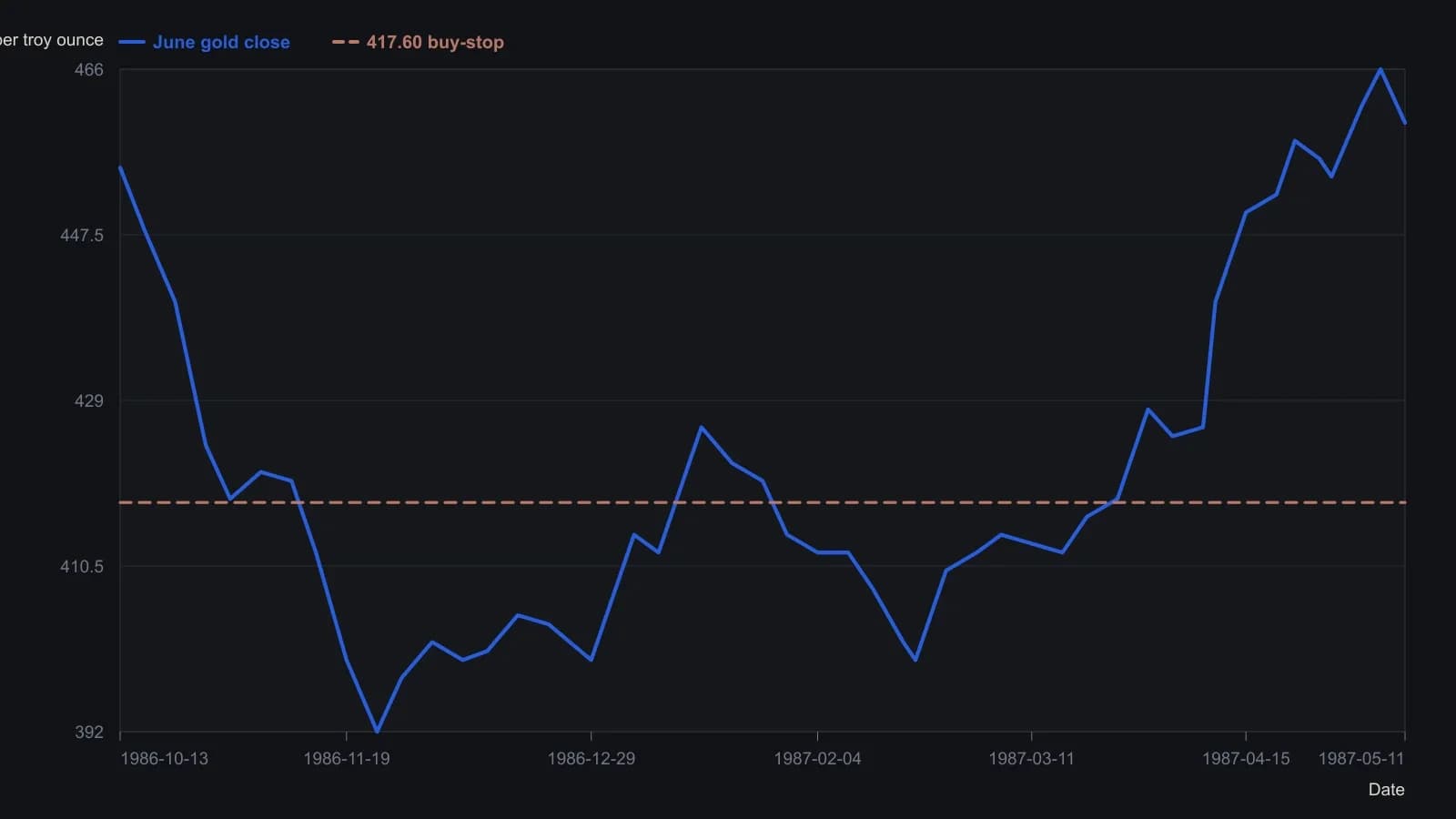
Daily OHLC bars were sampled about twice a week so the path stays inside 60 points. Y is dollars per troy ounce at about one-dollar resolution (the source grid is one dollar per square). The 417.60 threshold is the buy-stop given in the text, not a line fitted to the raster.
All readings on this track · 11 readings
- 1987Broken bias: stops, cash flow and unfilled gaps
- 1999A surviving weekly gap still needs a confirmation-breakout
- 2000Repeatable volume-price silhouettes as falsifiable hypotheses
- 2004Constructing pivot commonality across timeframes
- 2005A finished crude-oil top as a classroom for necklines, candles, and gaps
- 2007Journal a gap breakout as three sequential gates
- 2008Same-open kicker as a two-bar reversal case
- 2010Filtered gap follow-through entry rules
- 2010Cloudbank overhead resistance and breakout recovery
- 2015Post-exit cooldown as a system rule
- 2018Classifying chart gaps before fill or follow