1992issue C081-6
Opening-referenced percentile stops for same-session gaps
A gap-up or gap-down open that reverses in the same session can leave an opening entry with an unrealized loss by the close, even when that close does not reverse the prior settlement. Editorial: treat the gap open as the origin of risk, freeze exposure with a stop-loss measured from that open, and use quantile-analysis of historical open-to-extreme spreads as a checkable filter.
- A same-session gap reversal can leave a position entered at the open with an unrealized loss by the close, even if the session does not reverse the prior settlement.
- Because the reversal forms after an entry at or soon after the open, the stop-loss is an opening-referenced stop, not an offset from the prior settlement.
- Percentile stop distance comes from the historical open-to-extreme spread on up periods and down periods, so a later session can be compared with a chosen quantile.
- A closer percentile stop reduces the cash loss if hit and increases the chance of being stopped on a session that later settles in the intended direction.
Same-session gap reversals
A gap-up or gap-down open that reverses during the same session can leave a position entered at the open with an unrealized loss by the close. Gap-analysis reads that gap open against the prior close and the same-session high-low as a repeatable chart condition that can be tested rather than trusted as confirmation.
Editorial: treat the gap open as the origin of risk, not as confirmation. The same print that makes a directional story look finished is the price from which a stop-loss can be measured before a same-session gap reversal rewrites the loss.
Wheat and crude-oil sessions
In a December 1991 wheat session, a long at the 340.00 gap-up open saw a 328.50 low and a 330.50 close, a 9.50-cent unrealized loss versus the open even though that close was 5.75 cents above the prior 324.75 settlement.
In an August 1990 crude-oil session, a short at the 26.05 gap-down open saw a 26.98 high and a 26.84 close, 0.79 above the open, recorded as a 790-dollar unrealized loss per contract.
Why the stop is referenced to the open
Because the reversal forms after an entry at or soon after the open, the stop-loss is placed relative to the opening price rather than the prior settlement. A stop-loss is a precommitted filter that bounds loss or exposure from a stated reference price before entry and while the position is open.
An opening-referenced stop is a protective order whose trigger is offset from the session open rather than from the prior close or a later extreme.
Open-to-extreme spreads and percentile stop distance
An up period is a day or week that settles above its open. A down period is a day or week that settles below its open. An open that is also the period low or high produces a zero open-to-extreme spread.
Quantile-analysis orders historical open-to-extreme observations over a stated lookback so a chosen percentile can be compared with a later session. Stop width is taken from the percentile distribution of the open-to-low spread on up periods and the open-to-high spread on down periods, using a historical sample such as January 1987 through December 1991.
On the wheat up-day sample, the 90th-percentile open-to-low distance was 2.50 cents, so a sell stop 2.50 cents under a 340.00 open sat at 337.50, with a stated one-in-ten chance of trading through that level and still settling above the open.
On the crude-oil down-day sample, the 90th-percentile high-to-open distance was 29 ticks, so a buy stop 29 ticks above a 26.05 open sat at 26.34, with a stated 0.10 probability of trading through that level and still settling below the open.
Chicago wheat open-to-extreme spreads by percentile
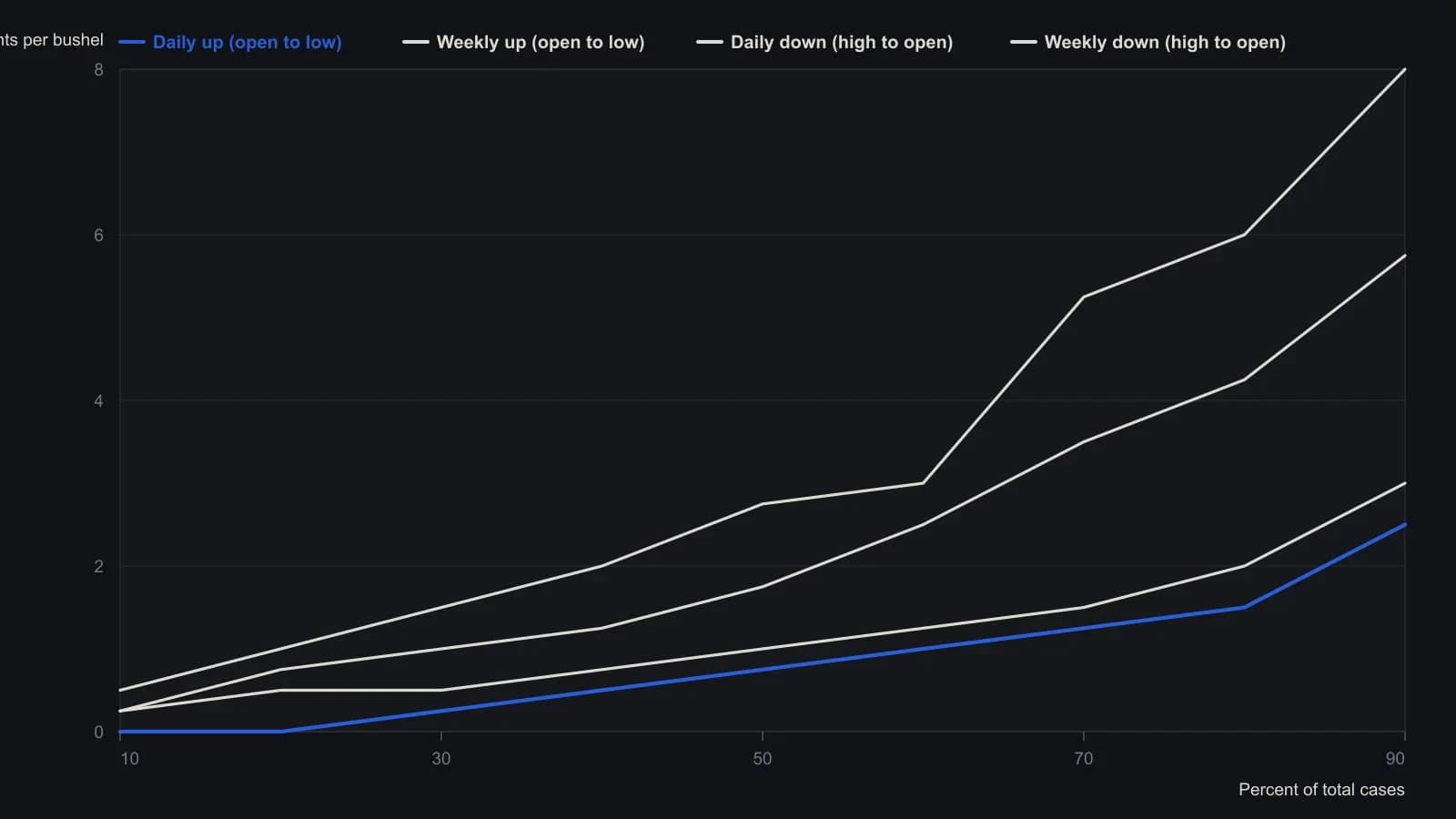
An up period settles above the open; a down period settles below it. Minimum fluctuation is 0.25 cents per bushel ($12.50 per contract). Daily 10% and 20% up-session spreads share a printed zero, consistent with many up days opening at the low.
Closer percentiles and sample consistency
A closer percentile stop reduces the cash loss if hit and increases the chance of being stopped on a session that later settles in the intended direction.
A comparison of those open-to-extreme spread distributions for 1980-87 and 1987-91 was reported as highly consistent.
All readings on this track · 6 readings
- 1986Evaluate the price random-walk question as a gated quantile lab
- 1989Path quantiles versus net return for index velocity regimes
- 1992Opening-referenced percentile stops for same-session gaps
- 1995Read one equity position on a joint yield-regime card
- 2012Construct a pairs-trading worksheet from residuals and quantile ranks
- 2015Constructing mean, median, and mode from ordered prices