2015issue C0920-22
Bid-ask queues and the instant-adjustment critique
A research program treated prices as already reflecting known and unknown information and adjusting at once. This article treats that shortcut as a routing failure and chains order flow analysis, volume-price analysis, and trend following to ask who consumes the book.
- A half-century research program treated prices as already reflecting known and unknown information and adjusting at once, which implies consistent outperformance is near-impossible.
- Untouched long-horizon index holding is the residual action if analysis is treated as futile, yet that residual is critiqued because markets are produced by people interacting.
- Volume-price analysis reads open, high, low, close and volume, while order flow analysis works with market depth and the side of the book a print consumed.
- Trend following treats directed moves that last months or years as the holding-period object, described as inertia when short-term positive feedback outweighs brief damping.
The instant-adjustment shortcut
A half-century research program treated prices as already reflecting known and unknown information and adjusting at once. That framing implies consistent outperformance is near-impossible. The same framing also implies consistent large losses are hard if a single trade does not risk the entire stake. Untouched long-horizon index holding is then the residual action if analysis is treated as futile.
Why residual holding is critiqued
That residual action is critiqued because markets are produced by people interacting. Emotion and bias enter price formation. Rationality cannot be assumed.
Printed residue and lag
Volume-price analysis reads a narrow output stream of open, high, low, close and volume, sometimes tick by tick. A broader input set arrives at lower frequency, such as monthly or quarterly.
Orders placed in reaction to printed prices close a feedback loop, so lag is inherent. That lag is used to question the claim that mispricing cannot exist, because price is composed of reactions rather than of news itself.
Editorial: the printed tape is residue. Orders that react to those prints re-enter the system and create lag between information and adjustment.
Queues and who consumes the book
After entry, later orders determine the result. Open bids and offers sit in the order book. Market depth shows queue length, which is the working object of order flow analysis. Visible length of bid and offer queues is used to judge buying support or selling pressure before an order is sent.
A transaction occurs only when bid meets ask. A print occurs only when one side crosses and a resting bid and offer become the same price. An uptick indicates a buyer met the offer. A downtick indicates a seller met the bid. Large-versus-small volume can be split by the side of the book that was consumed.
Editorial: order flow analysis of who consumes the book is how the instant-adjustment shortcut is tested at the queue. If joining the bid or lifting the offer did not change outcomes, that split would not matter.
Facebook effective volume: large versus small players
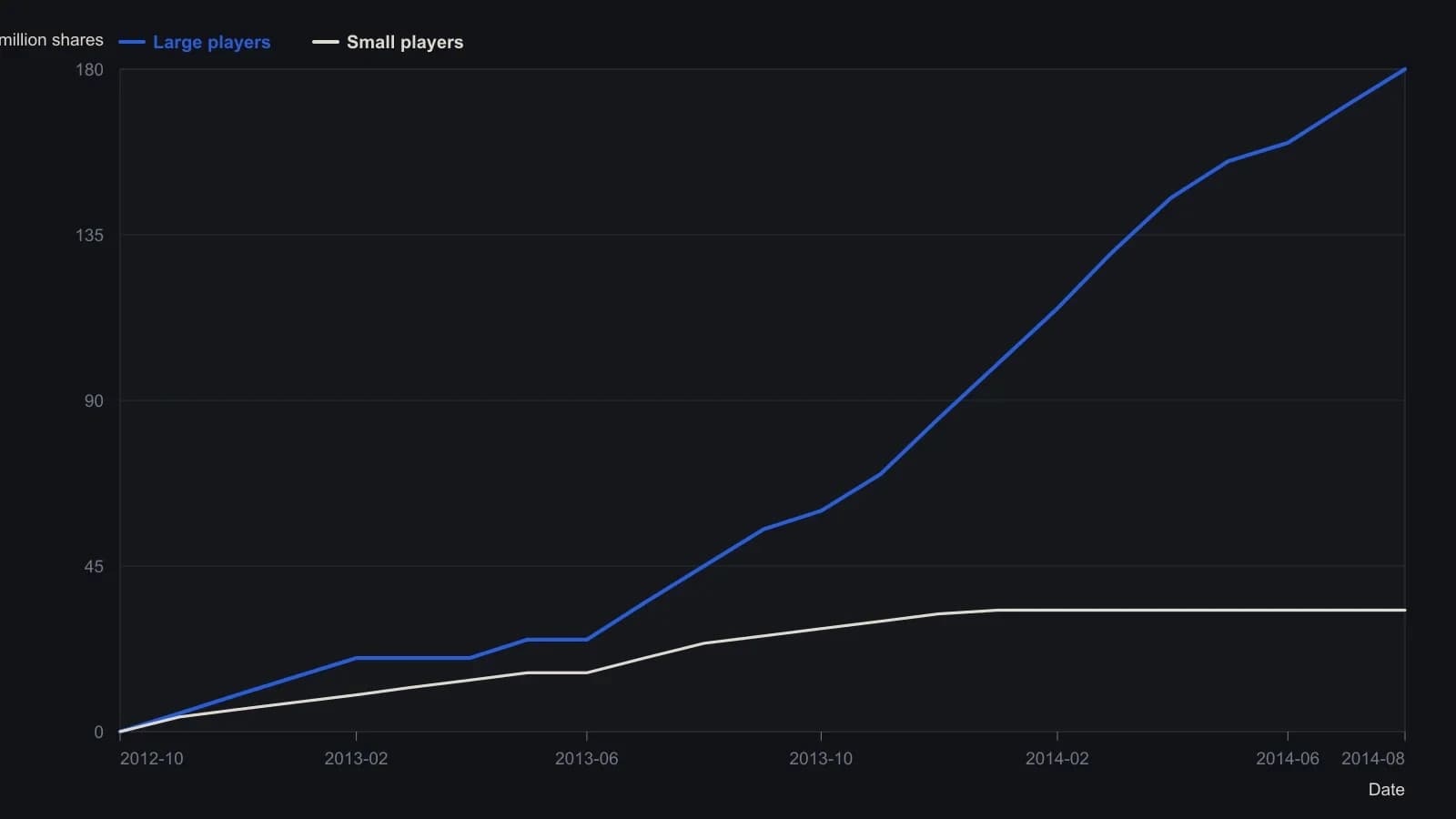
Pascal Willain Effective Volume as Chartmill plotted it, split into large and small players. Approximate monthly readings from a labeled 0–180 million share scale; the source printed a raster, not a table.
Trend inertia and the unstated side
When a strong trend damps, short-term negative feedback is present. When damping stops, feedback turns positive and the move resumes. That sequence is described as inertia. Trend following treats directed moves that last months or years as the holding-period object. Persistence of a directed move appears when short-term positive feedback outweighs brief damping intervals.
Editorial: trend-following rules stay incomplete until they name the side they intend to hit. The holding-period object is unfinished if the rule does not say whether it will join the bid or lift the offer.
All readings on this track · 12 readings
- 1988Constructing a value area from TPO, volume, and order flow
- 1988Constructing Value Area trends from half-hour auction profiles
- 1988Constructing auction structure with volume as a clock
- 1999Direct access routing and the visible book
- 1999A floor-to-screen case for the trading decision
- 2001Round-number clusters behind support and pattern signals
- 2001Displayed-size filters in multi-venue index-share execution
- 2006A high-volume wide bar as an auction-intent check
- 2007Market Profile as auction context for inventory imbalance
- 2008Decimalization, liquidity, and why price-only charts miss the tape
- 2013Liquidity pockets and order routing after the speed race
- 2015Bid-ask queues and the instant-adjustment critique