Elliott Wave, rebuilt for accuracy: cleaner counts and setups priced from the live market
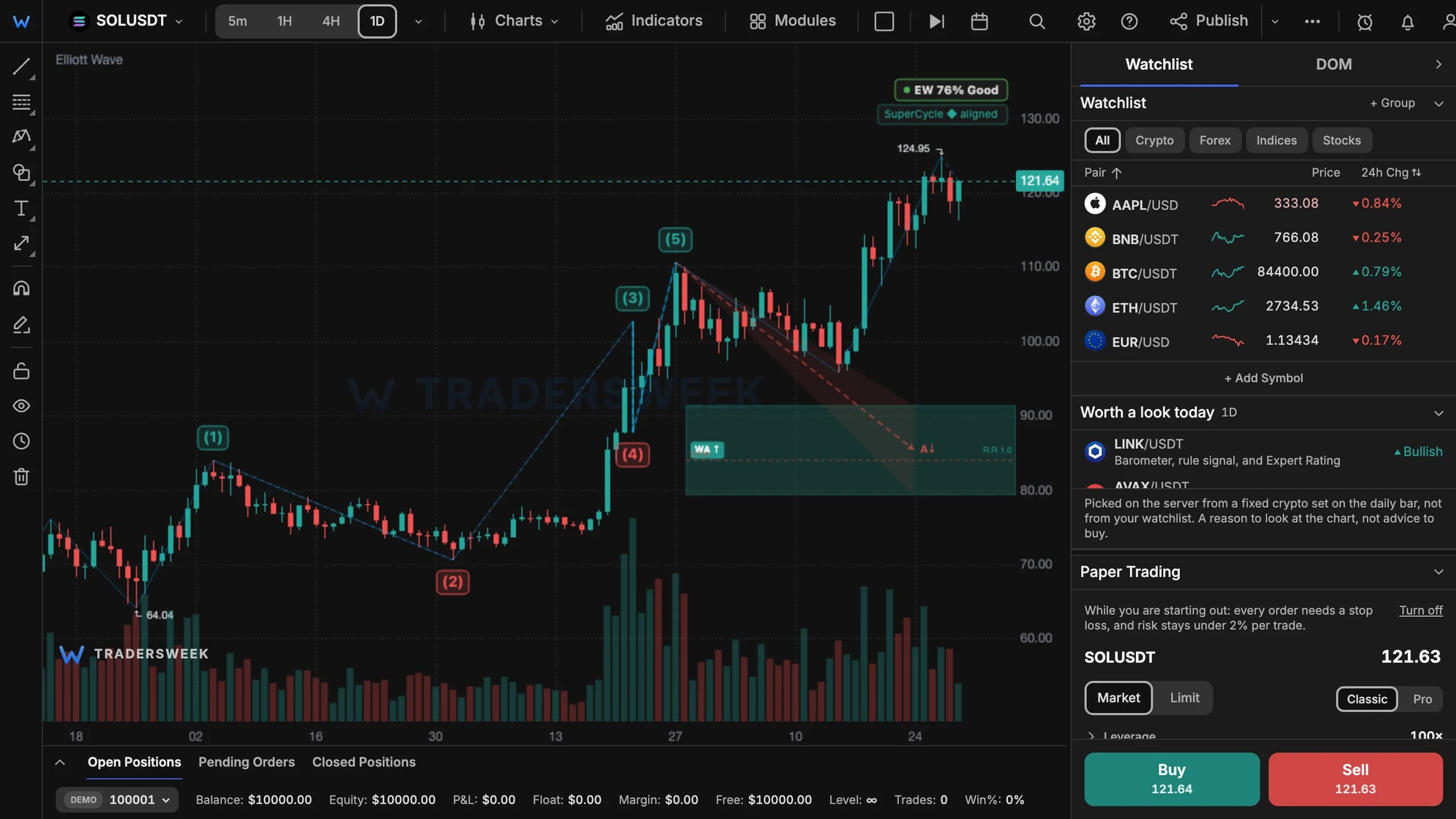
We took the automatic Elliott Wave count apart rule by rule. Labels now sit on real highs and lows, counts that break a rule no longer rank, and trade setups measure risk and reward from the current price. Plus two new setup types, higher timeframes in Replay and rule explanations in 14 languages.
Why we went back to it
Since the automatic count became free in September, it is on more charts than any other module. That made its mistakes everyone's mistakes, so we audited it end to end on real market data: the swing detector, the rules, the ranking, the Fibonacci targets, the trade setups and the drawing. This is what changed.
The count itself (free)
- Labels sit on the true high or low between neighbouring swings, and a single candle can no longer carry both a top and a bottom — so no more waves zero bars long.
- The rules now check that waves come in order in time and alternate, and that each pattern keeps to its textbook boundaries. In a diagonal, wave 4 may not move past the end of wave 2.
- A count that breaks a hard rule, or that price has already invalidated after its last label, no longer makes the ranking. All scores share one 0–1 scale.
- The count you are looking at stays selected when a new bar arrives, instead of jumping to a near-equal neighbour.
- Prices follow each instrument's tick size, so forex pairs and coins priced below a cent are no longer rounded to two decimals.
Trade setups (Premium)
Setups used to quote risk/reward from the historical pivot they came from, which could flatter a trade long after the move had gone. Now everything is measured from the current price:
- stops sit on the structure and are at least one ATR(14) wide at the trigger bar;
- setups whose live risk/reward is below 1, or that price has already played out, are not shown;
- each setup gets a grade from A+ to C. A+ needs a strong count, one of the most reliable strategies, live risk/reward of at least 2 and a trade no more than a quarter of the way to its first target. While the last pivot is still unconfirmed, the best grade is A.
There are now six setup strategies. Wave 3 Entry, Wave 5 Entry, ABC Reversal and Post-Impulse Correction are joined by Combination Reversal — a reversal after the last leg of a W-X-Y or W-X-Y-X-Z — and Triangle Thrust, the breakout from a contracting or running triangle after wave E, with targets at 0.618 and 1.0 of the triangle's width.
Replay, edits and languages
- The higher-timeframe context and Multi-TF now work in Replay, computed only from bars before the cursor, so the past never sees the future.
- Multi-TF labels each timeframe with its own grid of wave degrees.
- Drag a label by hand and the rules, status, Fibonacci levels, subwaves and setups are all recomputed for your version of the count.
- Rule details, hypotheses and pattern templates are translated into all 14 terminal languages, and so is the Wave Finder tab.
Switch it on from Modules → Elliott Wave in the terminal. The count is free; setups, target clusters, the Fire Map, channels and the EW Inspector are Premium — free for every signed-in account until 1 January 2027.