Hyperliquid liquidation map: real positions, not a model
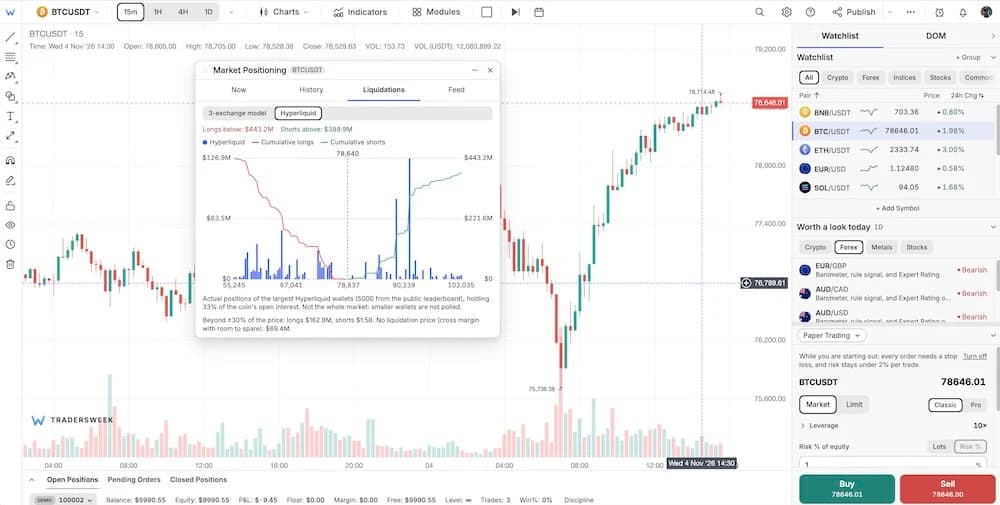
Hyperliquid publishes every wallet's positions with their exact liquidation price. We poll the 5,000 largest wallets and draw where their positions would be force-closed — on a free page at /crypto/hyperliquid and as a source in the terminal's Market Positioning panel.
Why this map is different
Centralised exchanges don't publish where open positions would be liquidated, so every liquidation map for them — our own Crypto Positioning map included — is an estimate built on leverage assumptions. Hyperliquid is different: positions are public, and each one comes with its exact liquidation price. So for Hyperliquid we don't estimate; we read.
How it is built
- We take the 5,000 largest wallets by account value from Hyperliquid's public leaderboard, refreshing the list every six hours.
- Their positions are polled in rotation — a full pass takes about 17 minutes — and the map is rebuilt every minute.
- Levels within ±30% of the price are drawn in 0.5% buckets: longs below the price, shorts above. The window is wide on purpose — large wallets use little leverage, so very little of their liquidation volume sits close to the price.
- The limit is coverage, not guesswork: smaller wallets aren't polled, so each map states the share of open interest it covers, plus the amounts beyond the window or with no liquidation price at all.
On the site and in the terminal
/crypto/hyperliquid shows maps for the four coins with the most open interest, a table of the biggest clusters and the 50 largest positions, each linked to the on-chain explorer. It is free and needs no account.

In the terminal, Crypto Positioning → Liquidations has a source switch: the exchange model or Hyperliquid's real positions. The two are never mixed, and the choice is remembered. Crypto Positioning is part of Pro — free for every signed-in account while Premium is free until 1 January 2027.