1997issue C051-9
Zero-lag cycle filters can fail on a price series
A historical zero-lag filter bank scans a noisy price stream with resonators until one band answers as a dominant cycle. A constant-input check later showed that the published lowpass-filter does not hold the same level as a steady series when the dc-offset is large.
- The teaching object is a zero-lag filter bank of tuned resonators, not an extra entry rule.
- A dominant cycle is the band that responds as a coherent rhythm rather than as random stimulation.
- The published lowpass-filter fails a constant-input check on series with a large dc-offset.
- Those offsets may be tolerable inside a bandpass-filter, but a standalone lowpass-filter needs compensation.
A filter bank, not an entry rule
The source treats market prices as a noisy stream that can be scanned with a bank of resonators, each tuned to a slightly different period, until one band responds as a coherent cycle rather than as random stimulation. That strongest recurring rhythm is the dominant cycle a detector reports in a price, volume, or breadth series over a defined lookback.
The intended teaching object is not an extra entry rule but a zero-lag filter bank, analogous to tuned circuits, whose bandwidth and overlap can be adjusted to isolate non-seasonal market rhythms. A zero-lag filter keeps the extracted cycle in phase with the original series rather than delayed like a moving average.
The lowpass stage fails a constant-input check
The published lowpass stage fails a basic constant-input check. A lowpass-filter is meant to pass slow components, including a near-constant level, while rejecting high-frequency noise. On a steady series the output does not settle at the same level as the input. The mismatch is most visible on series with large level, such as an S&P 500 close in the 700s.
That large near-constant level is the dc-offset. Recursive filters can mishandle it even when the frequency plot still looks orderly.
Roundoff and design fitness
One identified cause is single-precision recursive arithmetic. Small roundoff errors accumulate when the series has a large dc-offset, while relatively centered data can still behave as designed.
A second cause is the filter's own design fitness. The genetic search favored impulse and frequency shape under coarse bar spacing and paid little attention to gain and offset. Those gaps only became acceptable because the lowpass-filter was meant to sit inside a bandpass-filter with a high-pass companion. A bandpass-filter passes a chosen band of cycle lengths and attenuates slower drift and faster noise.
When the offset can be left alone
The correction note states that those offsets may be tolerable when the only concern is phase and frequency response inside a bandpass-filter, but they need compensation if the lowpass-filter is used on its own.
TradersWeek editorial view: treat the frequency chart as a shape check, not as proof that the same lowpass-filter is a usable standalone signal on a raw price series.
Profit and drawdown versus cycle-resonance threshold
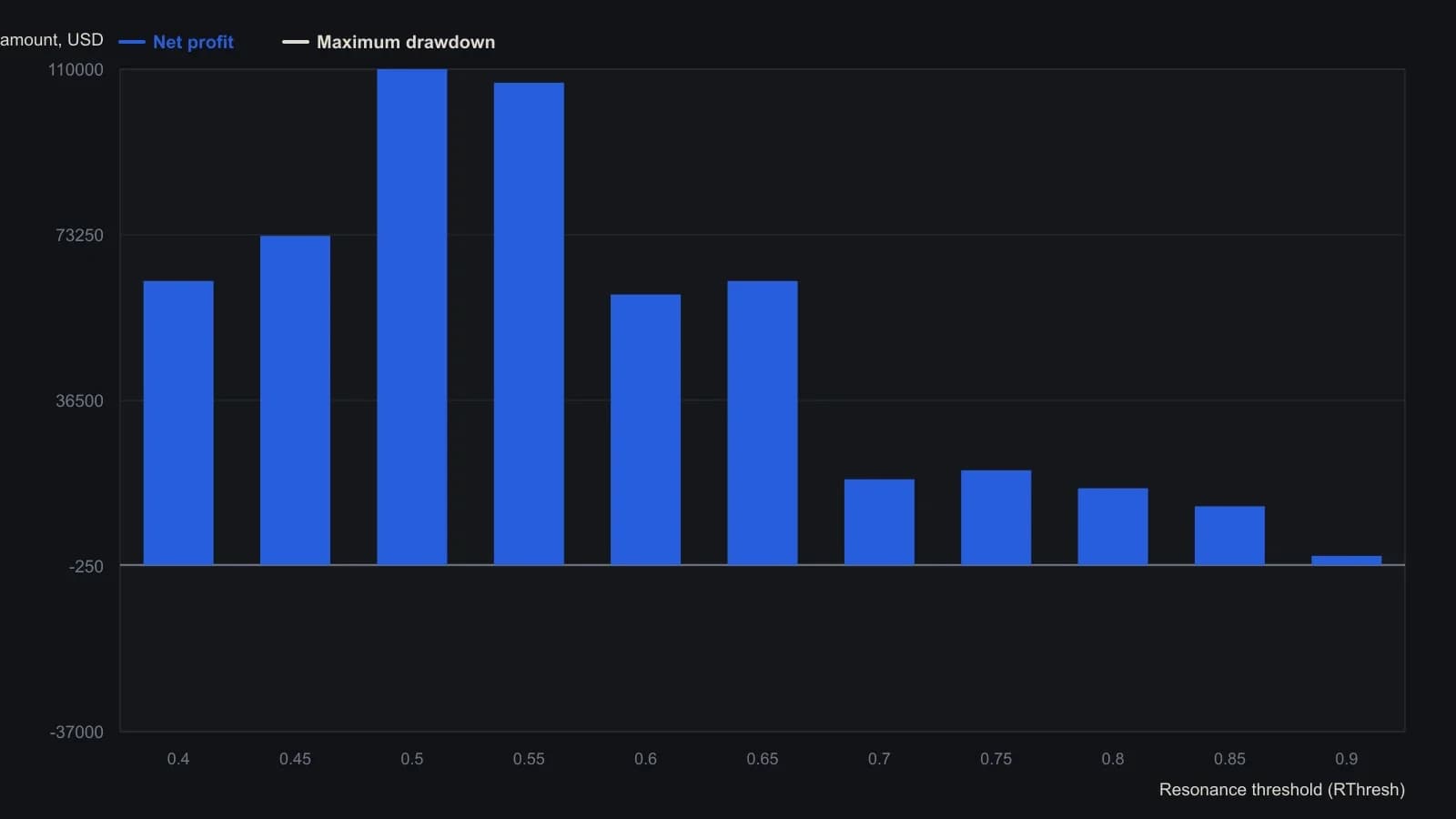
Bandwidth factor was already locked at 0.92. Katz stepped RThresh from 0.4 to 0.9 by 0.05 on continuous S&P 500 futures, 3 January 1990 through 1 November 1996. Heights are approximate raster readings, rounded to the nearest thousand dollars.
All readings on this track · 9 readings
- 1991Constructing a coincident moving average as a lowpass filter
- 1994Centering a dual lowpass bandpass on a counted cycle
- 1997Zero-lag cycle filters can fail on a price series
- 2002Constructing zero-lag finite-impulse-response and exponential smoothers
- 2010Constructing cycle versus trend mode filters
- 2010Constructing a trend filter as a low-frequency model
- 2015Whitened lowpass filters for trend and countertrend
- 2016Building Nyquist-safe lowpass trend filters
- 2018Constructing a Finite Impulse Response Filter compared with Exponential smoothing