2017issue C0860-61
Why the simpler looking system is harder to run
Developing traders often treat running a trading system as simpler than it is because screen-based actions look easy. Emotional demand is less visible than physical skill, so the work of following the rules is easy to undercount.
- Screen-based actions make a trading system look simpler to run than it is, because emotional demand is less visible than physical skill.
- Knowing the completed outcome of two rule sets still does not show which set an operator can follow until both have been tried.
- An all-in, all-out trend rule can become harder to follow as open gains expand, because unease and greed can prompt impulsive early exits.
- In the illustrated case, scale-out trend following is preferred because it matches the operator's temperament and keeps a remainder under a trailing stop.
The look of an easy system
Developing traders often treat running a trading system as simpler than it is because screen-based actions look easy. The work required to operate a system is easy to undercount because emotional demand is less visible than physical skill.
Unrealistic expectations judge a trading procedure by how easy it looks as an idea, before the operator has had to follow it under live pressure. Emotional stamina is the capacity to keep applying entry, hold, reduction, and exit rules while feelings intensify.
A trading psychology process handles feelings as part of the same procedure as signals and constraints, not as a separate afterthought.
The scale-out in the example
The illustrated scale-out procedure marks an entry, an initial stop, two partial exits, and a trailing stop on the remaining third of the position. Scale-out reduces a position in planned stages and leaves a remainder under a later exit rule.
Scale-out is used in the example to keep emotions manageable while a remainder continues to be trend-followed. Trend following stays with a move until a predefined end-of-trend or trailing condition is met. The trailing stop is the protective exit advanced with the remaining position after the earlier reductions.
Expedia scale-out: entry, stop, and two exits
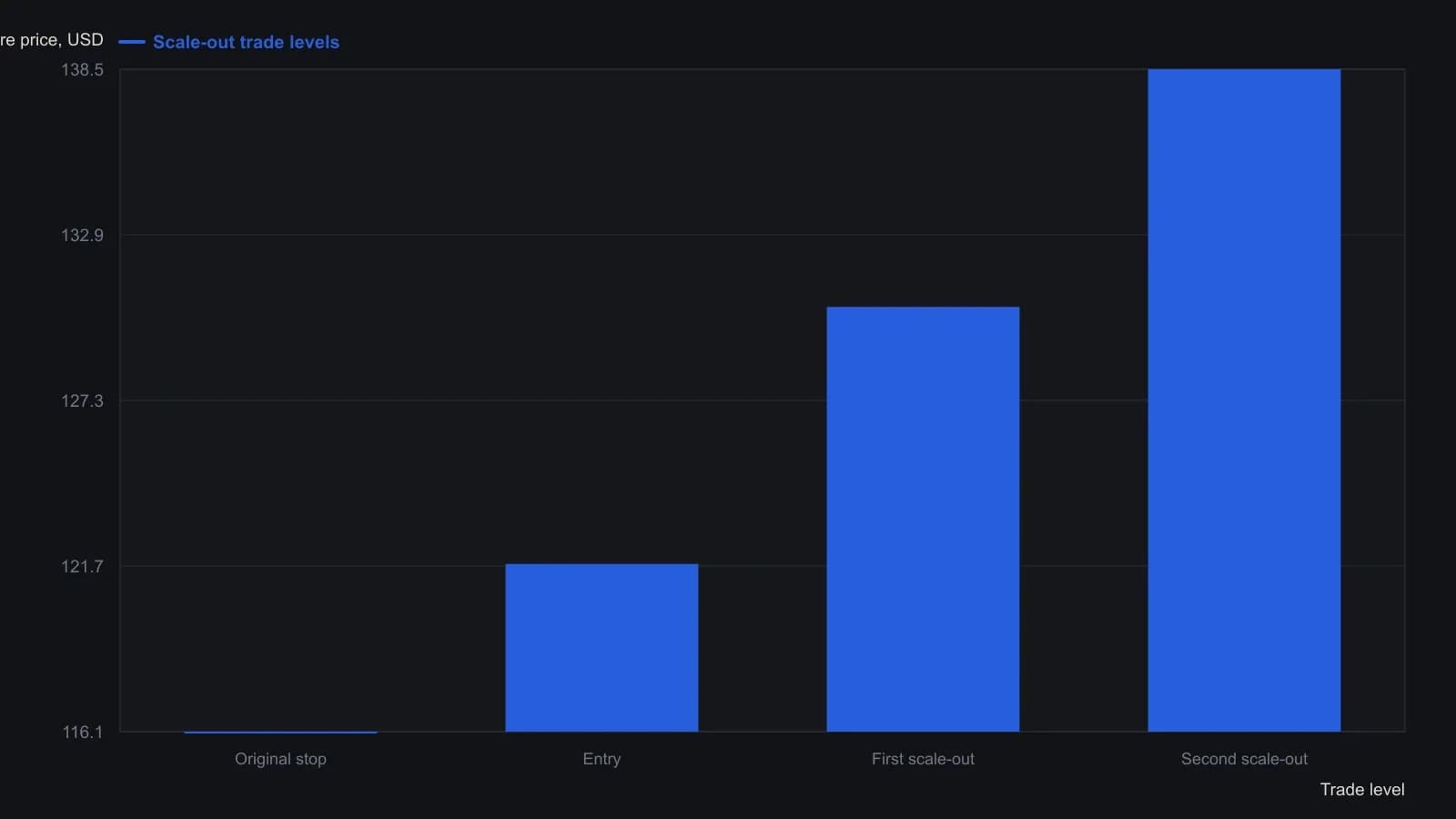
Read from the TradeStation price tags on the weekly EXPE chart, not from a table. The author presents a single trade and says it is not a statistical sample. After the second scale-out the last third of the position was still being trailed.
All-in, all-out under open gains
An all-in, all-out trend rule takes the full size at entry and exits the full size when the trend rule fires. That rule can become harder to follow as open gains expand because unease and greed can prompt impulsive early exits.
Knowing the completed outcome of two rule sets still does not show which set an operator can follow until both have been tried.
What real-time use makes clear
A system's usable characteristics for an operator become clear only after real-time use, not from inspecting the idea on paper. In the example, scale-out trend following is preferred to all-in and all-out because it matches the operator's temperament.
All readings on this track · 18 readings
- 1989One add option sizing with a scale-out and a trail
- 1991Precommit scale-outs and puts to replace impulse
- 1991A written game plan for checklist, scale-out and staggered stops
- 2004Name the stop, require a 1:3 reward, then scale out half
- 2005Why pre-target scale-outs lower expected value
- 2008Preplanned butterfly exits with stops and scale-outs
- 2010Qualified trend, volume breaks, and a staged scale-out
- 2011Gated entry and scale-out after a climactic selloff
- 2011First-target review: scale out or flatten
- 2012Tiny scale-out as a systems decision test
- 2014Written size and exit scripts for scaling and risk
- 2017Constructing livable scale-out exit rules
- 2017Why the simpler looking system is harder to run
- 2018Prewritten scale-out and exponential moving-average exit procedure
- 2019A dual-career swing procedure that must output entry, scale-out, or abstention
- 2019A same-session opening-range breakout with a whole-number stop and scale-out
- 2019Grade the first seasonal long-put gain as a maintenance exam
- 2019Failed candlestick fades with breakout permission and scale-out