2018issue C1162-63
Prewritten scale-out and exponential moving-average exit procedure
A historical swing long treated hold or exit as one written procedure: read the weekly picture first, reduce size in planned thirds, and use a close below the 8-period daily exponential moving-average as a checkable discretion clause.
- Write entry, exit, and standing aside as one trading-psychology-process so the emotional-component is not the rule when outcomes are only probable.
- Use weekly-then-daily review, then a scale-out-position plan, so later exits carry less size and less decision load.
- Keep a standing moving-average close as a discretion clause and leave the hard-stop unused if that clause already ends the trade.
- Apply a next-setup-reset so unused remainder on one open trade does not dominate the next choice.
Knowledge and emotion in one choice
Trading choices are framed as a knowledge-component plus an emotional-component. The knowledge-component is the strategy checklist, targets, stops, and what-if clauses already written before the live choice. The emotional-component is the loss-tinged feelings that arise when a new risk or an unused remainder of a winner is still possible. The emotional-component is identified as the main source of difficulty.
Decision stress is tied to the feelings a choice evokes because outcomes are only probable. A new position can evoke fear of loss. The hold-or-exit moment can evoke fear of unused remainder if the position is left on or if risk is tightened.
A complete written strategy, including predefined what-if handling, is presented as the practical way to make those choices less stressful. That written sequence is the trading-psychology-process. It turns entry, exit, and standing aside into one checkable procedure when outcomes are only probable.
Weekly picture first, then the daily long
Chart review always started on the weekly timeframe before moving to the daily timeframe. That weekly-then-daily order was part of the written checklist. The weekly picture was read first. Action was taken only on the daily chart.
The case opened a daily swing long in Marathon Oil (MRO) on 16 March 2018 only after every listed strategy condition had been checked.
Staged thirds and a checkable moving-average close
The open risk used a scale-out-position plan. The position was split into thirds. The first two slices scaled out at predefined average-true-range targets. The last third was reserved for a trailing-stop trend hold. Later choices then carried less size and less decision load.
A standing plan clause allowed a discretionary close if price closed below the 8-period exponential moving-average. That moving-average is an explicit average of ordered closes over a stated lookback. Here the lookback is the 8-period exponential average on the daily chart, used as the discretionary early-exit condition. That close was used. The hard-stop was left unused.
Three separate exits from the same entry were recorded. They matched the staged thirds design rather than a single all-in close.
MRO swing long, three staged scale-outs
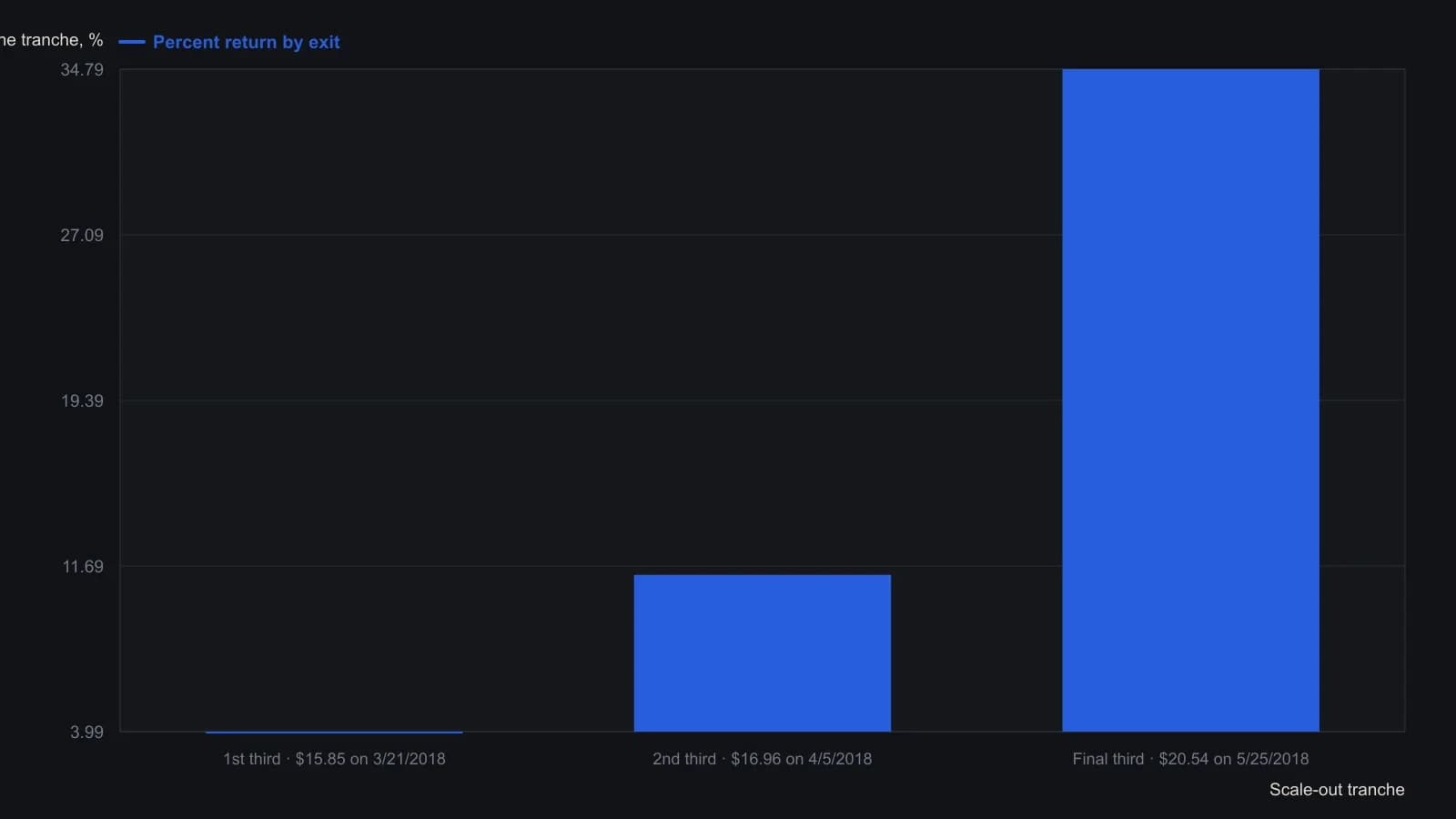
Same $15.23 entry on 3/16/2018 for every third; the unused hard stop on the daily chart is not a plotted series.
Reset to the next setup
Treating another valid setup as always available is presented as a way to reduce attachment to any one open trade and to move on to the next decision. That next-setup-reset keeps one open trade from dominating the next choice.
The unused remainder then stays inside the written procedure. It is a planned last slice, not a reason to replace the checklist with a feeling.
All readings on this track · 18 readings
- 1989One add option sizing with a scale-out and a trail
- 1991Precommit scale-outs and puts to replace impulse
- 1991A written game plan for checklist, scale-out and staggered stops
- 2004Name the stop, require a 1:3 reward, then scale out half
- 2005Why pre-target scale-outs lower expected value
- 2008Preplanned butterfly exits with stops and scale-outs
- 2010Qualified trend, volume breaks, and a staged scale-out
- 2011Gated entry and scale-out after a climactic selloff
- 2011First-target review: scale out or flatten
- 2012Tiny scale-out as a systems decision test
- 2014Written size and exit scripts for scaling and risk
- 2017Constructing livable scale-out exit rules
- 2017Why the simpler looking system is harder to run
- 2018Prewritten scale-out and exponential moving-average exit procedure
- 2019A dual-career swing procedure that must output entry, scale-out, or abstention
- 2019A same-session opening-range breakout with a whole-number stop and scale-out
- 2019Grade the first seasonal long-put gain as a maintenance exam
- 2019Failed candlestick fades with breakout permission and scale-out