2019issue C0348-49
Grade the first seasonal long-put gain as a maintenance exam
A long-put on a crude-linked fund expressed October and November weakness in crude. Once the fund had declined, the case compared a scale-out-position, a same-expiry roll-down, and a financed two-sided-overlay by remaining-delta and residual lock.
- After a seasonal long-put has already paid October and November weakness, leaving the contracts unchanged still exposes both the original debit and the open gain to a rally.
- A scale-out-position that sells seven of ten puts can lock a residual credit and cut remaining-delta further than a same-expiry roll-down that keeps ten lower-strike puts.
- A half-after-a-double exit does not grade this book, because that rule applies only after a doubling that is uncommon in practice.
- Open put value can fund a two-sided-overlay of later-dated calls and puts so a large move either way can still be expressed while the seasonal decline is still in force.
Seasonal-trading opens a limited-risk long-put
A limited-risk long-put on a crude-linked exchange-traded fund was used to express seasonal-trading, here a negative October and November bias in crude oil. The case opened ten January 2019 17-strike puts. The debit paid was the maximum loss, and January expiration breakeven was 15.18 per share.
By 23 October 2018 the fund had declined 8 percent. Leaving the long-put unchanged then left both the original debit and the open gain exposed if the fund rallied.
A doubling exit does not grade an ordinary gain
A common half-after-a-double exit was treated as incomplete because it only applies after a doubling that is uncommon in practice. The book still needed a position-adjustment: buying or selling options to change an existing position, typically giving up one feature of the payoff to obtain another.
Scale-out cuts leftover delta more than a roll-down
Selling seven of the ten puts was the scale-out-position. It locked a residual credit if the underlying reversed. Remaining-delta, the leftover share-equivalent sensitivity after the adjustment, fell from about 900 to about 270 in absolute value, so further declines would add less incremental gain.
A roll-down sold the ten 17-strike puts and bought ten January 2019 14-strike puts of the same expiry. That kept some downside participation at the lower strike, but remaining-delta stayed about 448 in absolute value, more than after the seven-contract scale-out.
January expiration P/L for three ways to handle the USO put
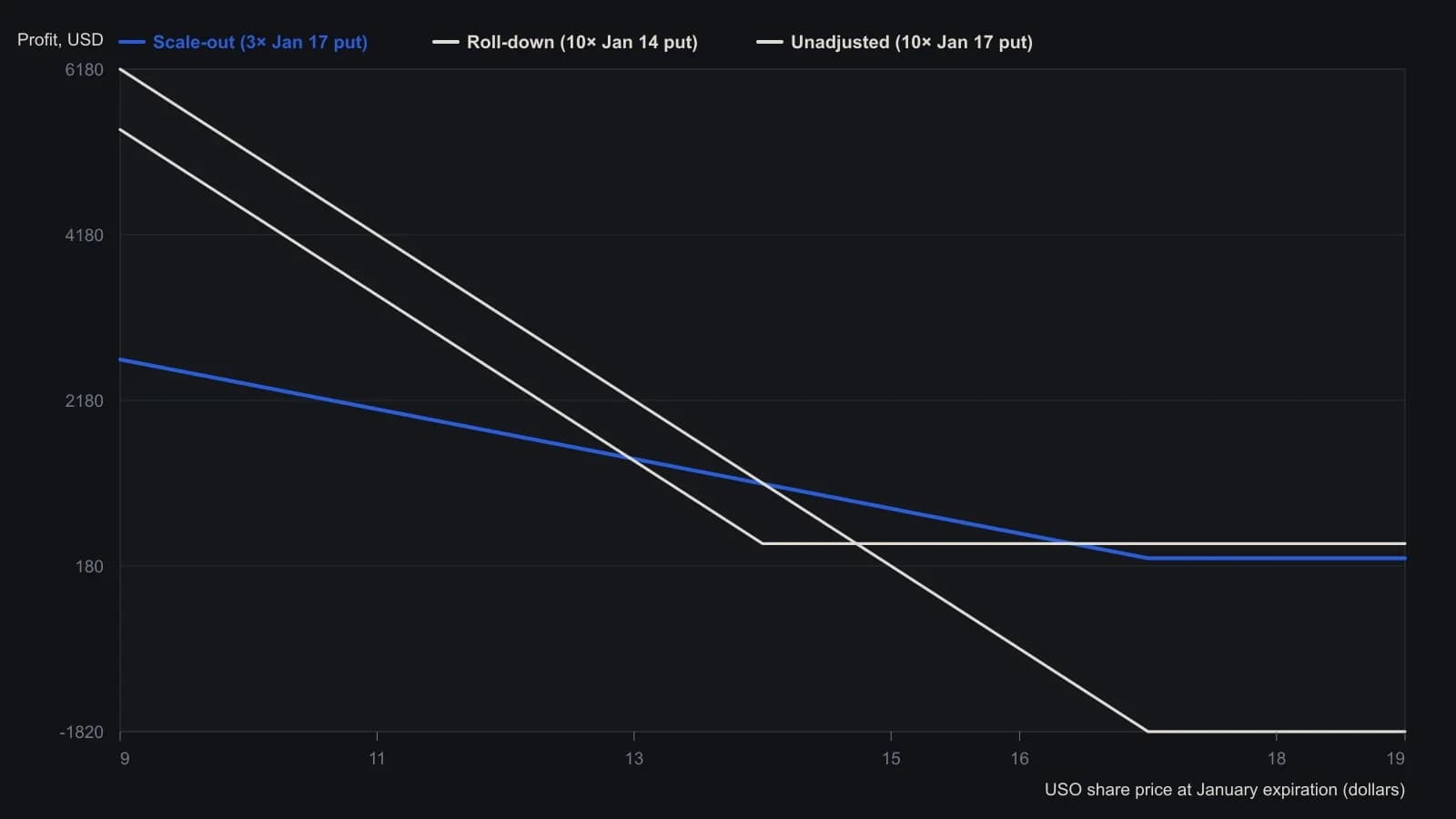
Expiration value only. Pre-expiration model curves on the vendor graphs were not traced. The financed two-sided overlay (Figure 4) is not in this unit.
Open put value can finance a later two-sided overlay
Open put value was used to sell January 2019 16-strike puts and buy four April 2019 14-strike calls and four April 2019 14-strike puts. That two-sided-overlay added later-dated long calls and puts while the seasonal decline was still in force, so a large move either way could still be expressed.
All readings on this track · 18 readings
- 1989One add option sizing with a scale-out and a trail
- 1991Precommit scale-outs and puts to replace impulse
- 1991A written game plan for checklist, scale-out and staggered stops
- 2004Name the stop, require a 1:3 reward, then scale out half
- 2005Why pre-target scale-outs lower expected value
- 2008Preplanned butterfly exits with stops and scale-outs
- 2010Qualified trend, volume breaks, and a staged scale-out
- 2011Gated entry and scale-out after a climactic selloff
- 2011First-target review: scale out or flatten
- 2012Tiny scale-out as a systems decision test
- 2014Written size and exit scripts for scaling and risk
- 2017Constructing livable scale-out exit rules
- 2017Why the simpler looking system is harder to run
- 2018Prewritten scale-out and exponential moving-average exit procedure
- 2019A dual-career swing procedure that must output entry, scale-out, or abstention
- 2019A same-session opening-range breakout with a whole-number stop and scale-out
- 2019Grade the first seasonal long-put gain as a maintenance exam
- 2019Failed candlestick fades with breakout permission and scale-out