2008issue C121-4
Weekly engulfing, hammer, and soldier reversals as a control test
This archive case study walks through weekly British pound index candles as a staged sequence. Editorial reading treats an engulfing bar as a proposed handoff, three crows or three soldiers as the test that a new side is in charge, and a later hammer or stall as the checkpoint that keeps or kills the hypothesis.
- An engulfing reversal is defined only after a clear prior trend, when the second real body completely wraps the first real body. The wicks do not have to be wrapped.
- Editorial reading treats that engulfing bar as a proposal only. Three black crows or three white soldiers are the later test of whether the new side is actually in charge.
- After the weekly decline, an inverted hammer with a short lower shadow still needed the next bar's bullish open and a wrapping bullish candle before the pause was treated as confirmed.
- If later soldiers weaken into an advance block or a stalled pattern, the sequence is used to protect existing longs rather than to start shorts.
A staged weekly control test
The archive case study is a weekly British pound index walkthrough. Editorial reading treats that walkthrough as a staged control test. An engulfing bar only proposes a handoff. Three black crows or three white soldiers then test whether the new side is in charge. A later inverted hammer or a stall is the checkpoint that keeps or kills the hypothesis.
What counts as an engulfing reversal
A two-candle engulfing reversal is defined only when a prior trend is already clear and the second real body completely wraps the first real body. The wicks do not have to be wrapped.
The second engulfing body is expected to be the opposite color of the first, except when the first body is a doji or spinning top wrapped by a large opposite body after an extended move.
The weekly British pound engulfing
On the weekly British pound index example, a six-week rise from about 196 beginning in June 2007 was followed by a seventh-week bearish engulfing. After that bar, 206 was treated as resistance and the index later declined to 197.77.
Editorial reading stops at the proposal stage. The engulfing bar offered a bearish handoff. It did not, by itself, show that the new side was in charge.
Weekly British pound index through the 2007–08 reversals
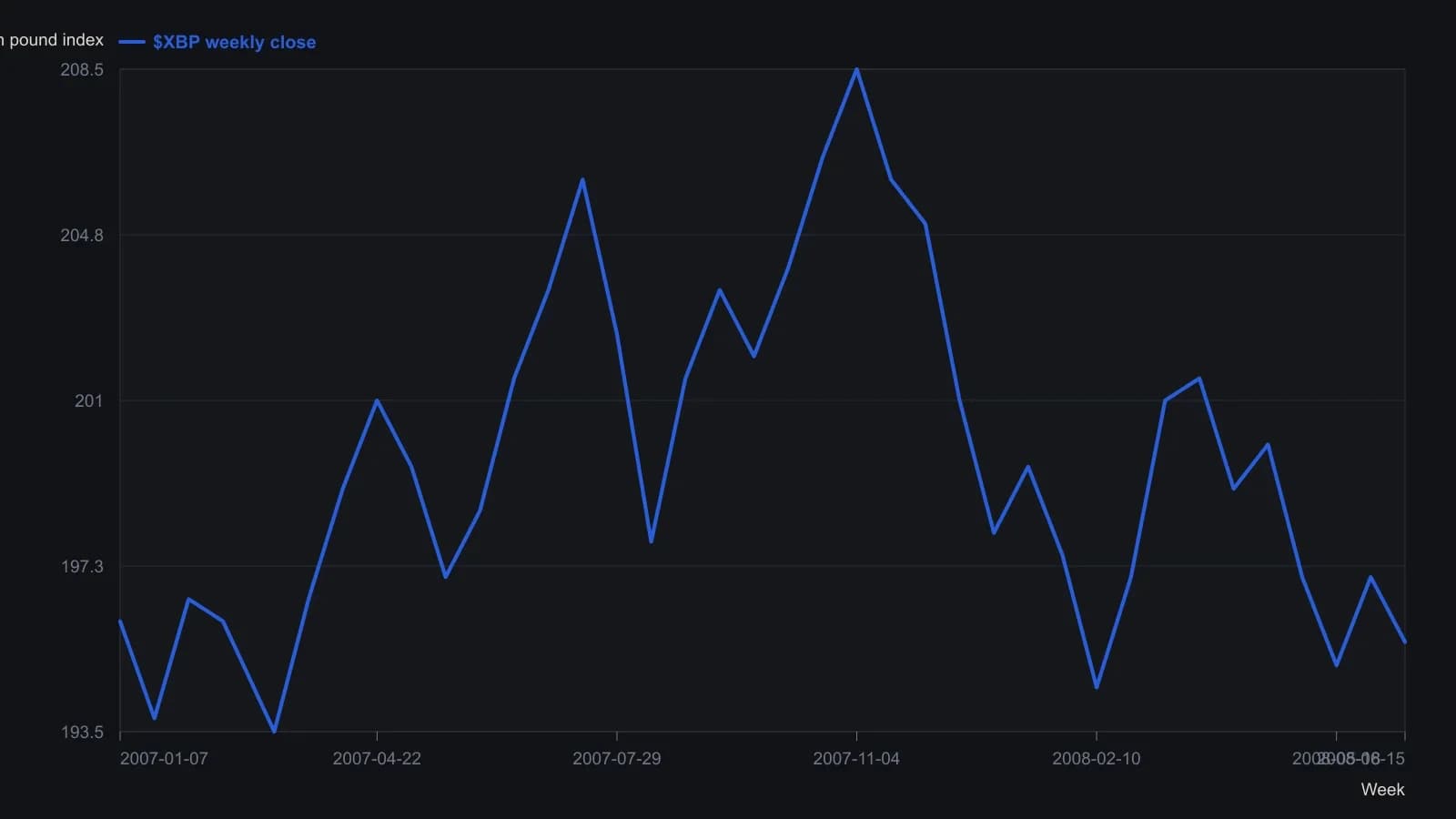
Closes are approximate to the nearest half index point except where the printed last price or a nearby labeled extreme pins the bar. Highs such as 211.15 and 203.87 are wicks, not closes. The small oscillator pane above the candles was not read.
Three black crows as confirmation
Three black crows are specified as three consecutive declining candles, each opening inside the prior real body and closing at a new low, ideally near that session's low.
In that same weekly sequence, the first crow was smaller than the next two. The index later printed a low of 194, a few points above the March 2007 low of 192.
In editorial terms, the crow sequence is the confirmation stage. The new downside was treated as in charge only after those three declining weekly closes.
The inverted hammer checkpoint
After that decline, an inverted hammer with a short lower shadow was confirmed by the next bar's bullish open and then wrapped by a bullish candle, forming a bullish engulfing of the hammer.
Editorial reading treats that inverted hammer as an early pause-in-decline cue that still needed later bullish follow-through. The next bar's bullish open and the wrapping bullish body were that follow-through. They formed a bullish engulfing of the hammer and served as the checkpoint that overturned the downside-in-charge reading.
Three white soldiers and weakened follow-through
Three white soldiers are specified as three consecutive bullish candles with higher closes, each opening inside the prior body and finishing at or near the session high, with shadows shorter than the real body and bodies not excessively large.
If the second and third soldiers, or only the third, weaken, the sequence is labeled an advance block or a stalled pattern. An advance block is a weakened soldier sequence marked by long shadows and smaller real bodies on the later candles. A stalled pattern is a weakened soldier sequence in which two large new-high bullish bodies are followed by a small bullish body, read as fading upside force. Either label is used to protect existing longs rather than to start shorts.
The longer weekly map
On the longer weekly chart, an inverted hammer near 172.5 in early April 2005 preceded three white soldiers and a later high near 205 where a bearish engulfing appeared. A stalled pattern was later marked in February 2008.
Editorial reading keeps the same stage order on that longer span. The inverted hammer is the early pause, the soldiers test whether upside is in charge, the engulfing near 205 proposes a handoff, and the later stalled pattern is marked as a checkpoint rather than as a new short trigger.
All readings on this track · 8 readings
- 1992Constructing candlestick reversals from body, shadow, and trend location
- 2002A staged reading from long-shadow hammer to engulfing
- 2003Constructing a hammer from a failed breakdown
- 2004Hammer and hanging-man bars still need context and confirmation
- 2004Strength-rated hammer candlestick construction
- 2004Treat every paper umbrella as a timed experiment
- 2008Weekly engulfing, hammer, and soldier reversals as a control test
- 2018RSI, hammer, and moving-average gates for range hypotheses