2002issue C051-3
Reading doji and engulfing after extended trends
Two early-2000s charts are used as a classroom lab for late-trend candlesticks. After an extended move, a doji or an engulfing-class candle is treated as a stall already printed in open-high-low-close structure. A reversal idea is stated only then, and later bars are left to confirm or kill it.
- A candlestick signal is the record of a sentiment change that has already occurred, not a forecast of a change that might occur later.
- A doji is a session whose open and close are the same, read as a stall in that bar's directional pressure after an extended move.
- Engulfing patterns are grouped with other major reversal signals that depend on real-body placement after a prior move.
- The Enron chart showed pullback signs on the candlestick series, while the size of the later decline is something the pattern view could not anticipate.
A classroom lab, not a timing tool
The TradersWeek editorial reading of this archive is simple. Two early-2000s charts are treated as a classroom lab. After an extended move, a late-trend doji or an engulfing-class candle is read as a visible stall in participation.
A reversal hypothesis is stated only then. Later bars are left to confirm or kill that idea. The aim is to read sentiment already printed in open-high-low-close structure, not to time a bottom or top.
Color and placement are read together
Under the stated drawing rule, a close above the open produces a white candle and an open above the close produces a black candle. Color and placement together are what get interpreted.
The method is described as putting more weight on a period's open, high, low, and close than other common chart styles do. Repeatable open-high-low-close formations turn a chart condition into a checkable idea about whether buying or selling pressure has already changed.
The Nasdaq Composite after a large advance
A shooting star is specified as a bar whose open and close lie at or near each other in the lower third of that session's range. The Nasdaq Composite case places one at the end of a large advance.
A doji is specified as a session whose open and close are the same, read as a stall in that bar's directional pressure. The Nasdaq case locates one before a later attempt to print a new high.
Editorial reading: those two bars are not treated as a timed top. They are treated as a stall already visible in that period's directional pressure. The later attempt to print a new high is the next check. If later bars fail to hold the idea, the reversal hypothesis is killed.
Engulfing-class candles after a prior move
An engulfing pattern is a major two-candle structure named in the case material. It is grouped with other reversal signals that depend on real-body placement after a prior move.
Named major signals listed include the hammer, engulfing patterns, dojis, the dark cloud, the piercing line, the kicker, and the hanging man.
The material states that there are about 40 basic candlestick signals and that familiarity with eight to ten of them is treated as enough for practical chart reading.
Enron as a hindsight case
The multi-year Enron chart is used as a hindsight case in which pullback signs appeared on the candlestick series.
The size of the later decline is stated as something the pattern view could not anticipate. Editorial reading: the candlestick series can show that participation has already stalled. It does not size the move that may follow.
Enron after the late-1990s advance
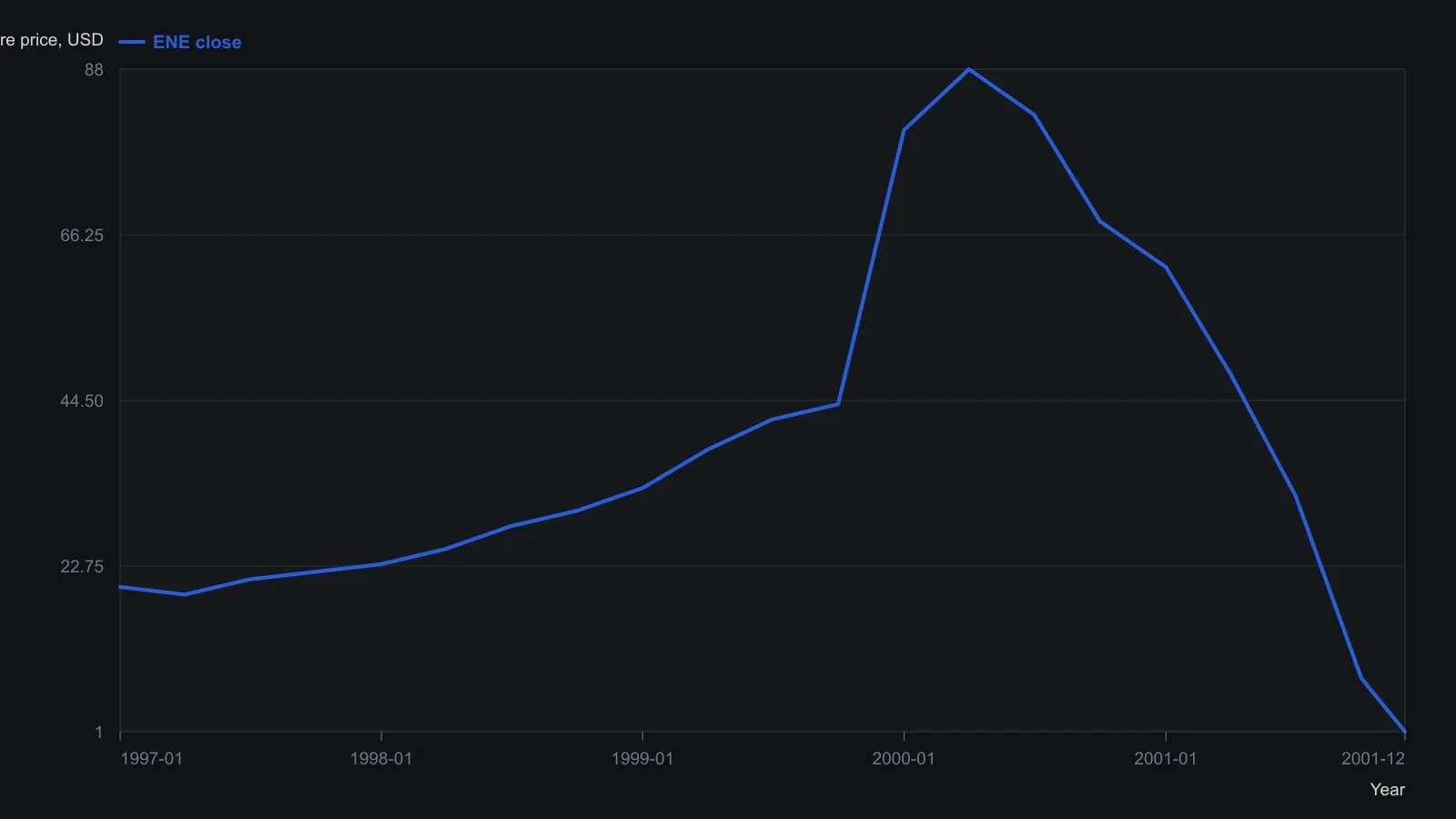
Closes only, digitized from the raster; the source prints no table. Axis mapping uses the figure’s 0–90 price scale and yearly time ticks. Values are approximate to the printed grid, not tick data.
The same structures on several horizons
The same signals are described as readable on day, swing, and longer horizons, including as a price-structure check for holders who otherwise follow company fundamentals.
Stochastics and volume are named as optional confirming overlays that can be added to the candlestick reading.
Editorial reading: a late-trend doji or engulfing-class candle is only a reason to state a reversal hypothesis after an extended move. The next sessions decide whether buying or selling pressure has changed in a way that still shows on the chart.
All readings on this track · 11 readings
- 1992Constructing signed engulfing and doji detectors
- 1997Candlestick breadth timing on the 1996 S&P 100
- 2002Reading doji and engulfing after extended trends
- 2002A three-lock checklist for doji, gap, and stochastic reversals
- 2002Candlestick reliability after one-day follow-through
- 2004Constructing trendline calls with doji and engulfing
- 2004Doji construction, shadow geometry, and confirmation
- 2011Candlestick signals are not automatic trades
- 2011Breakout side versus catalog labels on finished candle recipes
- 2011Grading candlestick signals by frequency, trend, and breakout
- 2015Constructing candlesticks, doji, and hammer from OHLC