1996issue C041-3
Constructing option theta from premium, volatility, and moneyness
The archive assembles theta from remaining premium, implied volatility, and strike distance, with separate decay paths once the option is no longer at the money. Editorial reading: that construction places one option inside a weeks-to-months regime instead of judging it on direction alone.
- Theta is the estimated change in option premium as one day of calendar time elapses, holding other pricing inputs fixed; the decay path is nonlinear and usually speeds up as expiration nears.
- Split the option premium into intrinsic value and time value before scaling. At-the-money remaining premium can use square-root-of-time scaling; in-the-money and out-of-the-money premiums do not follow that path.
- Implied volatility converts strike distance into moneyness in standard deviations, which can show when out-of-the-money decay should slow rather than accelerate.
- A one-day Black-Scholes theta is a local time derivative. Projecting it across many sessions is less reliable when the horizon is large relative to remaining life.
Theta is a local daily estimate
Theta is the estimated change in option premium as one day of calendar time elapses, holding other pricing inputs fixed. In the archive workflow, that figure is the estimated daily decline in premium as time passes.
The decay path is nonlinear and usually speeds up as expiration nears. A single day's theta is therefore a local reading of that path, not a constant daily charge.
Split option premium into intrinsic value and time value
An option premium is the full price of the option. It can be split into intrinsic value and time value.
Intrinsic value is the amount the option would be worth if exercised immediately. When that amount is positive, it is the gap between the underlying price and the strike.
Time value is the part of premium above intrinsic value. It reflects the chance the underlying finishes through the strike and the assumed spread of future prices.
At-the-money remaining premium uses square-root-of-time scaling
At-the-money is the case in which the underlying price equals the strike, so finishing in the money is treated as roughly even odds for any remaining life.
For an at-the-money option, remaining premium can be scaled by the square root of life left as a fraction of current life. Square-root-of-time scaling is that shortcut: multiply current time value by the square root of remaining life as a fraction of current life.
A 90-day at-the-money option priced at 2.00 is estimated near 1.63 after 30 days, a 0.37 or 18.4 percent decline.
Moneyness in standard deviations changes the decay path
In-the-money and out-of-the-money premiums do not follow the at-the-money decay path, because the chance of finishing in the money rises or falls as calendar time is removed.
Implied volatility is the annualized volatility input that converts strike distance into standard-deviation units and feeds the decay estimate. Moneyness in standard deviations is how far the strike sits from the underlying, measured in log price distance divided by volatility-scaled time.
With one week left, a 35-strike call on a 30 underlying is about 15.4 percent out of the money on a log-distance basis. At 32 percent annualized volatility that gap is more than three weekly standard deviations, or roughly a 0.1 percent chance of reaching the strike.
Daily theta versus days left to expiration
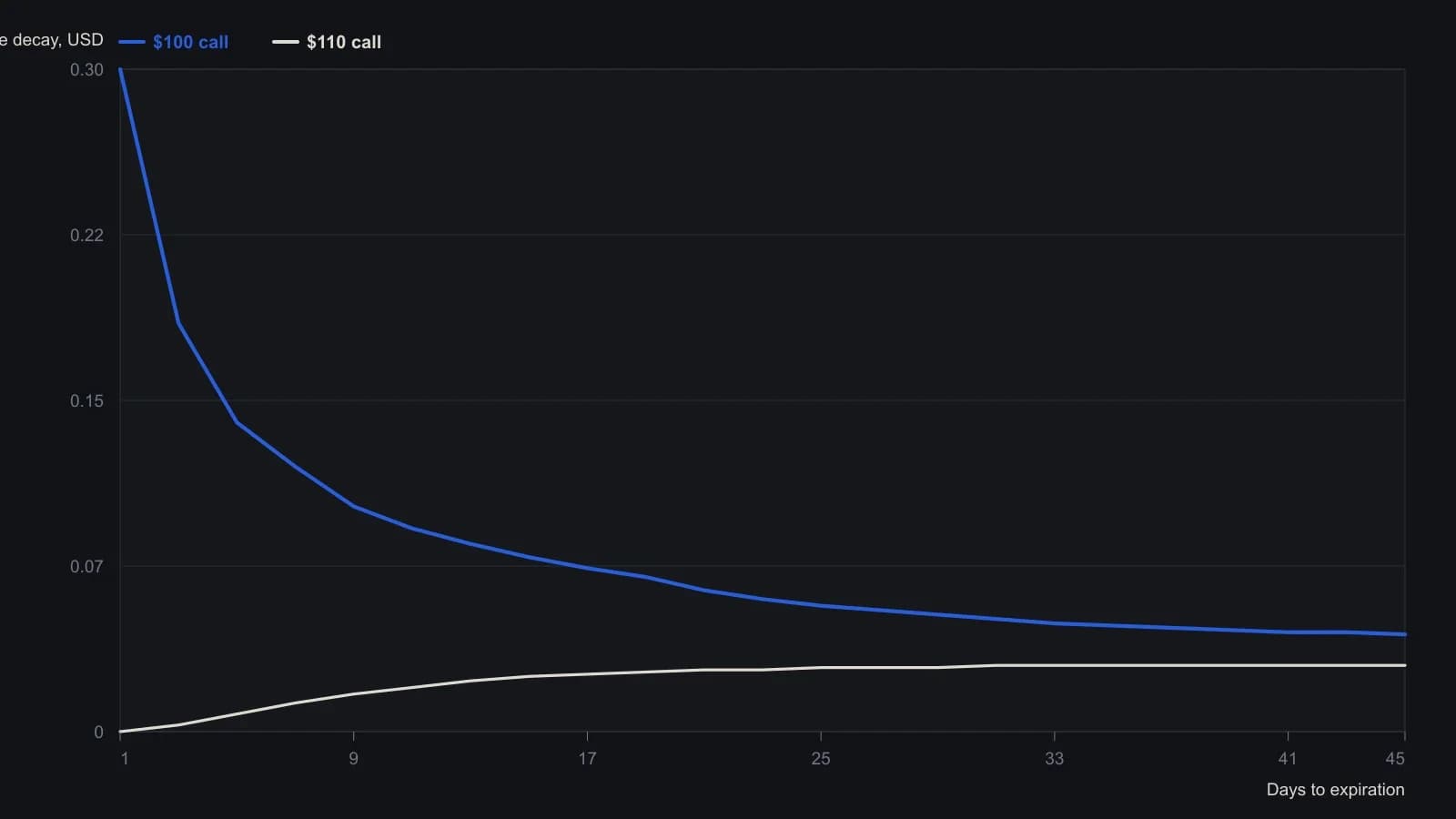
Digitized from the printed curves, not from a source table. The figure header 32.$100 is treated as 32 percent volatility with the underlying at $100. Days to expiration are ordered rising (1 to 45) even though the original plot ran 45 down to 1. Y values are approximate to about half a cent.
One day's theta is not interchangeable with the next
At-the-money daily decay tends to accelerate into expiration, while out-of-the-money decay can slow once the underlying is unlikely to reach the strike. One day's theta is not interchangeable with the next.
A one-day figure can be built from a Black-Scholes-style premium
A one-day theta can be built as the time derivative of a Black-Scholes-style premium from underlying price, strike, remaining days, quoted premium, annualized volatility, and the interest rate. Black-Scholes theta is that partial derivative of the premium with respect to time.
The 108-day worked case with premium 1.13, 90 percent volatility, and a 5.22 percent rate yields 0.008 per day.
Projection is weaker when the horizon is large relative to remaining life
Projecting a one-day theta across many sessions is less reliable when the horizon is large relative to remaining life. A seven-day estimate can be reasonable with 108 days left, but multiplying one day's figure by seven can mislead when only 14 days remain.
All readings on this track · 18 readings
- 1988Critiquing Black-Scholes early exercise on futures options
- 1988Constructing option premiums against a Black-Scholes baseline
- 1989Limit fills around option fair value
- 1990When volatility skews are regimes, not mispricings
- 1994Estimating closeout value on a Treasury bond options strangle
- 1996Constructing option theta from premium, volatility, and moneyness
- 2002Calendar income from volatility skew and time stops
- 2003Constructing option value from historical and implied volatility
- 2004Calendar construction from exercise style, time budget, and carry
- 2005A mid-life payoff chart is a volatility-regime assumption
- 2005Exotic option payoffs beyond the vanilla premium
- 2006Auditing index volatility inputs in call income studies
- 2008Ratio write delta adjustment when the tape rises
- 2010Expiration-dated volatility cones as portfolio context
- 2015Auditing buy-write recovery overlays against pricing and scenario breaks
- 2015Odd-lot mini-option hedges versus implied volatility
- 2018Implied volatility as an option-premium construction gauge
- 2019Black-Scholes construction from a covered-call balance sheet