2015issue C0342-46
Odd-lot mini-option hedges versus implied volatility
Mini-options let an odd-lot holding use a covered call, married put, or collar without adding stock to fill a standard contract. Archive cases mark the option premium against payoff limits, a Black-Scholes implied-volatility baseline, and nearby volatility skew and put-call ratios.
- A mini-option references 10 shares, so an odd-lot holding can be overlaid without buying more stock to fill a standard contract.
- Archive cases keep or spend option premium under explicit payoff caps, then read 10 shares plus one scaled contract from a full-lot diagram by removing about 90 percent of the full-size prices.
- Each overlay sat in a recurring block of index-option volatility skew, sentiment extremes, and put-call ratios.
- Implied volatility is recovered with a Black-Scholes model and compared with prior composite readings, while expected return uses historical volatility on the stock line and is treated as a many-trade average.
A mini-option for an odd-lot holding
Scaled equity options introduced in March 2014 were specified as one-tenth the value of a standard contract and referenced 10 shares. That size let an odd-lot holding take an overlay without buying more stock to reach a 100-share lot.
After about a year of listing, most volume in those scaled contracts was concentrated in Apple, Amazon, Google, a gold exchange-traded fund, and a broad-market exchange-traded fund, rather than across every odd-lot name.
Three overlays on ten Google shares
A covered-call case on 10 Google shares bought at 500 sold a one-month 500-strike scaled call for 30 of premium. That credit remained if the shares expired at 500, but a jump to 600 still required delivery at 500.
A married-put case bought a one-month 500-strike scaled put for a little less than 10 points to cover about 5,000 of stock for 30 days. A rise to 600 left about 90 points after the premium, and a 100-point decline still allowed sale at 500, while a sideways path consumed the protection cost.
A collar on the same 10-share lot combined the long put and the short call so that protection and leftover upside were both limited.
Full-lot diagrams as a scale model
Full-contract payoff diagrams were treated as a ten-times scale model. Costs and risks for 10 shares plus one scaled contract were read by removing about 90 percent from the full-size prices.
A single overlay in a market-regime block
The same issue placed single-position overlays inside a recurring market-regime block that included index-option volatility skew, sentiment extremes, and put-call ratios.
Expected return and the Black-Scholes calculator
An expected-return worksheet treated average profit or loss as meaningful only across many trades. It required historical volatility on the underlying line and implied volatility on the option line, including multi-leg spread quantities.
Implied volatility was to be compared with prior composite implied-volatility readings rather than used as an isolated level.
A pricing calculator recovered implied volatility from strike, underlying price, and historical volatility with a Black-Scholes engine. It reported greeks across many stock-and-strike pairs and plotted profit-and-loss under a lognormal price assumption at expiration and at earlier dates.
Overlay profit and loss versus underlying price
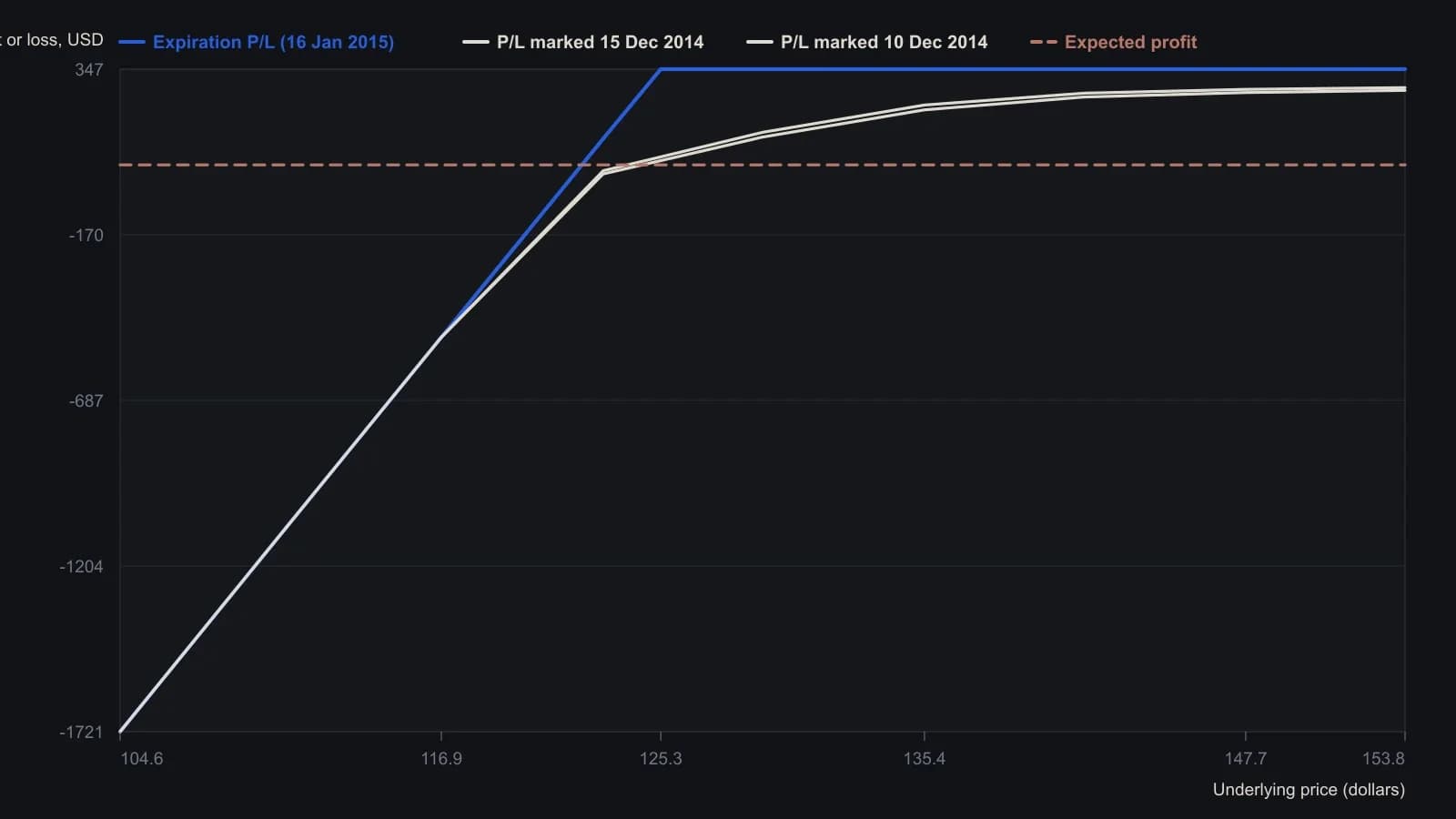
The calculator assumes lognormal prices and marks the overlay at two user dates plus 16 Jan 2015 expiration. Dollar P/L uses a standard 100-share multiplier; a mini-option on ten shares would be one-tenth these amounts.
All readings on this track · 18 readings
- 1988Critiquing Black-Scholes early exercise on futures options
- 1988Constructing option premiums against a Black-Scholes baseline
- 1989Limit fills around option fair value
- 1990When volatility skews are regimes, not mispricings
- 1994Estimating closeout value on a Treasury bond options strangle
- 1996Constructing option theta from premium, volatility, and moneyness
- 2002Calendar income from volatility skew and time stops
- 2003Constructing option value from historical and implied volatility
- 2004Calendar construction from exercise style, time budget, and carry
- 2005A mid-life payoff chart is a volatility-regime assumption
- 2005Exotic option payoffs beyond the vanilla premium
- 2006Auditing index volatility inputs in call income studies
- 2008Ratio write delta adjustment when the tape rises
- 2010Expiration-dated volatility cones as portfolio context
- 2015Auditing buy-write recovery overlays against pricing and scenario breaks
- 2015Odd-lot mini-option hedges versus implied volatility
- 2018Implied volatility as an option-premium construction gauge
- 2019Black-Scholes construction from a covered-call balance sheet