1990issue C081-8
Withhold a random-walk label until grouping and lookback are checked
This editorial evaluation drill withholds a random-walk label until the same interleaved frequency-histogram and chi-square decile test has been rerun on raw prints, on neighbor-sum aggregates, and on more than one lookback.
- Editorial: withhold a random-walk label until the same interleaved frequency-histogram and chi-square decile test has been rerun on raw prints, on neighbor-sum aggregates, and on more than one lookback.
- In the historical workflow, unaggregated daily prices from a broad equity index were judged apparently random, while pair sums and triple sums on one window of daily closes were not.
- Extending the lookback made the single-price and pair-sum histograms match again, so a failed short-window aggregate test did not become a series-wide verdict.
- A matching-density randomness verdict is not an independence verdict, and aggregated neighbor groups change if the starting offset is shifted.
The unaggregated daily comparison
The historical workflow took unaggregated daily prices from a broad equity index and used an interleaved split, sending successive observations into two parallel frequency histograms. Each frequency histogram was a bin count of those single prices, later turned into a density by dividing each bin by that histogram's total count.
The two densities were compared at decile prices with a chi-square test, a check of whether percentile gaps between two interleaved densities differ from an even decile baseline enough to reject a match. That comparison was not treated as significant, so the single-print series was judged apparently random.
Neighbor-sum tests on one window
The workflow then applied higher-order aggregation, replacing each single print with a sum of adjacent pairs or triples before repeating the same histogram comparison.
On one window of daily closes, adjacent pair-sums assigned to two interleaved histograms produced a chi-square treated as significant, so the pair aggregates were not judged random. In that same window, adjacent triple-sums produced a chi-square treated as evidence that the two histograms differed, so the triple aggregates were not random.
The same tests after the sample is extended
Extending the sample made the two single-price histograms essentially identical, so unaggregated daily prices were judged random over the longer window. On that longer window, the two pair-sum histograms were also essentially identical, so pair aggregates that had failed the short-window test were judged random once the lookback was lengthened.
Six-price sums in the longer sample produced odd-group and even-group histograms that were similar enough to be treated as random, even though they were not identical.
In this workflow a random-walk hypothesis test is a verdict that prices or neighbor-sum aggregates behave as if the two empirical densities are interchangeable, so no extra structure is detected at that grouping and window.
S&P 500 daily-close quantiles from two interleaved histograms
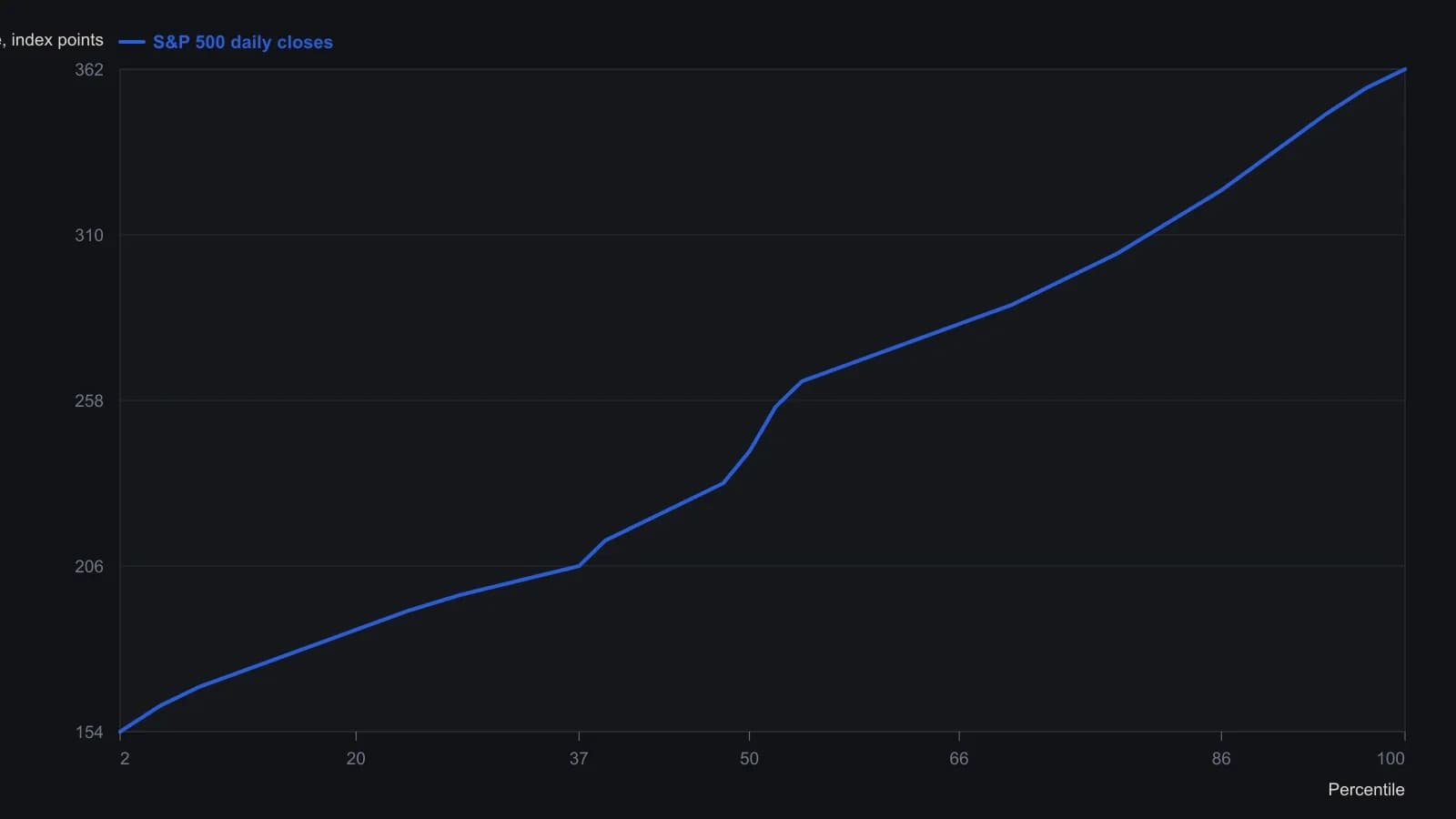
Y values are approximate readings from the raster, rounded to a few index points. The two printed histograms overlap within that tolerance and are reported as one series. Sherry treated this overlay, plus a chi-square decile test, as evidence of randomness on the long window only.
A second start for aggregated groups
Unlike the single-print test, the aggregated tests form different neighbor groups if the starting offset is shifted. A second pass with another start is part of a cautious evaluation.
Uncertainty beyond expected-return scatter
The evaluation treated uncertainty as more than the standard deviation of expected return. A series described as non-stationary, independent, and random was framed as higher uncertainty than one described as stationary, dependent, and not random, even when expected-return level and that standard deviation looked similar.
Stationarity here means whether the rules that generate the price series stay stable across the sample used for the test. Independence versus randomness keeps two series properties apart: whether one observation influences another, versus whether two interleaved densities still match.
Editorial reading
TradersWeek editorial reading: withhold a random-walk label until this same interleaved-split, density, and chi-square decile test has been rerun on raw prints, on neighbor-sum aggregates, and on more than one lookback. Randomness is then a setting of the test rather than a property of the series.
The archive facts describe that historical workflow. They do not say that any present series is random, dependent, or stationary.
All readings on this track · 10 readings
- 1984When random walks fail to explain market averages
- 1988Building probability-density adaptive weights and a chi-square trend filter
- 1990Withhold a random-walk label until grouping and lookback are checked
- 1991Constructing a variable-lookback random walk trend filter
- 1992Ranking futures trend tendency against a random walk
- 1995A normalized dispersion screen for trend-following
- 1997Why failed random-walk tests still need careful Monte Carlo work
- 2007Constructing a random-walk baseline from ordered returns
- 2011Constructing a cycle-free trend filter against an ATR-scaled random walk
- 2013How to evaluate a hybrid growth and money-flow scan