2010issue C0640-42
Write the rubber-band long before the fill
This archive case turns a stretched-from-value long into one written procedure. Impulse wave confirmation, a MACD timing cue, a pullback to 4.10, a stop at 3.93, and a first target at 4.90 were named before the 4.11 fill.
- The case required four concurrent conditions for a long: a weekly descending wedge that had already resolved upward, heavy volume that marked a low then a new low, a stretched-from-value mean-reversion setup, and a high short-interest backdrop.
- Impulse wave confirmation was the weekly upside resolution of that wedge, and only after price closed back inside the envelope and the impulse reading turned blue.
- After the volume sequence stabilized, daily timing waited for a MACD crossover. The written plan then bought a slight pullback to the February 8, 2010 high of 4.10, with a stop under Friday's range low at 3.93 and a first target at the prior break low of 4.90.
- The fill at 4.11 followed the pullback rule despite hesitation about a false breakout. A strong close after pennant-type consolidation was the first check that the entry rule had not been immediately invalidated.
Four conditions, one long
In editorial terms, this is a rubber-band name for a stretched-from-value mean-reversion long. The archive case did not treat that stretch as a trade by itself.
The case defined four concurrent conditions for a long: a weekly descending wedge that had already resolved upward, heavy volume that marked a low then a new low, a stretched-from-value mean-reversion setup, and a high short-interest backdrop. Those four factors were held as one assessment, not as four separate reasons to buy.
Impulse wave confirmation
The weekly upside resolution of the descending wedge was treated as the Impulse wave confirmation once price closed back inside the envelope and the impulse reading turned blue. Until that close and that reading, the weekly event was not counted as confirmation.
MACD as the daily timing cue
Daily timing required a MACD crossover after the volume-driven sequence of a low, a new low, and subsequent stabilization. The crossover was the timing cue. It did not replace the weekly Impulse wave confirmation or the four-factor screen.
Entry, invalidation, and first target
The written plan specified a buy on a slight pullback to the February 8, 2010 high of 4.10. The invalidation stop sat under Friday's range low at 3.93. The first target was the prior break low of 4.90, which matched a July 2009 interim low. Those three prices were part of the same Rule-based entry procedure.
The pullback fill
Execution followed the pullback rule. After a holiday-delayed open at 4.15 and a rise to 4.19, the fill occurred at 4.11 when price returned to the planned 4.10 area.
Staying with the written plan
The trader still took the fill despite hesitation that a false breakout might be forming. The four-factor assessment was the reason to stay in the procedure rather than abandon the planned pullback.
First check against invalidation
After a pennant-type consolidation, price broke the session high and closed strong. The write-up presented that close as the first confirmation that the entry rule had not been immediately invalidated.
Editorial reading
The archive value is the order of work. Impulse wave confirmation, MACD timing, the 4.10 pullback, the 3.93 stop, and the 4.90 first target were specified while the long was still unfilled. Hesitation about a false breakout did not rewrite those rules. The later strong close was only a first check against immediate invalidation, not a statement about later results.
HEV weekly close versus rubber-band envelopes
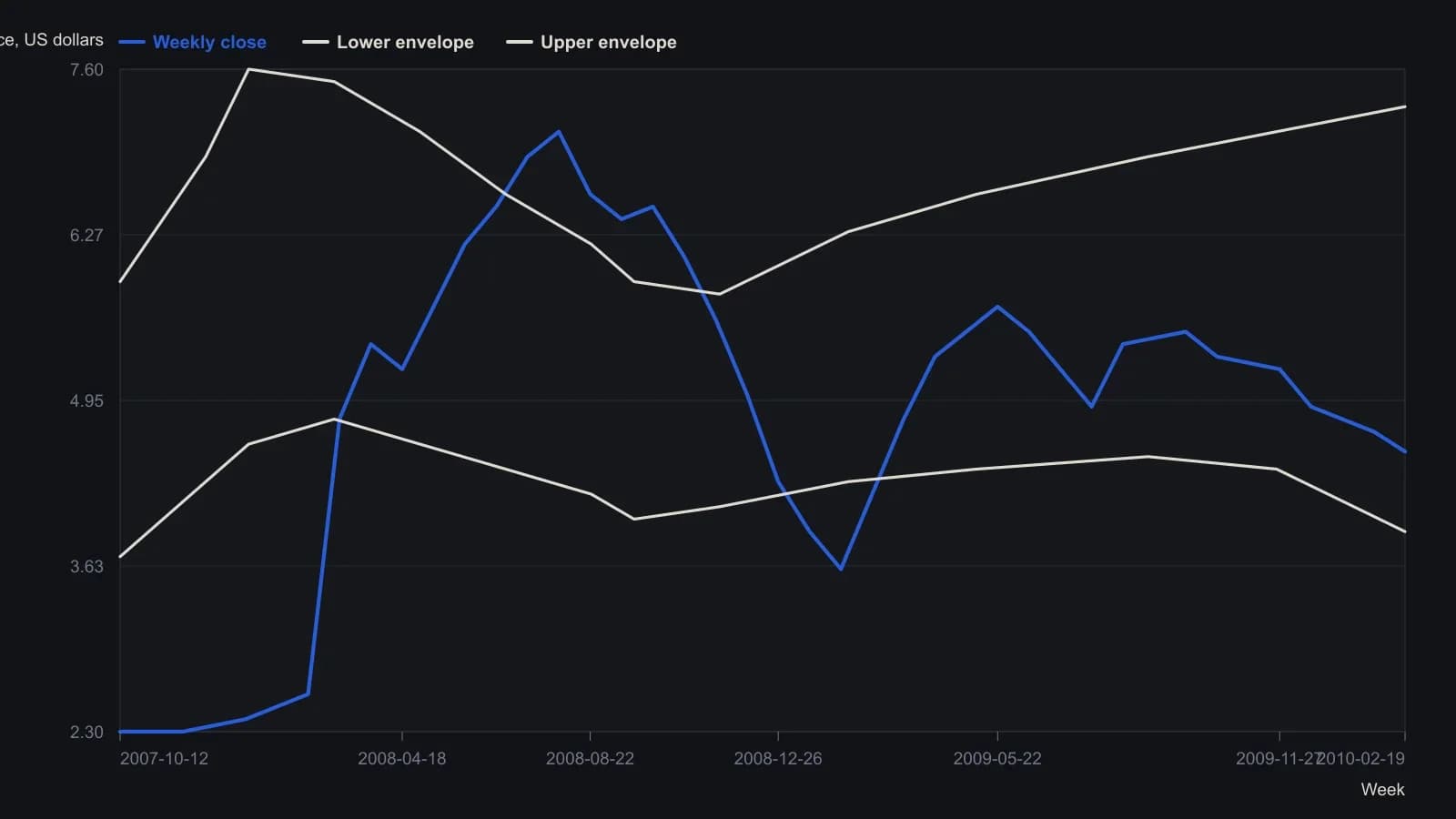
Y-scale taken from the printed weekly axis (2.00 to 9.00 dollars). Closes and envelope traces are read off the raster, so they are approximate to about a tenth of a dollar. Envelope series start where those lines first appear, after the 2008 impulse.
All readings on this track · 12 readings
- 2001Impulse-wave subcounts as a case-study filter
- 2006Wave 3 trend exits with pitchforks, channels, and Fibonacci
- 2006Four-leg Fibonacci reversal as an impulse wave checkpoint
- 2010An unfinished fifth wave blocked a second-wave count
- 2010Write the rubber-band long before the fill
- 2011A 5% trail cannot say whether the impulse-correction count is still alive
- 2012Wave counting as context before trade setups
- 2012A weekly-close test of impulse, correction, and the 61.8% stop
- 2013When wave templates fail under momentum override
- 2013Late momentum is a five-wave sentiment trap
- 2019Counting successive impulses after a productivity shock
- 2020Wave counts and Fibonacci targets as a falsifiable trade plan