2012issue C1247-53
Wave counting as context before trade setups
This archive case study treats wave counting as a labeling canvas. A five-wave impulse plus a three-wave pullback becomes a trade hypothesis, and other technical tools are layered only after that structure is clear.
- Elliott wave analysis is presented as a pattern-recognition framework that treats market movement as fractal and grounded in crowd psychology.
- Wave counting is context for price action, including the option to mark a fifth wave as a terminating move, rather than a complete trading method.
- The historical case-study setup is to buy three-wave pullbacks inside an uptrend and sell three-wave rallies inside a downtrend.
- Trade search starts with recognizable Elliott wave structure as the canvas. Other technical tools are applied only after that structure is found.
Wave counting as a labeling canvas
The interview presents Elliott wave analysis as a pattern-recognition framework that treats market movement as fractal and grounded in crowd psychology.
Wave counting is presented as context for price action rather than a complete trading methodology. In this editorial reading, the count is a labeling canvas: it names a repeatable structure so a later trade idea can be checked against that structure.
Motive and corrective families
Five core wave patterns are identified. Impulse and ending diagonal sit in the motive family. Zigzag, flat, and triangle sit in the corrective family.
Impulse waves are described as five-wave motive structures. Zigzags and flats are described as three-wave corrections labeled A, B, and C.
What a completed five-wave move implies
A completed five-wave advance is treated as evidence that the larger trend is up. A completed five-wave decline is treated as evidence that the larger trend is down.
Wave counting also includes the ability to mark a fifth wave as a terminating move.
The case-study setup
The practical case-study setup is to buy three-wave pullbacks inside an uptrend and sell three-wave rallies inside a downtrend.
A five-wave advance followed by a three-wave decline is treated as a zigzag, or five-three-five, pattern that can be used as a trade hypothesis. In this editorial reading, that impulse-plus-pullback count is the falsifiable claim: if the three-wave correction does not hold as labeled, the setup is discarded.
MGM Resorts daily, 2012 high through 10 October
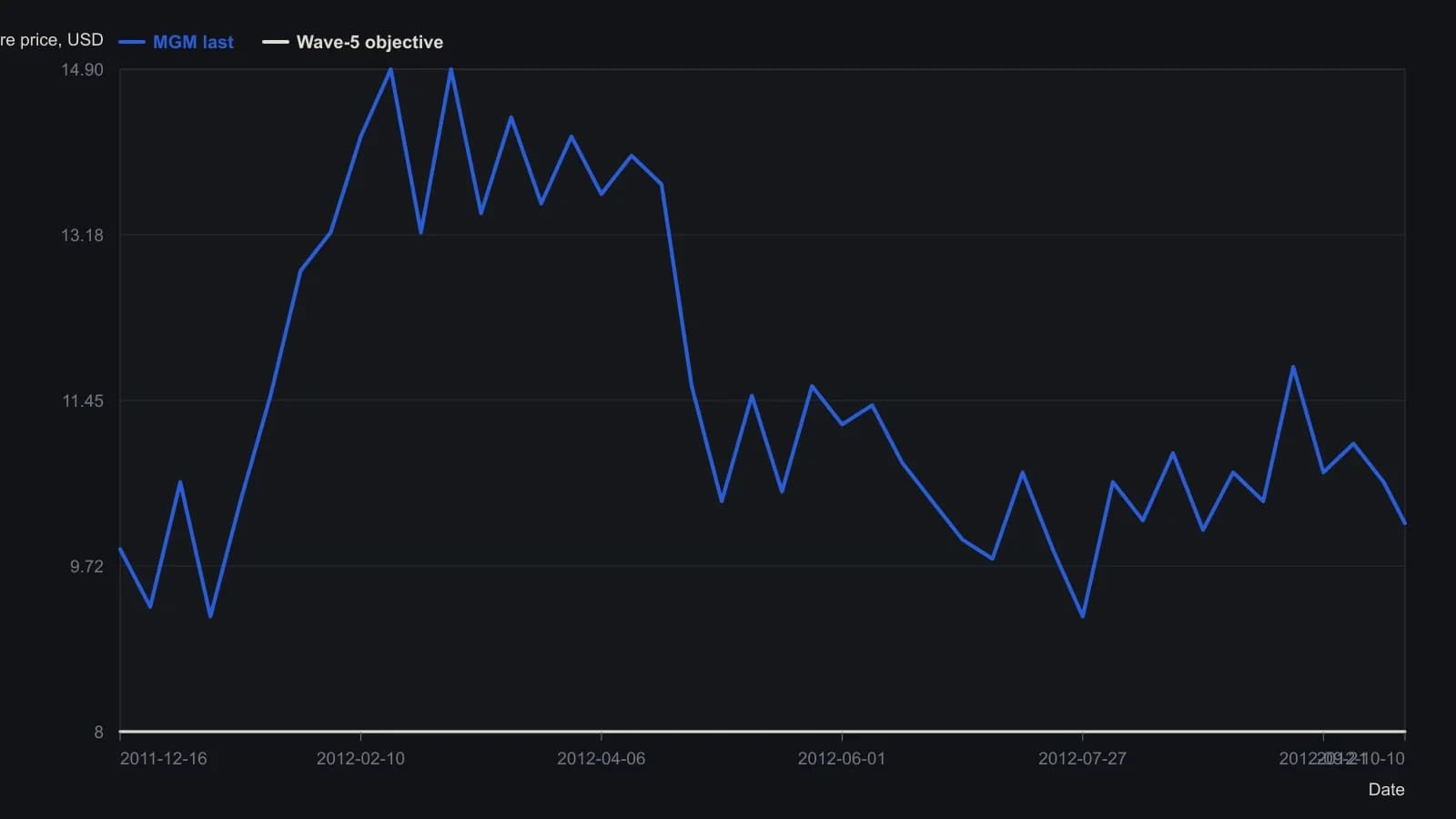
CQG printed the stock in hundredths of a dollar (the tagged last print 1017 equals 10.17 USD). Points are turning-point samples from the daily candlesticks, not every session, so intra-week extremes are approximate to about 0.10 USD. The eight-dollar objective is Kennedy’s stated wave-5 target, not a print on this chart.
Find the structure, then add other tools
Trade search is described as beginning with recognizable Elliott wave structure as the canvas, then applying other technical tools only after that structure is found.
This editorial framing keeps the impulse-and-pullback count first. The other tools are layered later so they do not replace the wave labels.
All readings on this track · 12 readings
- 2001Impulse-wave subcounts as a case-study filter
- 2006Wave 3 trend exits with pitchforks, channels, and Fibonacci
- 2006Four-leg Fibonacci reversal as an impulse wave checkpoint
- 2010An unfinished fifth wave blocked a second-wave count
- 2010Write the rubber-band long before the fill
- 2011A 5% trail cannot say whether the impulse-correction count is still alive
- 2012Wave counting as context before trade setups
- 2012A weekly-close test of impulse, correction, and the 61.8% stop
- 2013When wave templates fail under momentum override
- 2013Late momentum is a five-wave sentiment trap
- 2019Counting successive impulses after a productivity shock
- 2020Wave counts and Fibonacci targets as a falsifiable trade plan