2017issue C0422-24
A timeboxed fade for New Zealand dollar news spikes
Wait 10 minutes after a high-impact New Zealand print, fade the first move only when the nzd-complex actually reacts, and exit inside a 30-minute to one-hour window instead of a profit target.
- The procedure is limited to the nzd-complex, so New Zealand dollar pairs and crosses are read as one family that can trend together or sit in a shared equilibrium-phase.
- A post-news-fade waits 10 minutes on a 30-minute chart after a high-impact New Zealand print, then sells a rally or buys a decline.
- The impact-filter makes abstention part of the same rule set: place nothing when the release has little or no market impact.
- A timeboxed-hold of 30 minutes to one hour replaces a fixed take-profit, with a 1 percent allocation and a 100-pip stop.
One procedure for the nzd-complex
The procedure is limited to New Zealand dollar pairs and crosses. Those markets are treated as one nzd-complex that can trend together or sit in a shared equilibrium-phase.
NZDUSD daily downtrend, May–August 2015
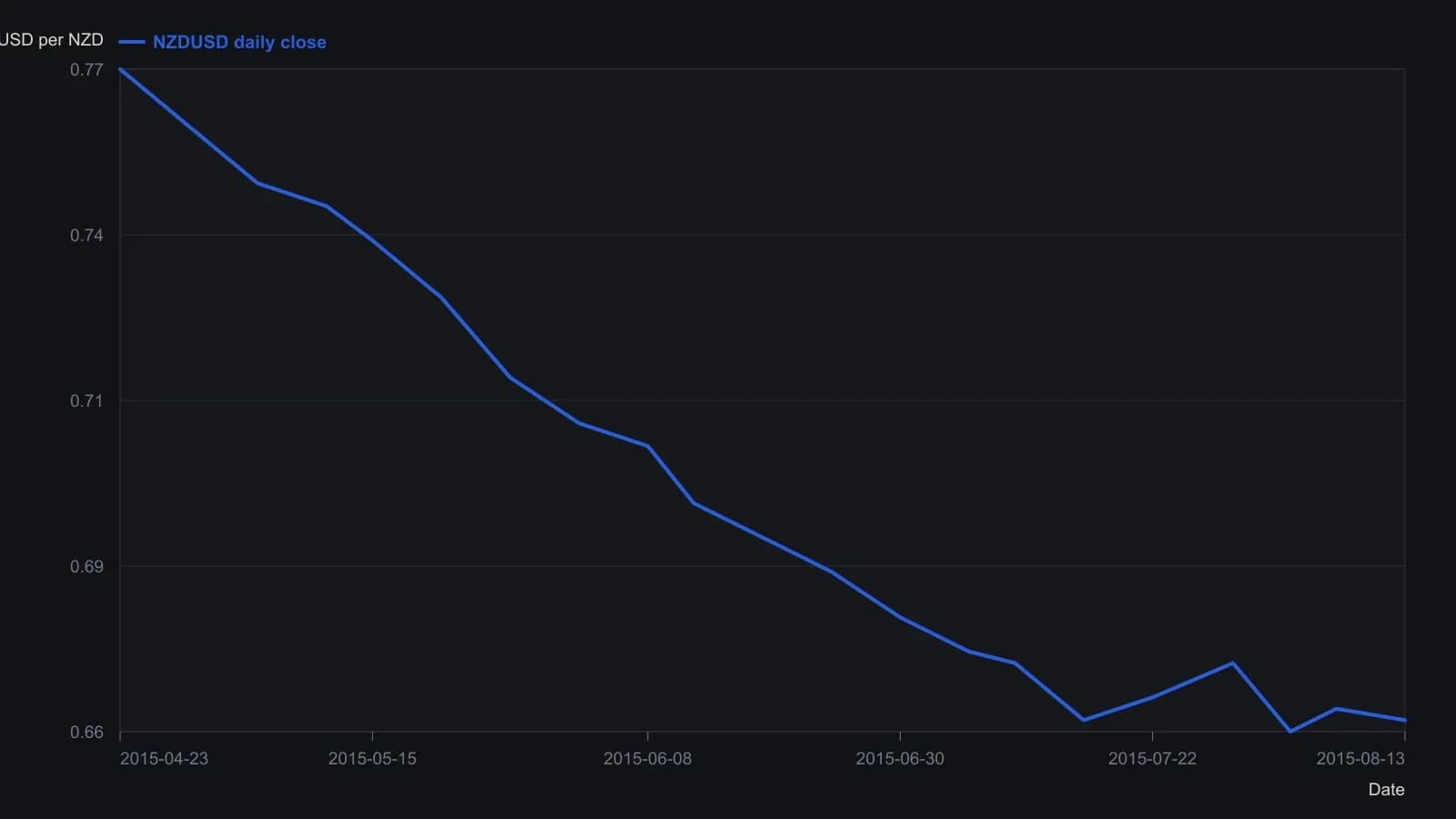
OHLC bars were collapsed to one close-style point per sampled date; values are approximate because the source is a raster chart, not a printed table.
Entry, size and the timeboxed-hold
On 30-minute charts the entry wait is 10 minutes after a high-impact New Zealand print. The first move is then faded: short after a rally, long after a decline. That delayed, opposite-side entry is the post-news-fade.
The snapshot caps activity at two trades per news release.
Each position is meant to be closed inside a 30-minute to one-hour window. There is no fixed take-profit level in the snapshot. That clock window is the timeboxed-hold.
Stated risk controls are a 1 percent allocation per trade and a 100-pip stop.
When the impact-filter says no
A no-trade filter applies when the release has little or no market impact, so abstention is part of the same rule set as entry. That rule is the impact-filter.
The stated rationale is crowd overreaction. After a strong news-driven push, price may pause or reverse before the next phase, and that later phase is the intended setup.
A dated budget-day case
A dated case uses the 26 May 2016 New Zealand annual budget near 03:00 GMT, with an earlier private-capital-expenditure print, and marks entries on AUDNZD and NZDUSD from a signal-candle. The next bar is only a check on how the position then behaved.
Historical context includes a NZDUSD downward stretch through May to July 2015 and a multi-pair sideways episode around 16 to 20 May 2016 across GBPNZD, EURNZD, NZDJPY, NZDUSD, AUDNZD, NZDCHF, and NZDCAD. That sideways stretch is an equilibrium-phase for the nzd-complex.